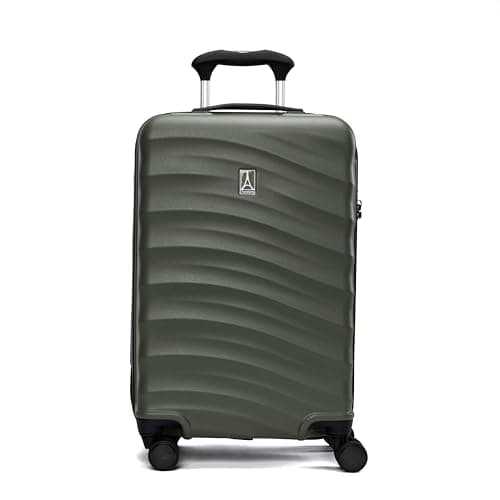
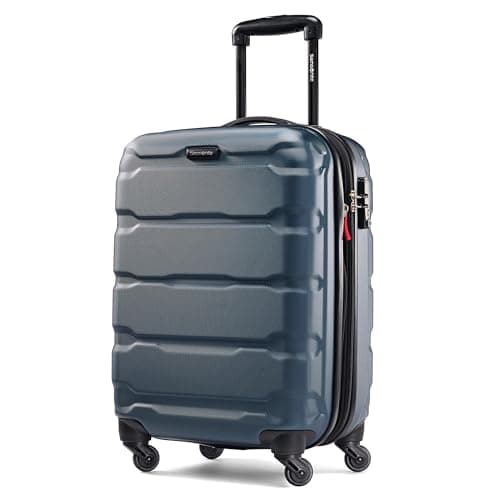
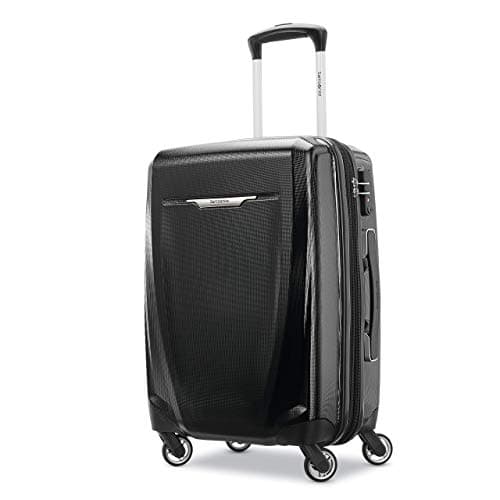
The best polycarbonate case is the Samsonite Winfield 3 DLX Carry-On Spinner, and it wins for the buyer who wants the material claim on the record rather than implied: Samsonite publishes the shell as 100% polycarbonate, backs it with a 10-year limited warranty, and publishes the overall dimension — which almost nobody in this category does. For the lightest genuine polycarbonate carry-on here, the Travelpro Maxlite Air V2. And the budget pick is the Samsonite Omni PC: the cheapest case in our registry whose maker names polycarbonate on the record, which is the only spec this page is willing to rank on.
Here is why that framing matters. Polycarbonate is not a marketing word, it is a resin— the same thermoplastic used in safety glazing and headlight lenses. Its useful property for luggage is that it flexes under impact and returns to shape, so a hold-handling dent usually pops most of the way out. ABS is the other cheap hardside resin, and it behaves differently: stiffer, easier on the price, and more likely to crack rather than deform when a loader drops a case on a corner.
The trap is the middle. A very large share of the hardside market is sold as “ABS+PC”— an ABS shell with a polycarbonate film or a blended sheet — and on a shelf, in a photo and in most listing copy it is indistinguishable from the real thing. It is not a scam; it is a different material at a different price. But if you searched for polycarbonate, you did not search for that. So the rule for this page is narrow and it is the whole ranking: a case appears here only if its maker publishes polycarbonate as the shell material.Two cases this site likes a great deal — the Coolife 22×14×9 carry-on and the Coolife 28-inch checked case — are published as ABS+PC and are therefore deliberately absent, along with the ABS-shelled Amazon Basics 21-inch. They are good value. They are not this.
Among the cases that clear that gate, three things separate them, and they are the three columns in the table below. Published empty weight, because polycarbonate is light for its strength and a maker who spends that advantage on a thicker shell has made a choice you should get to see. What the warranty names, because a 10-year limited warranty on the shell and a limited lifetime warranty that names wheels and zippers are promises about entirely different parts. And the lock, because a polycarbonate shell is only as secure as the zipper line and the hardware bolted through it.
If you have not settled the material question yet, read polycarbonate vs ABS vs aluminum first — it is the decision this page assumes you have already made — and polypropylene vs polycarbonate covers the fourth resin that has started appearing at the premium end. For the whole hardside field without a material filter, see best hardside luggage; if your budget is the brief rather than the resin, the best carry-on luggage under $200 ranks the same class on price alone.
Every product here is one the site has already researched on its own roundup — the scores are the scores it earned there, and the verdicts are rewritten for the material brief. Specifications are the manufacturer's published figures; we have not lab-tested any of these and we have not sent a shell to a materials lab. See how we test.
The short answer
Quick picks
| # | Product | Best for | Score | Price |
|---|
| 01 | Samsonite Winfield 3 DLX Carry-On SpinnerThe case to buy if you want the material claim on the record rather than implied. Samsonite publishes the Winfield 3 DLX shell as 100% polycarbonate - not a blend, not a film over ABS - and pairs it with a mounted TSA lock, dual spinners and a 10-year limited warranty. It is also the only case on this page whose maker publishes the overall dimension, which tells you something about how the rest of the category reports specs. | Best polycarbonate luggage overall | | $135.67·Amazon |
| 02 | Travelpro Maxlite Air V2 Hardside Carry-OnThe polycarbonate pick for anyone flying a weight-capped cabin allowance. Travelpro's Maxlite line exists to spend as little of your allowance as possible on the case itself, and a polycarbonate shell is how you get there without giving up impact recovery. Self-aligning spinner wheels, and a limited lifetime warranty that names wheels, zippers and extension handles rather than covering unspecified defects. | Lightest published polycarbonate carry-on here | | $148.00·Amazon |
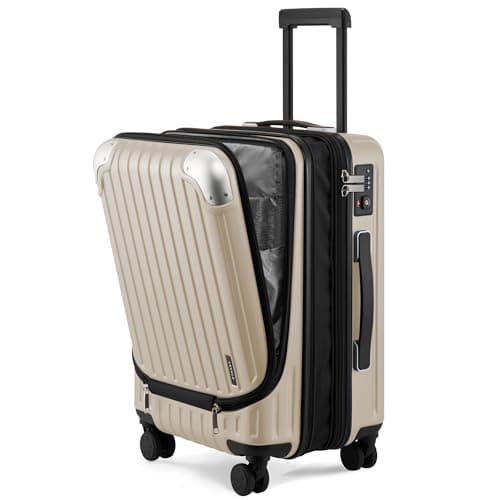
| 03 | LEVEL8 Grace Carry-OnThe only case here whose maker names the specific polycarbonate it uses - Makrolon, Covestro's PC resin - rather than the generic material. That is a small thing and it is also exactly the kind of disclosure this page rewards. Add a front laptop compartment no other polycarbonate case on this page has, dual spinners and a TSA lock. | Best polycarbonate case with a named resin | | $134.99·Amazon |
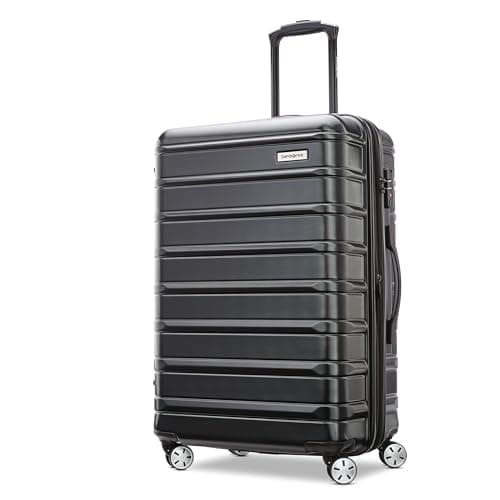
| 04 | Samsonite Omni 2 Checked-Medium, 24-InchThe checked-class answer, and the only pick here that is not a cabin bag. Samsonite publishes a polycarbonate shell at 55.25 linear inches and 9.0 lb empty with a 24 x 16.5 x 11 in interior - inside the 62-linear-inch checked allowance every major US carrier publishes, with real margin. A polycarbonate shell earns its keep most in the hold, where you are not there to see what happens to it. | Best polycarbonate checked bag | | $199.99·Amazon |
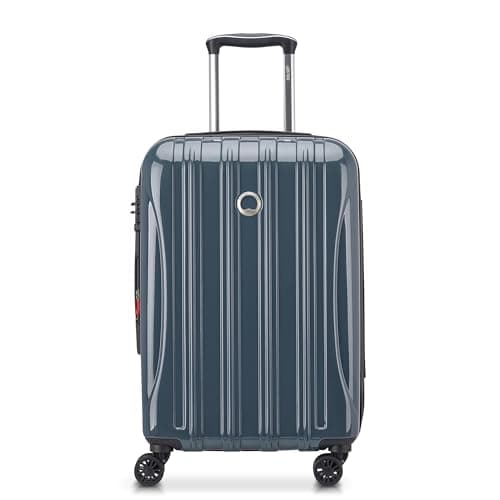
| 05 | Delsey Paris Helium Aero Carry-OnThe polycarbonate pick for anyone who has had a TSA lock wrenched off a case. Delsey sinks the lock flush into the shell rather than hanging it off the zipper line, so there is nothing protruding to catch a carousel belt or to lever off. Polycarbonate shell, dual spinners and an expansion zip, with a service network that exists if the case needs a part. | Best polycarbonate case with a recessed lock | | $119.99·Amazon |
| 06 | Samsonite Omni PC Hardside Carry-OnThe budget pick, and the cheapest case in our registry whose maker publishes polycarbonate rather than a blend. The micro-diamond texture is the detail that justifies it over a plain shell: a faceted surface hides the scuffing that makes a smooth gloss case look two years older than it is after one trip. Dual spinners, a mounted TSA lock and the same 10-year limited warranty as the Winfield above. | Budget pick - cheapest published polycarbonate case here | | $100.10·Amazon |
#ad · Live prices from the Amazon Product API, as of November 12, 2026. Where we have no verified live price, we show none — a gap beats a number that has rotted.
In detail
The picks, in full
Best polycarbonate luggage overall
Samsonite Winfield 3 DLX Carry-On Spinner
20-inch spinnerPolycarbonateDual spinners10-yr limited warranty
The case to buy if you want the material claim on the record rather than implied. Samsonite publishes the Winfield 3 DLX shell as 100% polycarbonate - not a blend, not a film over ABS - and pairs it with a mounted TSA lock, dual spinners and a 10-year limited warranty. It is also the only case on this page whose maker publishes the overall dimension, which tells you something about how the rest of the category reports specs.
- Weight
- 7
- Size compliance
- 9
- Build
- 9
- Wheels
- 8
- Value
- 8
Pros
- +20-inch case clears strict overseas sizers a 22-inch bag fails
- +Full polycarbonate shell flexes under impact instead of cracking
- +Built-in TSA lock and dual spinner wheels
- +10-year limited warranty with a global service network
Cons
- −Heavier than a softside bag on a 7 kg allowance
- −Glossy shell shows scuffs and fingerprints quickly
Don't buy this if…
…you fly a carrier with a rigid metal gate sizer - the published overall is 22.25 x 14.5 x 9.5 in, which is over the US 22 x 14 x 9 in convention on all three axes, and a frame does not care what the shell is made of.
A 100% polycarbonate shell is doing one specific job: absorbing a drop by deforming and then coming back. On this case the shell is paired with 6.97 lb of empty weight, which is unusually light for a case of this external size and is the real benefit of the resin rather than a marketing line — polycarbonate gets its impact resistance from flex, so a maker needs less of it than it would need of ABS.
The 10-year limited warranty is what you are buying alongside the material, and it is worth reading rather than assuming. Samsonite's published terms cover manufacturing defects for the first purchaser or gift recipient and specifically exclude transport damage caused by airlines, normal wear, and damage from water or solvents — which is to say the warranty covers the shell cracking and does not cover the carousel. Full published figures in our Winfield 3 DLX review, and the warranty landscape in warranties explained.
Lightest published polycarbonate carry-on here
Travelpro Maxlite Air V2 Hardside Carry-On
PolycarbonateSelf-aligning wheelsLightweightLimited lifetime warranty
The polycarbonate pick for anyone flying a weight-capped cabin allowance. Travelpro's Maxlite line exists to spend as little of your allowance as possible on the case itself, and a polycarbonate shell is how you get there without giving up impact recovery. Self-aligning spinner wheels, and a limited lifetime warranty that names wheels, zippers and extension handles rather than covering unspecified defects.
- Weight
- 9
- Size compliance
- 8
- Build
- 8
- Wheels
- 9
- Value
- 7
Pros
- +Light for a hardside — closes much of the gap to a softside bag
- +Self-aligning wheels track straight instead of wandering
- +Limited lifetime warranty
- +Hard shell protection without the usual weight penalty
Cons
- −Costs more than the Omni PC for similar protection
- −Lighter shells flex more under heavy packing
Don't buy this if…
…you will not register the bag - Travelpro's Trusted Companion Promise covers airline damage on top of the warranty, but only if you register within 120 days of purchase, and the registration is the half of the promise most buyers skip.
On an international carrier working to a 7 kg (15.4 lb) cabin cap, empty weight stops being a comfort question and becomes a capacity question: every pound the case spends on itself is a pound of clothing you cannot bring. Polycarbonate is the right resin for that fight, and the Maxlite Air V2 is the case on this page that most clearly spends the material advantage on weight rather than on shell thickness.
The warranty is the second argument and it is a genuinely different shape to Samsonite's. A limited lifetime warranty that NAMES wheels, zippers and handle tubes is a promise about the three parts that actually fail on a wheeled case; a 10-year shell warranty is a promise about the part that almost never does. Neither is better in the abstract — they insure different risks. The full range is in our Travelpro roundup, and the model's three conflicting published heights are set out in the Maxlite Air V2 review.
Best polycarbonate case with a named resin
LEVEL8 Grace Carry-On
20-inch caseMakrolon polycarbonateFront laptop compartmentTSA lock
The only case here whose maker names the specific polycarbonate it uses - Makrolon, Covestro's PC resin - rather than the generic material. That is a small thing and it is also exactly the kind of disclosure this page rewards. Add a front laptop compartment no other polycarbonate case on this page has, dual spinners and a TSA lock.
- Weight
- 7
- Size compliance
- 9
- Build
- 8
- Wheels
- 8
- Value
- 8
Pros
- +Front compartment takes the laptop out at security without opening the case
- +Makrolon polycarbonate shell — the good grade, not an ABS blend
- +20-inch size suits strict overseas limits
- +Looks considerably more expensive than it is
Cons
- −The front compartment eats some main-case volume
- −Warranty is shorter than Samsonite's or Travelpro's
Don't buy this if…
…you need the case to be as small as possible on the sizer - the front compartment adds usable depth you will be tempted to fill, and depth is the axis that fails first on a 55 x 40 x 20 cm international frame.
Naming the resin is not a performance claim, but it is a verifiable one, and in a category where “hardside” is often the only material word on the listing it is worth something. Makrolon is a branded polycarbonate from Covestro; a maker that names its supplier has committed to a specification it can be held to, which is a different posture to publishing nothing at all.
The front compartment is the functional reason to pick this over the Samsonite. A hardside case normally forces you to lay it flat and open the clamshell to reach a laptop; this one does not, which matters in a security line and on a cramped train. The cost is that a front compartment on a rigid shell is a fixed volume you cannot compress. More on the format in best carry-on with a front pocket and the model itself in our LEVEL8 Grace review.
Best polycarbonate checked bag
Samsonite Omni 2 Checked-Medium, 24-Inch
55.25 linear inches9.0 lb emptyPolycarbonate shell24 x 16.5 x 11 in interior
The checked-class answer, and the only pick here that is not a cabin bag. Samsonite publishes a polycarbonate shell at 55.25 linear inches and 9.0 lb empty with a 24 x 16.5 x 11 in interior - inside the 62-linear-inch checked allowance every major US carrier publishes, with real margin. A polycarbonate shell earns its keep most in the hold, where you are not there to see what happens to it.
- Shell
- 9
- Weight
- 7
- Wheels
- 8
- Warranty
- 9
- Value
- 8
Pros
- +Publishes its PACKING dimensions, not just the overall size - rare, and the figure that actually matters
- +55.25 linear inches overall is the second-tightest number on this page
- +Scratch-resistant polycarbonate with an integrated TSA lock
- +Samsonite's 10-year limited warranty and service network
Cons
- −9.0 lb is mid-pack here; the Omni PC below publishes 8.34 lb for less money
- −Interior organization is a divider and mesh rather than a structured panel
- −Sold largely as single colorways, so matching a set later is luck
Don't buy this if…
…you only ever fly cabin-only - this is a 24-inch checked case and it will not clear any carry-on sizer, expanded or not.
The hold is where the material argument stops being theoretical. A cabin bag lives under your own supervision; a checked bag is loaded by machine and by hand onto a belt, into a container and under other bags, and those are impact loads rather than steady ones. That is precisely the case where a resin that deforms and recovers beats one that is stiffer and cracks.
The published figures are the reason this is the checked pick rather than a bigger case. At 55.25 linear inches it sits nearly seven inches inside the 62-inch allowance, so it survives an expansion zip and an optimistic packing job without becoming an oversize fee. At 9.0 lb it leaves about 41 lb of the standard 50 lb allowance for contents. The size ladder either side of it is in best 24-inch luggage and best 28-inch luggage, and the allowance itself in checked bag size and weight limits.
Best polycarbonate case with a recessed lock
Delsey Paris Helium Aero Carry-On
PolycarbonateDual spinnersRecessed TSA lockExpandable
The polycarbonate pick for anyone who has had a TSA lock wrenched off a case. Delsey sinks the lock flush into the shell rather than hanging it off the zipper line, so there is nothing protruding to catch a carousel belt or to lever off. Polycarbonate shell, dual spinners and an expansion zip, with a service network that exists if the case needs a part.
- Build
- 8
- Weight
- 8
- Capacity
- 8
- Wheels
- 7
- Value
- 9
Pros
- +Hard polycarbonate shell at a consistently low price
- +Recessed TSA lock sits flush and resists snagging
- +Expansion zipper adds a useful extra inch of packing
- +Established French luggage brand with wide availability
Cons
- −Warranty terms are shorter than Samsonite's on some lines
- −Interior organization is basic
Don't buy this if…
…you intend to use the expander on a cabin trip - an expanded case is a different case as far as a sizer is concerned, and depth is the axis that fails.
A recessed lock reads as a styling choice until you have watched a protruding one disappear somewhere between the hold and the carousel, taking a strip of zipper tape with it. Sinking the lock into the shell removes the most exposed piece of hardware on a hardside case, and on a polycarbonate shell it also removes a stress riser — a bolted-on fitting is the point where a flexing panel stops flexing.
The second reason to look at Delsey rather than a cheaper polycarbonate shell is repairability: a brand with a service route is a brand whose wheel you can replace in year four instead of replacing the case. The full range is in our Delsey roundup, and what a repair actually involves is in wheel replacement.
Budget pick - cheapest published polycarbonate case here
Samsonite Omni PC Hardside Carry-On
20-inch spinnerPolycarbonateMicro-diamond texture10-yr limited warranty
The budget pick, and the cheapest case in our registry whose maker publishes polycarbonate rather than a blend. The micro-diamond texture is the detail that justifies it over a plain shell: a faceted surface hides the scuffing that makes a smooth gloss case look two years older than it is after one trip. Dual spinners, a mounted TSA lock and the same 10-year limited warranty as the Winfield above.
- Weight
- 7
- Size compliance
- 9
- Build
- 8
- Wheels
- 7
- Value
- 9
Pros
- +Textured shell hides scuffs far better than a gloss finish
- +20-inch size clears the sizers a 22-inch bag fails
- +Same 10-year limited warranty as pricier Samsonite lines
- +Frequently the cheapest genuine polycarbonate case here
Cons
- −Interior organization is basic next to the LEVEL8
- −Still a hardside, so still heavier than the Maxlite
Don't buy this if…
…you want the lightest case you can get - this is the value pick in the polycarbonate class rather than the weight pick, and the Maxlite Air V2 above is the one to buy if an airline is weighing your cabin bag.
This is where the page's rule pays off. A buyer looking for cheap polycarbonate will be shown a wall of ABS+PC cases at half this money, and the Omni PC is the point at which the published material and the price stop fighting each other. The “PC” in the name is the shell, not a model code.
The texture is a genuinely useful piece of design rather than decoration. Polycarbonate scratches — all of it does, at every price — and a micro-faceted surface breaks up the light so the scratches do not read as a scuffed panel. It is the same logic as a hammered finish on cookware. The brand's wider range is in best Samsonite luggage, and the model has its own Omni PC review.
The shell material, as published, pick by pick
Every row below is the maker's own published material wording, not our paraphrase of it. Where a figure is not published for a listing, the row says so instead of carrying an estimate. Live prices and a per-row buy button are in the Quick picks table above; the numbers there come from the price layer with their own date stamp.
| Case | Published shell material | Published empty weight | Lock | What the warranty names |
|---|
| Samsonite Winfield 3 DLX carry-on | 100% polycarbonate | 6.97 lb | Mounted TSA lock | 10-year limited, shell defects |
| Travelpro Maxlite Air V2 carry-on | Polycarbonate | Published at 6.4 lb for this line | Not published for this listing | Limited lifetime: wheels, zippers, handles |
| LEVEL8 Grace carry-on | Makrolon polycarbonate (resin named) | Not published for this listing | TSA lock | Not published for this listing |
| Samsonite Omni 2 checked-medium 24-inch | Polycarbonate shell | 9.0 lb | Integrated TSA lock | 10-year limited, shell defects |
| DELSEY Helium Aero carry-on | Polycarbonate | Not published for this listing | Recessed TSA lock | Delsey limited warranty, service network |
| Samsonite Omni PC carry-on | Polycarbonate, micro-diamond texture | Not published for this listing | Mounted TSA lock | 10-year limited, shell defects |
Four of six cases do not publish an empty weight for the exact Amazon listing, which is the single most common gap in this category and the reason this site refuses to print a weight it has not read. If empty weight is your deciding factor, buy from the two rows that publish one.
Why polycarbonate, in one paragraph
Because it fails gracefully. Under a point impact a polycarbonate panel deforms, absorbs the energy and springs back, so the common outcome of bad baggage handling is a dent that mostly disappears. ABS is stiffer and cheaper and tends to resist until it does not, so its failure mode is a crack — and a cracked shell is not repairable in any meaningful sense. Aluminum does neither: it dents permanently on the first flight and then behaves identically for a decade. If you want a case to keep looking new, buy none of them and accept a softside; if you want a case to keep working, polycarbonate is the sensible default, and that is why it took over the category.
How to tell real polycarbonate from “ABS+PC”
Read the material line and treat silence as an answer. A maker using 100% polycarbonate says so, because it costs more and it is the reason to pay. A listing that says ABS+PC, PC+ABS, PC film or just hardsideis telling you something, and the something is usually that the structural shell is ABS. There is no reliable way to tell by eye, by tapping, or from a photograph — the finishes are identical and both are injection-molded. Price is a weak signal and brand is a weaker one. The published material word is the whole test, which is why this page is built on it.
What actually fails on a polycarbonate case
Wheels first, every time — they are the only part in constant contact with the ground and they carry the whole load. Zipper sliders second. Handle tubes third. The shell itself comes a distant fourth, which is the uncomfortable implication of the whole material debate: you are choosing carefully between resins for the part least likely to break. That is why the warranty column above matters as much as the material column, and why a limited lifetime warranty naming wheels is worth more in practice than a shell guarantee you will probably never use. Repair routes for all three real failures are in wheel replacement, zipper repair and handle repair.
Polycarbonate sets, and why there is no set on this page
Because our registry does not hold a multi-piece set whose maker publishes polycarbonate for every piece in it — the value sets are overwhelmingly ABS or ABS+PC, and printing one here would break the rule the page is built on. If a set is what you want, best hardside luggage sets ranks the field on the criteria that actually separate sets, and the best luggage sets under $500 covers the band where the better shells start to appear. Buying two of the cases above separately is the honest way to get a genuinely polycarbonate pair.
How we picked
We did not lab-test these bags
Everyone in this category says they tested twenty suitcases. We have not lab-tested any of these, and we say so. What we did instead: compiled each bag's published specifications, checked its dimensions against the airline sizers, ran the cost-per-trip and weight-to-capacity math, read the aggregated owner reviews, and scored every pick against a published rubric. The scores are judgments from documented research — not measurements we took, because we do not have a lab and we will not pretend we do. Where a number came from someone else's work, we name them in Sources.
Questions
Frequently asked
What is the best polycarbonate luggage?+
The Samsonite Winfield 3 DLX carry-on spinner, because Samsonite publishes the shell as 100% polycarbonate rather than a blend, publishes the overall dimension, and backs it with a 10-year limited warranty. For the lightest published polycarbonate carry-on, the Travelpro Maxlite Air V2; for the cheapest case here whose maker names polycarbonate on the record, the Samsonite Omni PC.
Is polycarbonate better than ABS for luggage?+
For durability, yes, and the reason is the failure mode rather than the strength number. Polycarbonate flexes under impact and returns to shape, so a drop usually leaves a dent that mostly recovers. ABS is stiffer and cheaper and tends to crack instead, and a cracked shell cannot be meaningfully repaired. ABS is a reasonable buy if the case is a two-or-three-trip-a-year proposition; polycarbonate is the right default if it is going in a hold regularly.
What does ABS+PC mean on a luggage listing?+
It means the shell is an ABS structure with polycarbonate in the mix - commonly a PC film or a blended sheet - rather than a polycarbonate shell. It is a legitimate, cheaper material and plenty of good cases use it, but it is not what you searched for if you searched for polycarbonate, and it is indistinguishable by eye. Treat the published material word as the only test; this page excludes every ABS+PC case for exactly that reason.
Does polycarbonate luggage scratch easily?+
All of it scratches, at every price. The finish decides whether you see the scratches: a high-gloss smooth shell shows every scuff, while a textured or faceted surface like the Samsonite Omni PC's micro-diamond pattern breaks up the light and hides them. Scratching is cosmetic on polycarbonate and does not weaken the shell - that is the difference between it and a cracked ABS panel.
Is polycarbonate luggage lighter than ABS?+
Usually yes, for the same strength, because polycarbonate gets its impact resistance from flexing rather than from stiffness, so a maker needs less material to hit the same durability. The caveat is that this is a maker's choice rather than a law: some spend the advantage on weight and some spend it on a thicker, tougher shell. Only two of the six cases on this page publish an empty weight for their exact listing, and we do not estimate the rest.
Is polycarbonate the same as polypropylene?+
No - they are different resins with different trade-offs. Polypropylene has started appearing at the premium end and is lighter again, with a different flex behavior and a different repair story. We set the two side by side in our polypropylene vs polycarbonate guide; for this page, only cases published as polycarbonate qualify.
Receipts
Sources
We do not run a testing lab, and we do not pretend to. Specifications come from the manufacturer's own listing or manual, and size and weight limits from the airline's official baggage-policy page. Where we could not verify something, we say so on the page rather than quietly leaving it out. Read our full method.