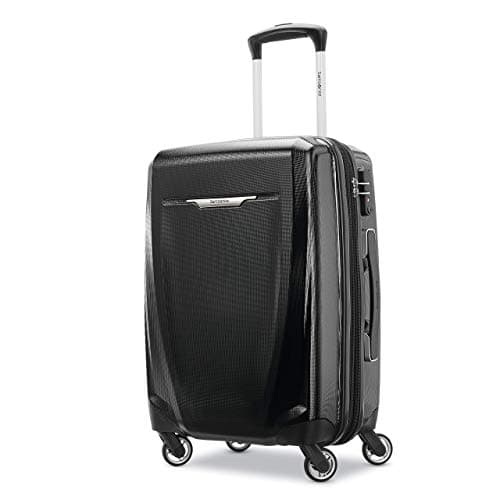
The Samsonite Winfield 3 DLX is the carry-on this site points to more often than any other. It tops our best carry-on luggage and best hardside carry-onrankings, it is the bag we name when someone asks which Samsonite to buy, and it is the benchmark we measure the premium direct-to-consumer cases against. That makes it the bag most in need of a proper examination rather than a recommendation — so this review works through Samsonite's own published figures one at a time, including the one that most listings bury.
Our verdict: still the right default for most people, for a reason that is easy to state — a genuine 100% polycarbonate shell, a fixed TSA lock and a 10-year warranty at a mid-tier price. The caveats are real and worth knowing before you buy: the "20-inch" case is published at 22.25 inches tall overall and sits over the US 22 x 14 x 9 in convention on every axis, it is not a light bag on a weight-capped carrier, and the warranty covers a narrower set of failures than a ten-year number suggests.
Method note: we have not tested this unit. This review works from Samsonite's published specifications and warranty terms, checks the dimensions against the airline standards we document elsewhere on this site, and sets the bag against the alternatives on our standard criteria. See how we test for what that does and does not mean.
The published numbers
| Spec | Samsonite Winfield 3 DLX 20" Spinner |
|---|
| Published overall dimensions | 22.25 x 14.5 x 9.5 in |
| Published body dimensions | 20.0 x 14.25 x 9.5 in |
| Published empty weight | 6.97 lb |
| Shell | 100% polycarbonate, scratch-resistant brushed finish |
| Expansion | 1.5 in |
| Wheels | Four oversized spinner wheels (dual casters) |
| Handle | Push-button locking telescoping handle, top carry handle |
| Lock | Mounted 3-digit TSA-approved combination lock |
| Interior | 4-pocket, two-sided divider panel |
| Warranty | 10-year limited, first purchaser or gift recipient |
| Sold on Amazon? | Yes — also direct and through department stores |
Figures are Samsonite's published specifications at the time of writing. We have not found a published liter capacity for this case, so we do not state one. Specifications and terms change without notice — confirm them on the listing before you buy.
A 20-inch bag that measures 22.25 inches
This is the figure to read twice. Samsonite names the case by its body height — 20 inches from the base of the shell to the top — but publishes the overall dimensions, wheels and handle included, at 22.25 x 14.5 x 9.5 in. Overall is what an airline sizer measures. Against the US convention of 22 x 14 x 9 in, that is a quarter inch over on height, half an inch over on width and half an inch over on depth — over on all three, before you touch the expander. Our how to measure luggage guide explains why the body-versus-overall distinction catches so many buyers, and what size is a carry-on sets out where the 22 x 14 x 9 figure comes from.
In practice, on US domestic flights this is very unlikely to matter. Sizers exist at every gate and are almost never used on a case that reads as normal carry-on luggage, and the Winfield 3 DLX fits a standard overhead bin without argument. Where it does matter is anywhere a bag is gauged rather than eyeballed. Converted, the published overall size is about 56.5 x 36.8 x 24.1 cm: over the 55 cm height and the 23 cm depth that several European full-service carriers publish, and well over the 20 cm depth of a low-cost cabin template. It clears the more generous 56 x 45 x 25 cm style allowances. Check your carrier in our carry-on size by airline table, and read the international carry-on size guidebefore assuming a "20-inch" label means what it sounds like.
The 1.5 inch expander makes the point starker. Unzip it and the depth goes to roughly 11 inches, which is checked-bag territory on any carrier. Treat the expansion as a way to get home with more than you left with and then check the bag, not as extra cabin capacity.
Why polycarbonate is the whole argument
Mainstream hardside cases come in three plastics, and the Winfield 3 DLX is built from the best of them. Polycarbonate deforms under impact and springs back; ABS, the cheaper plastic in most budget hardsides, is stiffer and cracks instead; polypropylene, used in the Freeform, is lighter but more flexible. Our materials guide covers the trade in full. The short version is that a full polycarbonate shell is the single specification that separates a hardside case that survives baggage handling from one that comes back with a split corner, and the Winfield 3 DLX has it at a price the premium brands do not compete at.
The finish is a brushed pattern under a gloss top coat, which Samsonite describes as scratch resistant. The pattern genuinely hides the fine scuffs that a plain gloss shell puts on display; the gloss layer still shows fingerprints, and deep gouges from a belt will mark it like any molded case. If a shell that hides wear matters more to you than the look, the Omni PC's micro-diamond texture does that job better — covered below.
What 6.97 pounds means
Just under 7 lb is respectable for a polycarbonate carry-on — lighter than an Away Carry-On at 7.5 lb, in line with a Monos at 7.01 lb, and heavier than the Samsonite Freeform and the softside Travelpro Maxlite 5, which is roughly a pound and a half lighter. On US domestic routes, where cabin bags are not weighed, that costs you nothing but the overhead lift.
On a 7 kg (15.4 lb) cabin allowance — common across Asia-Pacific and the Middle East and on some European fares — the empty case consumes about 45 percent of your entitlement before you pack. That is the honest reason the bag is not our first choice for weight-capped flying, and why our lightweight carry-on picks lead with softside bags instead.
The 10-year warranty, read properly
Samsonite's published terms apply to the first purchaser or gift recipient for ten years from the date of purchase, and cover manufacturing defects in material and workmanship — Samsonite decides whether to repair or replace. What they do not cover is the list worth reading: misuse, neglect, accidents, abrasion, exposure to extreme temperatures, solvents, acids and water, normal wear and tear, and transport damage, including by airlines.
That last exclusion is the one that matters, because a baggage belt is how most suitcases actually break. A cracked shell caused by a handler is a claim against the airline, usually within a short window after the flight, not against Samsonite. What the warranty is genuinely good for is the failures that are the manufacturer's fault — a handle that stops locking, a wheel housing that fails, a zipper that separates on its own — and Samsonite backs it with one of the largest authorized repair networks in luggage, which is the part a ten-year promise from a smaller brand cannot match. Our luggage warranties guide shows how to read terms like these, and for the one mainstream guarantee that does explicitly cover airline damage, see Briggs & Riley.
Inside the case
The interior is a clamshell with a four-pocket, two-sided divider panel — zippered pockets on both faces of the divider so small items are contained on either side rather than loose under a strap. It is a better arrangement than the single mesh divider most mid-tier hardsides ship with, and it adds organization without adding weight. The mounted three-digit TSA lock is fixed to the shell and secures the main zipper pulls; the push-button telescoping handle locks at height and has a rubber-enclosed button; and there is a top carry handle for the overhead lift. Our carry-on packing guide covers how to load a clamshell so the divider actually earns its keep.
What it does not have: a front-access pocket for a laptop, a built-in battery, or a wheel brake. Getting a laptop out at security means opening the whole case flat, which is the standard hardside compromise. If front access matters, the LEVEL8 Grace has it at a similar price.
Winfield 3 DLX, Omni PC or Freeform?
Samsonite's three mainstream hardside lines overlap enough to confuse, and the decision is simpler than the naming suggests. The Omni PCis also 100% polycarbonate, usually costs less, and has a micro-diamond textured shell that hides scuffs better than the Winfield's brushed gloss; what you give up is the Winfield's more finished hardware and interior. The Freeform is polypropylene rather than polycarbonate — lighter, and the right pick if weight is your constraint, at the cost of a shell that bows when overpacked. Our best Samsonite luggage page ranks all three including the sets and the checked sizes, the Omni PC reviewworks through that line's published figures size by size, and the Freeform review covers the polypropylene trade in detail.
Our rule of thumb: Winfield 3 DLX if you want the most complete bag of the three and do not mind paying a little more for it; Omni PC if value is the deciding factor and you are happy with the same shell material in a plainer package; Freeform if you lift your own bag overhead on every trip or fly weight-capped carriers. If it is only the first two you are deciding between, we have put their published figures side by side — and named the one dimension that settles it — in Samsonite Omni vs Winfield.
Against Away, Monos and the premium field
This is the comparison the Winfield 3 DLX was built to win. It offers the same shell material as the premium direct-to-consumer cases, a fixed TSA lock and dual spinners, and a warranty from a company with a repair network, at a price that is typically well under theirs. What it lacks is the design language — the felt-lined interior, the compression pad, the muted colorways — and if that is what you are buying, our Away The Carry-On review is the honest place to start. Where the two brands meet head to head, our Away vs Samsonite comparison works the value question through, and Samsonite vs Travelpro covers the hardside against softside decision using this exact bag.
The other sizes
The Winfield 3 DLX line runs in 20, 25 and 28 inch sizes and in matched sets. The 28-inch checked case is our pick in the best checked luggage roundup for the same reasons the carry-on wins here, and the sets are covered in best luggage sets. One practical note on buying any size: Samsonite's naming is by body height across the line, so read the published overall dimensions for each piece rather than the number in the name.
Who should buy it
Buy the Winfield 3 DLX if you want one hardside carry-on to stop thinking about — a real polycarbonate shell, a fixed TSA lock, a divider that organizes without weighing anything, and a ten-year warranty from a company that will actually honor it. Most of your flying is US domestic, you carry something worth protecting, and you would rather pay a mid-tier price once than a premium price for the same shell with nicer trim.
Buy something else if your flying is gauged or weighed. On a 55 x 40 x 20 cm template or a 7 kg cap, the published 22.25 x 14.5 x 9.5 in and 6.97 lb are both working against you, and a lighter softside case from our international carry-on picks is the better shape of purchase. And if you want to spend less for the same polycarbonate, the Omni PC is the rational answer — we would rather say so than pretend the difference is bigger than it is.