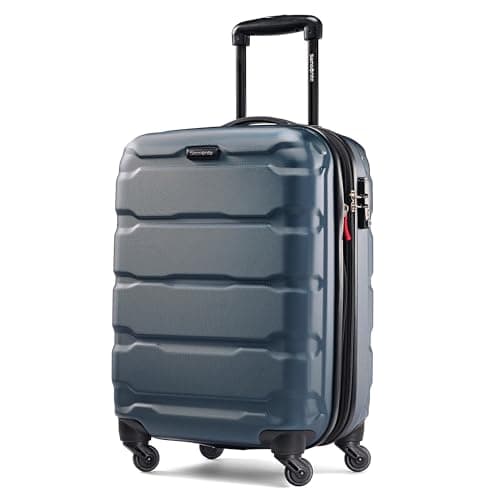
The Samsonite Omni PC is the bag this site names more often than any other when the question is cheapest real polycarbonate case. It is a pick on our hardside luggage and Samsonite roundups, it is one of the most-reviewed suitcases on Amazon, and the 24-inch version is the value pick on our 24-inch luggage page. That makes it the bag most in need of a proper examination rather than another recommendation — so this review works through the published figures one at a time, including the one almost every listing buries.
Our verdict: still the best value in hardside luggage, with one caveat that matters at a gate. A genuine micro-diamond polycarbonate shell, a TSA lock, spinner wheels and a 10-year limited warranty with the largest repair network in the category, at a price the newer lines do not go near. The caveat is size. The "20-inch" carry-on publishes overall dimensions of 22 x 15 x 9.5 in — at the 22-inch US height limit, an inch over the 14-inch width convention and half an inch over on depth — and that is before the expander. On a US domestic carrier with soft enforcement you will not notice. On a carrier that uses a hard sizer, you might.
Method note: we have not tested this unit. This review works from the published specifications and warranty terms, checks the dimensions against the airline standards we document elsewhere on this site, and sets the bag against the alternatives on our standard criteria. Samsonite does not serve its own product pages to automated requests, so the figures below are the consistent published figures across retailer specification sheets, cited in Sources. See how we test for what that does and does not mean.
The published numbers
| Spec | Omni PC Carry-On 20" |
|---|
| Published overall dimensions | 22 x 15 x 9.5 in |
| Published empty weight | 6.81 lb |
| Published capacity | 47.25 L |
| Shell | Micro-diamond textured polycarbonate |
| Expansion | Expandable (listed; no published inch figure found) |
| Wheels | Four spinner wheels |
| Lock | Side-mounted TSA-approved combination lock |
| Warranty | 10-year limited, against defects in materials and workmanship |
The size problem, stated plainly
A published 22 x 15 x 9.5 in is over the 22 x 14 x 9 in US domestic carry-on template on two of three axes. It is exactly at the limit on height, an inch over on width, and half an inch over on depth. Height is the dimension a gate agent eyeballs and the one a sizer catches first, so in practice this bag clears most US sizers and most overhead bins — which is why millions of them fly without incident. But the published numbers are the published numbers, and we would rather you knew them than found out at a gate.
Where it genuinely does not work is international. Several European carriers publish cabin templates around 55 x 40 x 20–23 cm; 22 x 15 x 9.5 in is roughly 55.9 x 38.1 x 24.1 cm, which is over on height and over on depth against the tighter templates. Add the expander and the case is not a cabin bag on those routes at all. If you fly European budget carriers or 7 kg-capped Asian ones, buy from our international carry-on roundup instead and read international carry-on size first.
This is not a flaw unique to the Omni PC. Samsonite's own Winfield 3 DLX publishes 22.25 x 14.5 x 9.5 in overall, which is over on all three — we said so in the Winfield 3 DLX review too. The industry convention is to name a case by the height of its body and let the wheels and handle push the overall figure past the limit. Knowing that is worth more than any single specification: the number in the product name is not the number the airline measures. Our guide to how to measure luggage shows where the tape actually goes.
Weight: the figure that justifies the price
A published 6.81 lb is the strongest number on this bag, and it is not close. It is lighter than the Winfield 3 DLX's published 6.97 lb, lighter than most polycarbonate cabin cases at twice the money, and it is roughly 44% of a 7 kg international cabin allowance — which is the right way to read a carry-on weight, because on a weight-capped carrier every ounce of shell is an ounce of clothing you cannot bring. Against an unweighed US domestic allowance it matters less, but it still decides whether the bag is liftable into a bin at the end of a long day.
The published 47.25 L capacity is the other half of that ratio: roughly 6.9 liters per pound of bag, which is competitive with cases costing considerably more. The lightweight luggage roundup ranks the whole field on this.
The shell: why micro-diamond texture is the real feature
Polycarbonate is the material to want in a hard shell. It flexes under impact and springs back, where ABS goes brittle and cracks — particularly in a cold cargo hold, which is where checked bags spend their time. The Omni PC is genuine polycarbonate rather than an ABS blend, and at this price that is unusual enough to be the main reason to buy it. The full material decision is in polycarbonate vs ABS vs aluminum.
The micro-diamond texture is the underrated part. A gloss hardside looks superb in a product photo and shows every scuff, fingerprint and belt mark from the first trip; a textured shell scatters that damage so it reads as finish rather than wear. If you intend to own one case for a decade, texture is worth more than gloss — which is the single clearest argument for this bag over the glossier, newer lines above it in the range.
The lock, the wheels and the interior: where the age shows
This is an older design and it does not hide it. Three specifics, in the order you will notice them.
The lock is side-mounted rather than recessed. It works and it is TSA-approved, but it sits proud of the shell where the newer integrated locks sit flush, so it is a thing that can catch on a belt. Worth knowing what a TSA lock is and is not: the master-key system is a deliberate universal bypass, so the lock is a deterrent against casual opening, not security — see TSA-approved luggage locks.
The wheels are the generation before the current oversized spinners. Four spinner wheels steer fine under a cabin load. Under a loaded 24 or 28-inch case they are the part of this line we would expect to fail first, which is also what the warranty does and does not cover — luggage wheel replacement covers the repair when it happens.
The interior is a divider and mesh, not a structured panel. For most people this is a non-issue solved by packing cubes, which organize a case better than any built-in panel. If you want built-in structure, that is a reason to move up the range.
The warranty, and what ten years actually means
Samsonite publishes a 10-year limited warranty against defects in materials and workmanship on its core hardside lines. That is a genuinely long term and it is backed by the largest repair network in luggage, which is the part competitors cannot copy quickly — a warranty is only worth the ease of claiming it, and Samsonite has more places to take a bag than anyone.
Read the scope rather than the number, though. A defects warranty is not a damage warranty. Transport damage caused by an airline, ordinary wear, water damage and damage from solvents sit outside it, which matters because airline handling is how checked luggage actually dies. If airline damage coverage is what you want, Travelpro publishes a promise that names it on its premium line — the comparison is in Samsonite vs Travelpro and the terms are unpacked in luggage warranties explained.
Which size: 20, 24 or 28?
The Omni PC is sold across the full range and the published figures differ more than the names suggest.
| Size | Published overall (in) | Linear in | Published weight |
|---|
| Carry-On 20" | 22 x 15 x 9.5 | 46.5 | 6.81 lb |
| Checked-Medium 24" | 26.5 x 17.75 x 11.75 | 56 | 8.34 lb |
| Checked-Large 28" | 28.5 x 20.5 x 13.5 | 62.5 | 10.5 lb |
Two conclusions from that table, and they are the practical reason to read it. The 24-inch is the sweet spot of the line. It publishes 8.34 lb — the lightest medium checked case on our 24-inch luggage roundup, where it is the value pick — with a published packing box of 24 x 17.5 x 11.5 in, and 56 linear inches leaves six inches of margin against the 62-inch oversize threshold.
The 28-inch publishes 62.5 linear inches, which is over the 62-inch standard before you expand it. Airlines rarely tape-measure a checked bag and usually judge by eye, so this is a published-fact problem rather than a daily one — but it is a published fact, and at 10.5 lb empty the case also starts a fifth of the way through a 50 lb allowance. We would buy the 24 instead, which is the same argument our 28-inch luggage roundup makes about the whole large class.
What to buy instead
Spend a little more: the Winfield 3 DLX is the step up inside the same brand and warranty — a flush integrated lock, the current oversized spinner wheels and a brushed finish, for a published 6.97 lb. It is the better bag; whether it is better value depends on the gap in price on the day.
Spend less: American Tourister is Samsonite's own value line, so a failed wheel still has the same service network behind it; the trade is a textured ABS shell rather than polycarbonate. The range is on the American Tourister roundup.
Want a softside instead: the Travelpro Maxlite 5 flexes to take the last item, adds external pockets, and carries a warranty that names wheels, zippers and handles.
Need the smaller, lighter Samsonite: the Freeform is the lightest big hard shell the brand makes, reviewed separately. And if what you actually want is the whole ranking rather than one bag, start at best hardside carry-on.