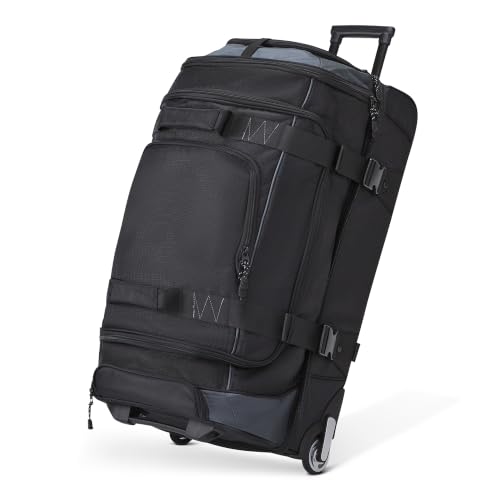
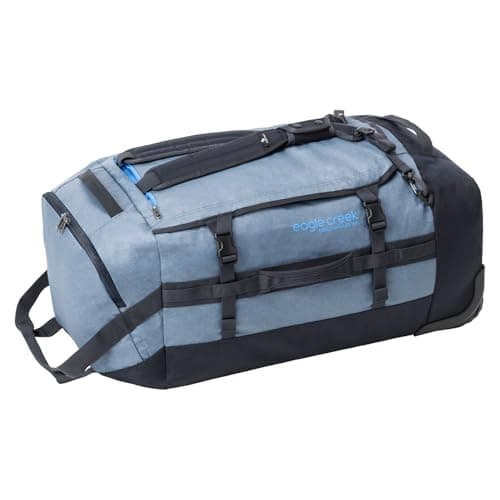
The best bag for moving abroad is the Eagle Creek Cargo Hauler Wheeled Duffel 110L, and the reason is a single published number that reorders this entire field: 4 lb 4 oz empty. Against a standard 50 lb checked allowance, a bag that weighs 4.25 lb lets you move 45.75 lb of your belongings. The 28-inch hardside spinner most people buy for a move publishes about 11 lb, which moves 39 lb. Same fee, same flight, same allowance — nearly seven pounds of difference in what actually crosses the ocean, per bag, because of the bag.
That is the whole argument, and it is the opposite of how you should shop for a holiday suitcase. A move is one trip. You are not buying a decade of durability; you are buying the maximum belongings per airline fee, once. Every pound of empty bag is a pound of your life you leave behind, and a case that would be the right answer on our most durable luggage page can be the wrong answer here precisely because it is built to last.
The second number is the one that costs money rather than belongings. Most airlines allow a standard checked bag up to 62 linear inches — length plus width plus depth, 158 cm — and charge an oversize fee above it. That fee is commonly in the $100–$200 range per bag on international routes, which on a move with three or four checked bags is real money. And here is the finding that should change what you buy: several of the biggest bags marketed for moving are already over the 62-inch line on their makers' own published figures, before you pack anything. We have printed the linear-inch arithmetic on every pick below, which no other roundup on this topic appears to do.
The five criteria, in the order they decide the bag
1. Payload per pound of empty bag. Published empty weight subtracted from the 50 lb (23 kg) allowance. This is criterion one and it is not close — the spread across the bags below is nearly seven pounds per bag, which over four bags is a 27 lb difference in what you move. It is also the criterion that puts soft-sided wheeled duffels at the top of a page where the obvious answer looked like a big hardside.
2. Published linear inches against 62. Length plus width plus depth, from the maker's overall figure — not the "28-inch" marketing label, which is usually the case body and not what an agent measures. A bag over 62 linear inches is an oversize fee waiting to happen, and on a one-way move you will be checking several bags at one desk, where attention is higher than on a single holiday case.
3. One brutal trip, not ten years. A moving bag gets packed to its weight limit, dragged over curbs, loaded into a van and put through two or three connections once. What matters is that it survives that, which is a different question from whether it survives three hundred segments. A 10-year warranty is close to worthless on a bag you will use for one journey; a seam that holds 50 lb is not.
4. What the bag does after you arrive. This is the criterion nobody mentions and it matters a lot in a first flat abroad, where storage is scarce and expensive. A hardside shell is a rigid box that must be stored full-size forever. A soft duffel collapses; a foldable duffel goes into a drawer. If you have no attic, four 28-inch hardsides is furniture you did not want.
5. The fee arithmetic, honestly. Second and subsequent checked bags cost more than the first, often substantially more on international tickets, and excess-baggage charges can exceed the value of what you are moving. Before you buy any bag on this page, read your own ticket's allowance — our checked bag fees by airline and checked bag size and weight limits guides have the thresholds — because for genuinely bulky, low-value goods (bedding, books, kitchen things) unaccompanied shipping or sea freight is routinely cheaper per pound than a fourth checked bag. The right answer to "what luggage do I buy to move abroad?" sometimes includes "fewer bags than you think, plus a shipment."
One trip where every conclusion on this page inverts: a safari. The light aircraft that fly bush transfers publish rules banning wheels and rigid frames outright, so the wheeled duffel that wins here is not even eligible there, and the weight cap is a total that includes your hand luggage and camera gear. Our best luggage for safari page works that constraint set through from published operator figures.
Two things we deliberately do not rank on. Warranty length, for the reason in criterion three. And liter capacity, because the published figures are not comparable across bag types — a duffel's liters and a spinner's liters are measured differently, and two of the bags below publish no capacity figure at all. Linear inches and empty weight are both published consistently, so those are what we use.
The linear-inch table, from published figures
Every figure here is the maker's published overall dimension — the number an airline measures — added up and set against the 62-inch threshold. This is the single most useful thing on the page.
| Bag | Published overall | Linear in | vs 62 in | Empty | Payload of 50 lb |
|---|
| Eagle Creek Cargo Hauler 110L | 30.25 x 13.5 x 15 in | 58.75 | 3.25 in clear | 4 lb 4 oz | ~45.75 lb |
| Amazon Essentials 30-in rolling duffel | 30 x 15 x 14 in | 59 | 3 in clear | Not published | Not calculable |
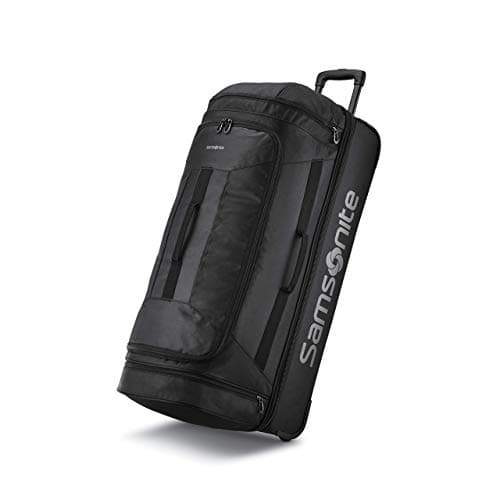
| Samsonite Andante 2, 32-in | 32.4 x 14.8 x 15.0 in | 62.2 | 0.2 in OVER | 7.9 lb | ~42.1 lb |
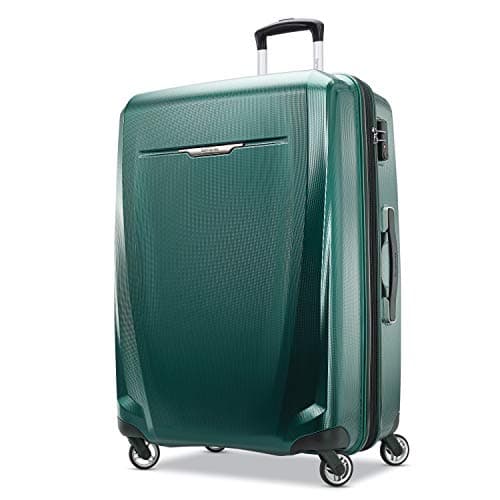
| Samsonite Winfield 3 DLX, 28-in | 30.5 x 20.5 x 13.25 in | 64.25 | 2.25 in OVER | ~11 lb | ~39 lb |
Three things that table makes obvious, and two of them are uncomfortable.
The hardside spinner is over the line. Samsonite publishes 30.5 x 20.5 x 13.25 in overall for the Winfield 3 DLX Checked-Large, against a 28 x 20 x 13.25 in packing dimension. The marketing label is 28 inches; the number an agent measures is 30.5, and the total is 64.25 linear inches — 2.25 in over the 62-inch threshold. That is the published figure and we are printing it even though this site has recommended this case as a 62-inch-compliant bag elsewhere, which on these numbers was wrong and has been corrected. If you are checking one holiday bag on a US mainline route, nobody will measure it. If you are checking four bags at an international desk on a one-way ticket, the odds change.
The 32-inch duffel is over too, by almost nothing. Samsonite publishes 62.2 linear inches for the Andante 2 — two tenths of an inch past the limit. In practice a soft bag measured at 62.2 in while under-packed will usually read as compliant, because fabric gives where a shell does not. That is a real, honest advantage of soft sides at this size, and it is not something you can rely on.
The lightest bag is also inside the limit. Eagle Creek publishes 58.75 linear inches and 4 lb 4 oz for a bag it rates at 108 L. It is the only pick here that is comfortably clear on both numbers simultaneously, which is why it tops the page despite being the one with the thinnest stock.
Soft versus hard, for a move specifically
Our hardside vs softside guide sets out the general trade. For a relocation the balance tips further toward fabric than it does for any other use case on this site, for four reasons.
Fabric bags are lighter for the same volume, which is criterion one. They give at a sizer, which matters when your bag is near the line. They collapse for storage, which matters in a small first flat. And their failure mode is better: an overpacked duffel strains a seam, which you can have stitched, while an overpacked hardside at 50 lb loads a rigid shell that can crack at a corner and cannot be repaired at all.
The one thing a shell does better is protect, and on a move you may well have things worth protecting — a laptop, framed pictures, ceramics, a musical instrument. That is a genuine reason to put one hardside in the mix rather than none, and it is why the Winfield is ranked here at all despite being the heaviest bag and 2.25 in over the threshold. The sensible shape of a four-bag move is usually one hard case for fragile and valuable things, and soft bags for everything else.
What to pack where, and the rules that bite on a one-way trip
A move puts things in checked bags that a holiday never does, and several of them are restricted or prohibited. Our checked luggage rules guide covers the detail, but the items that catch people moving house are consistent: aerosols and large liquid containers, anything with a lithium battery not installed in a device, cleaning chemicals, paint, lighter fuel and camping gas, matches, and in many jurisdictions food, plants, seeds and wooden items that fall under agricultural import controls at the destination. Customs at the other end is a separate question from the airline's rules, and a one-way ticket with four bags invites the question.
Two practical habits worth more than any bag choice. Weigh every bag before you leave for the airport — a luggage scale costs a fraction of one overweight fee and on a move you will be at the limit on every bag rather than one. And label the inside as well as the outside: a lost bag on a move is often a bag whose owner no longer lives at the address on the tag. Our luggage tags and luggage tracker pages cover both, and what to do when an airline loses a bag is worth reading before rather than after, because the compensation limits on a bag containing a third of your possessions are far below its value to you.
Finally, the packing method changes. Compression packing cubes earn their keep on a move more than on any trip, because you are weight-limited rather than volume-limited and compressing clothing lets you fill the remaining space with heavier, denser things instead of air. And wear the bulk: the coat and the boots you fly in do not count against any allowance.