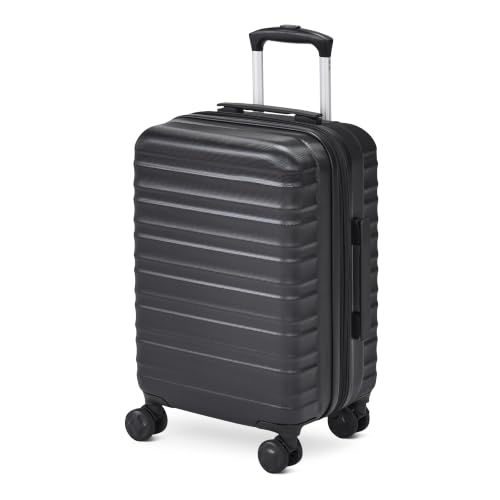
Start with the thing that will confuse you before you get to the bag. If you search for "Amazon Basics luggage" you will land on a listing titled Amazon Essentials. It is the same product at the same ASIN. When we read every Amazon house-brand luggage listing on this site through the Amazon catalog API on 2026-10-31, all five came back under the Amazon Essentials name — the 21-inch carry-on, the 26-inch medium checked case, the three-piece hardshell set, the 30-inch rolling duffel and the extra large foldable duffel. Amazon's own listings carry a "Previously Amazon Basics" marker, and one set listing states the change outright in a bullet. We found no press release and no date, so we are not going to give you one.
The rename is also visibly mid-flight: in the same pass, the catalog returned the Amazon Essentials title while the product page itself still served the old Amazon Basics 21" Hardside Carry-On Luggage title. Nothing about the bag changed. Nothing about the warranty appears to have changed. But if you are checking a review against a listing and the brand names do not match, that is why.
Now the bag. This is the cheapest case this site recommends anywhere, and it earns that recommendation — it is the #1 pick on our budget carry-on page and it appears on four others. It is also the case with the single largest gap between what its name implies and what its published figures say, and that gap is the whole reason this review exists.
The published specification
| Listing brand (catalog, 2026-10-31) | Amazon Essentials — previously Amazon Basics |
| Published exterior (retailer listings) | ~21.7 x 14.8 x 10 in, wheels included |
| Independently measured exterior | 14.9 x 10 x 22 in, handle stowed (Consumer Reports) |
| Handle extended height | 40.6 in (Consumer Reports) |
| Empty weight | 7.1 lb (Consumer Reports) / ~7.7 lb (third-party review) |
| Capacity | 40.6 L, 46.9 L expanded (Consumer Reports) / 34 L (third-party review) |
| Shell | ABS on most sources; one listing says polycarbonate |
| Expansion | "Up to 25% more space," per the listing title |
| Wheels | Four multi-directional spinner wheels |
| Interior | Divider plus three zippered pockets |
| Warranty | Three-Year Limited Warranty for Luggage |
Every row above is a published or independently measured figure, cited in Sources. Note how many rows carry two numbers — that is not sloppiness on our part, it is covered in full below, and it is one of the real costs of buying a house brand.
The finding: this is the bag most likely to be stopped at a sizer
The US cabin template is 22 x 14 x 9 in, wheels and handles included. Read the published exterior against it:
- Height. ~21.7 in published, or 22 in as measured independently. At or inside the 22 in limit. Fine.
- Width. ~14.8 in published, 14.9 in measured. That is 0.8 to 0.9 in over the 14 in allowance.
- Depth. ~10 in published and measured. That is a full inch over the 9 in allowance.
So the "21-inch" case is over the template on two of three axes before you expand it, and it is over on depth by more than any other bag in the budget class we rank. Added up, the published figures come to about 46.5 linear inches against the template's 45.
Here is why that matters more on a cheap bag than on an expensive one, and it is not the reason you would guess. It is not that the bag is badly made. It is that a rigid shell cannot be compressed at a gauge. A softside case that is an inch too deep can often be squeezed into a sizer; a hard shell either goes in or it does not. And the people buying a case at this price are disproportionately flying the carriers that actually use a sizer — low-cost and ultra-low-cost airlines, where the gate fee for an oversize cabin bag can exceed what this suitcase cost. Our what happens if your carry-on is too big guide works through those fees, and how to measure luggage explains how to take the overall figure yourself, which on this bag you should.
Two mitigations, both real. On most US mainline carriers the bin is deeper than the published template and nobody measures a carry-on on a domestic route — this bag flies thousands of segments a week without incident, which is exactly why it rates well on the budget page. And the one axis it clears is the one a rigid sizer catches first in European use: 21.7 in against the 55 cm (21.65 in) height gauge is close enough to call it level. The problem axis there is depth again, where the common European gauge is 20 cm — about 7.9 in — against this bag's 10. Our international carry-on size guide has the gauges by carrier.
The expansion makes the worst axis worse
The listing title promises "up to 25% more space", and Consumer Reports' figures bear that out in direction if not in exact magnitude: 40.6 L standard against 46.9 L expanded is about 15% more, measured their way.
But an expansion zip on a hardside adds its volume in one axis, and on this case that axis is depth — which is already the dimension in violation. Expanded, you are not an inch over on depth, you are something closer to two. That makes the expander a hold-bag feature on a cabin bag: genuinely useful on the return leg if you are checking the case anyway, and not something to rely on at a gate. This is true of every expandable hardside carry-on and we say so on our expandable carry-on page; it is just more consequential here, because this bag starts over the line rather than at it.
Three years, and what that actually means
The published warranty is an Amazon Basics Three-Year Limited Warranty for Luggage. Consumer Reports separately notes three- or four-year coverage available for an additional charge, which reads as a paid protection plan rather than the included term, so treat the three years as the figure and confirm the current wording on the listing before you buy — on a house brand the listing is the warranty document.
Three years is the shortest term of any case this site ranks, and the comparison is stark: Samsonite publishes ten years on the Winfield 3 DLX, Travelpro publishes a limited lifetime warranty, TUMI publishes five years and Briggs & Riley publishes unconditional lifetime repair. Our luggage warranties explained guide ranks those classes.
And yet — three years is the right warranty for this bag, and pretending otherwise would be dishonest in the other direction. A ten-year warranty on a case that costs a fraction of a Samsonite would be a promise nobody could fund. What you are buying here is three years of cover and, far more usefully, Amazon's returns process, which in practice resolves a dead wheel or a failed zip faster than any luggage brand's repair network does. On a cheap bag the returns window is worth more than the warranty length, and that is a real advantage of buying the house brand rather than a no-name case at the same price.
Shell, weight and capacity: the figures do not reconcile
This is the structural weakness of reviewing a house-brand product, and it deserves stating plainly rather than hiding behind a tidy spec table. There is no manufacturer specification sheet separate from the retail listing, so when sources disagree there is no tiebreaker. With Samsonite or Travelpro you can hold a retailer's number against the maker's own published figure. Here, the retailer and the maker are the same company, and the listing is all there is.
Shell. Most sources describe ABS. One listing describes a high-grade polycarbonate shell, which contradicts the rest and is most likely a listing error. We have ranked this bag as ABS across the site and we continue to, because that is what the weight of evidence says — and because at this price ABS is what you would expect. The practical difference is covered in polycarbonate vs ABS vs aluminum: ABS is lighter and cheaper and it is more brittle in cold, which means a hold on a winter long-haul is where it is likeliest to crack. As a cabin bag it rarely sees that.
Weight. Consumer Reports measured 7.1 lb. A third-party review puts it at about 7.7 lb. We are not averaging those. Either way it is light for a hardside and lighter than the Away and TUMI flagships, which is a genuinely good result for the cheapest bag here — though against a 7 kg international cabin cap even 7.1 lb is roughly 46% of your allowance.
Capacity. Consumer Reports measured 40.6 L, and 46.9 L expanded. A third-party review cites 34 L. Those are far enough apart that they are almost certainly measuring different things — one a geometric interior, the other a usable packing volume. If you need the figure to matter, work it from the case dimensions instead: our how many outfits fit in a carry-on guide does exactly that.
Who should buy it
Buy it if you fly two to six times a year on US mainline carriers, want a hardside spinner that locks and rolls, and do not want to spend more than the trip costs. On a cost-per-trip basis nothing on this site beats it. Buy it also as a student or first bag, or as the bag you are willing to leave behind at the end of a one-way trip.
Do not buy it if you regularly fly European low-cost carriers, or any airline that puts bags in a gauge. A published 10 in depth against a 9 in — or 20 cm — allowance is not a problem you can pack your way out of in a rigid shell, and one gate fee costs more than the bag. Our international carry-on page ranks on exactly that discipline and this bag is not on it.
Do not buy it either if you fly more than about twenty segments a year. Three years of warranty and an ABS shell is a two-to-four-year bag at that duty cycle; the Travelpro Maxlite 5 costs several times more, weighs less, and carries a limited lifetime warranty that covers the wheels — which is the part that actually fails. The arithmetic flips somewhere around trip twenty.
Every figure in this review is published by the retailer, published by Amazon, or independently measured by a named third party — all cited in Sources. We have not weighed, packed or stress-tested this case, and where sources conflict we have printed both numbers rather than choosing one. See how we test.