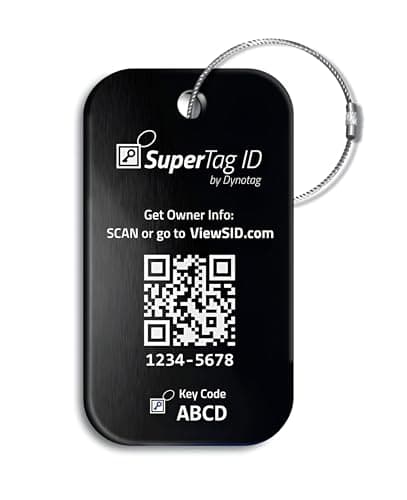
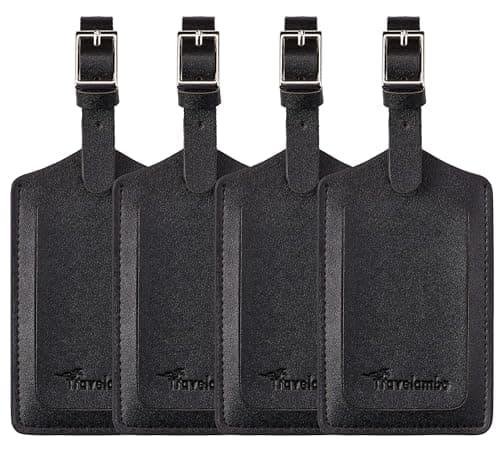
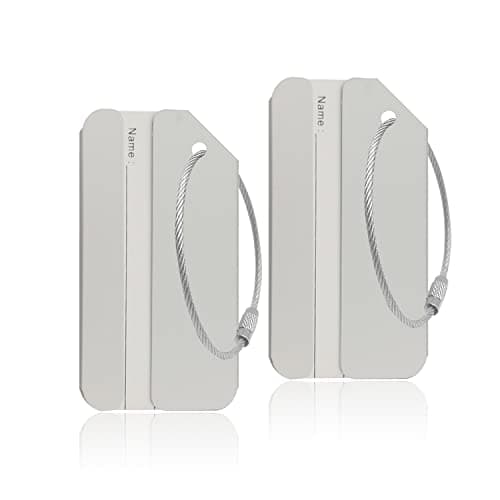
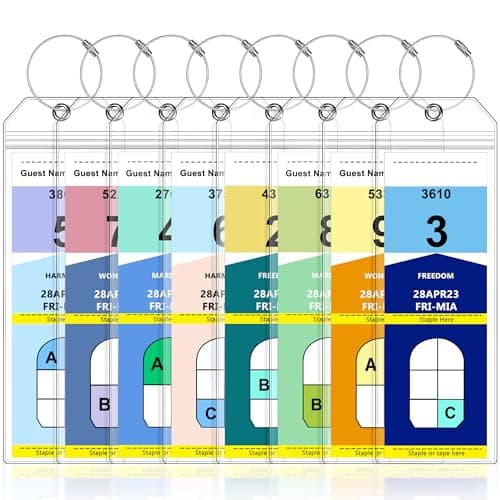
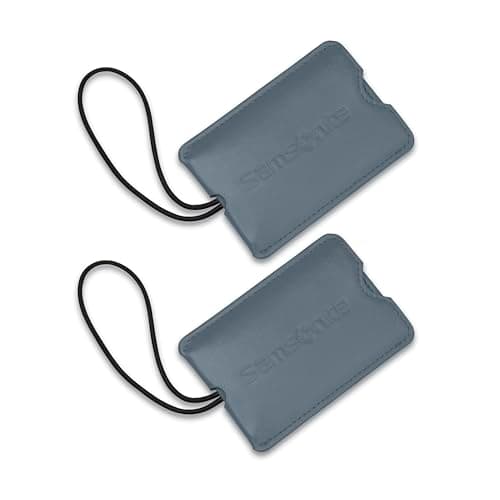
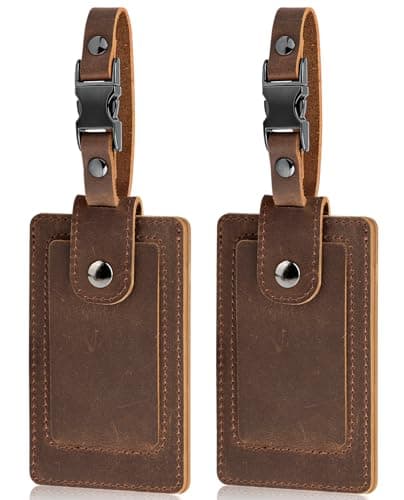
The best luggage tag is the Teskyer Premium Genuine Leather two-pack, and the reason is unglamorous: it survives the belt and it does not display your home address to everyone standing at the carousel. Those are the only two things a tag has to get right, and most tags get one of them wrong. If you would rather no address existed on the outside of the bag at all, the Dynotag Sentry Series metal tag replaces the address card with a scannable web ID on a steel loop. And if you are sailing rather than flying, what you actually need is not a tag but a holder for the printable tag the cruise line gives you — the SEAVILIA eight-pack below.
Start with what a tag is for, because it changes what you buy. When an airline mishandles a bag, the bag is routed on the barcoded tag the carrier attached at check-in, read by a scanner and matched to a file in the carrier's tracing system. Your own tag is the backup for when that barcode is gone — torn off, soaked, or shredded by a belt — which is exactly the circumstance where your tag will have taken the same punishment. So a luggage tag is not decoration and it is not insurance; it is a second, redundant copy of your identity that has to survive the thing that destroyed the first one. That is why this page ranks on durability and attachment before it ranks on looks.
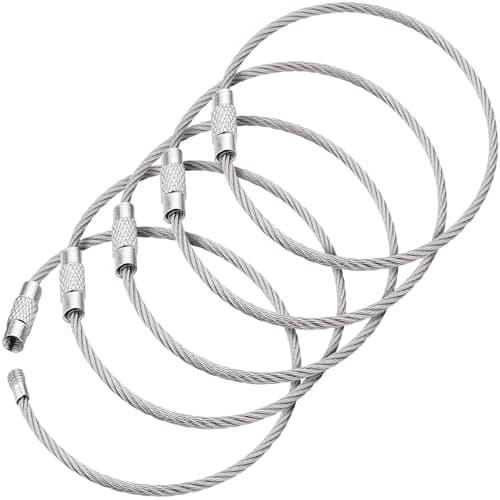
Three criteria decide it, in this order. The attachment — the single most common failure is not the tag, it is the loop. A molded plastic buckle or a thin elastic band shears under a belt roller; a steel cable loop or a riveted leather strap does not, and a tag that is no longer on the bag is a tag that did nothing. Privacy — a tag with your street address printed on the visible face broadcasts an empty house to every person in a public baggage hall, and a covered flap or a scan-to-contact code fixes that for no extra money. Legibility after weather — baggage carts sit outside, and a paper insert behind unsealed plastic becomes pulp while laser-engraved metal does not. Pack count matters too, because the right number of tags is one per case plus one on the bag you carry, not one.
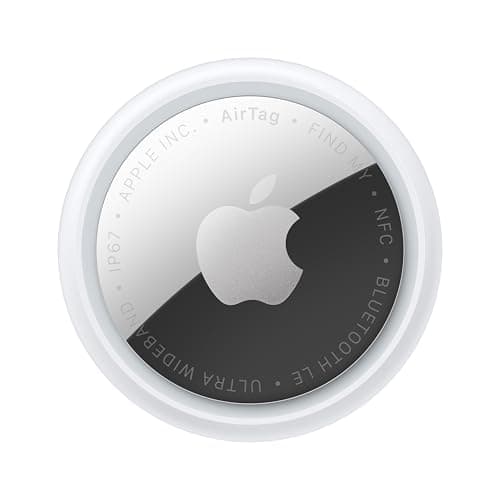
And one honest limit up front, because it decides whether a tag is what you actually want. A tag tells a stranger where to send your bag. It cannot tell you where your bag is. Those are different problems with different products, and the last pick on this page is the other one — our luggage tracker roundup ranks that category properly, and what to do when an airline loses your luggage sets out the claim, the refund and the liability ceilings when both fail.
Every tag below was confirmed live and purchasable before it was written up. Materials, pack counts and dimensions are as published by the maker or the listing; service terms are quoted from the manufacturer's own pages and cited in Sources. We have not lab-tested a tag to destruction and we do not claim to have. See how we test.
What should you write on a luggage tag?
Your name, a mobile number and an email address. That is enough for anyone who finds the bag to reach you, and it is the version that does not tell a stranger your house is empty for the next two weeks. Leave the street address off the visible face. If the tag has a covered card, you can put a full address inside it — a flap is enough privacy for the people milling around a carousel, and the one person who genuinely needs it will lift it.
Two additions that cost nothing and work. Write your destination — the hotel name and city for this trip — on the card as well, because a bag that misses a connection can be delivered to you rather than held. And put a second ID card inside the bag, on top of the packing, because when the exterior tag is gone a baggage service office opens the case looking for exactly that. The inside card is the one that works when everything else has failed.
Do luggage tags actually prevent lost luggage?
Not really, and it is worth being clear about it. Airlines route bags on the barcoded tag they attach at check-in, matched to a file in their tracing system; your tag matters in the specific case where that barcode is destroyed or the bag ends up off-system. That case is uncommon but it is the one where nothing else helps, which is why a tag is still worth five dollars. What genuinely shortens a lost-bag episode is a report filed before you leave the terminal and a tracker that tells you the bag's last known position — our guide to what to do when an airline loses your luggage covers the US DOT refund you are owed, the liability ceilings, and the order to do things in.
How many luggage tags do you need?
One per checked bag, plus one on the bag you carry. A two-pack covers a solo traveler with a checked case and a cabin bag; a four-pack covers a couple or a three-piece set; an eight-pack is a family. Buying one tag for a set of three matching cases is the most common mistake here, and it misses the second job a tag does: telling your bag apart from the identical ones. Give every case in a matching set a different tag rather than a matching one — the point is contrast, not coordination. Our family luggage page makes the same argument about four identical black bags on one belt.
Leather, metal, vinyl or silicone?
Leather is the best all-rounder: it flexes with the handle, it does not crack in cold, and a riveted strap is strong. It darkens and marks with use, which some people like. Metal — aluminum or steel — is the most durable and the only material that can carry permanently engraved details rather than a replaceable card; the trade is weight and the risk of scuffing a handle it rubs on. Vinyl and plastic are the cheapest and the shortest-lived: they stiffen in cold and split at the fold. Silicone is tough and bright, which makes it genuinely good at the identification job, but the moldings are usually one piece with the loop, so when the loop goes the tag goes with it. Whatever the body is made of, the loop is what fails first — which is why the steel wire loops above are the best five dollars on this page.
Luggage tags for cruises are a different product
If you are sailing, do not buy an ID tag and assume it covers you. Cruise lines route checked bags to your cabin on their tag, which arrives as a printable PDF in your e-documents — Royal Caribbean publishes them around 45 days before sailing, and its own instructions are to fold the tag three times and staple or tape it to the handle. Paper and staples on a bag that gets stacked on a wet cart is the common failure, and a clear plastic holder with a steel loop is the fix. Buy the holder that matches your line's tag format, put a normal ID tag on the bag as well for the flights either side, and pick the case itself from our cruise luggage roundup.
Tag or tracker? Buy in this order
A tag answers "whose bag is this and where should it go?". A tracker answers "where is my bag right now?". If you can only buy one, buy the tag, because it costs a few dollars and it is the only one of the two that works without you. If the bag is going in a hold on a connecting itinerary, buy both — the tracker is what turns an argument at a baggage desk into a fact, and Apple's Share Item Location now lets you hand that fact straight to the airline. Trackers are legal in checked bags within the FAA's lithium limits, which we document with the published figures on the tracker roundup.
A tag answers one of two separate questions. The other is recognition - spotting the bag from twenty feet - and the fixes for that rank differently, because almost none of them survive a conveyor system. Our guide to making your luggage stand out ranks them on exactly that, explains why a ribbon on a handle is the least durable popular fix, and covers the step most people skip: an identification card inside the bag, for when the external tag has been torn off.