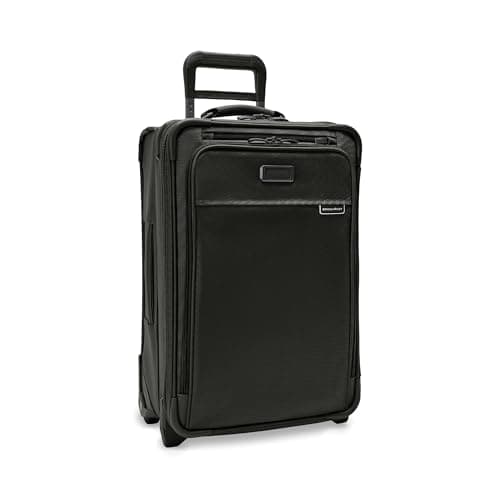
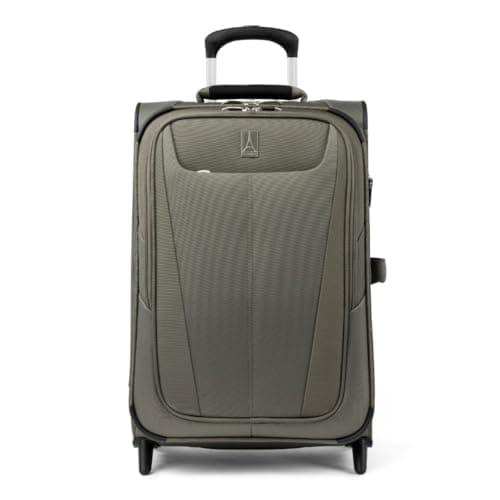
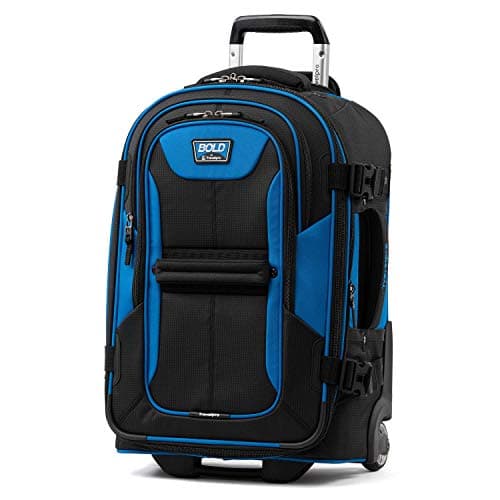
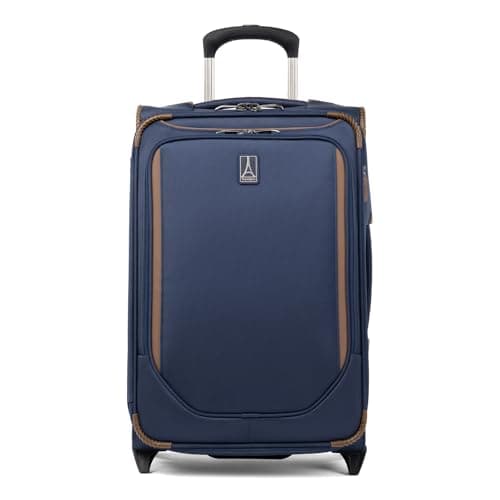
The best bag for a working flight attendant is the Travelpro Crew Classic Carry-On Rollaboard, and the reason is a geometry choice the consumer market has largely moved away from: two wheels, not four. Two large inline wheels sit inside a recessed housing in the shell, where four spinner casters are bolted beneath it — and wheels are the single most common failure point on any wheeled bag, as well as the part an airline breaks. Over a 300-leg year that one fact outranks everything else. Travelpro, a company founded by an airline pilot, still publishes two-wheel rollaboards in its Crew line for exactly that reason. If you want the buy-once version and the money is available, the Briggs & Riley Baseline Essential 2-Wheel is the only bag here whose guarantee covers airline-caused damage for life with no registration.
Before the picks, the single most useful thing on this page, because it is the thing every other crew roundup leaves out. A bag in commercial use is in a different warranty class. Travelpro publishes its consumer Built For a Lifetime Limited Warranty on the Crew Classic, Crew VersaPack, VersaPack+, Platinum Elite, Maxlite 5, Maxlite Air and Bold collections, with a Trusted Companion Promise on top that "covers the cost of repair for damage caused by an airline or other common carrier" if the bag is registered within 120 days. But for aviation professionals it publishes separate terms: a 3 Year Commercial Use Warranty on FlightCrew 5 and a 5 Year Commercial Use Warranty on Travelpro Pilot 5. Same manufacturer, same factory, and the professional lines carry years rather than a lifetime — because a bag that flies 300 legs a year is a different product to a bag that flies six.
There is a second consequence of that split, and it is the reason this page ranks the bags it does. The two lines built explicitly for crew — FlightCrew 5, which Travelpro describes as "the luggage of choice for more than 220,000 flight crew members," and Travelpro Pilot — are sold through the company's separate aviation channel, where the professional collections sit behind a login. They are not on Amazon. That channel also sells something the consumer market does not: a FlightCrew Parts section with wheel kits. So if you are two years into a career and your wheels are the problem rather than your bag, the answer may be a parts order rather than a purchase. Everything ranked below is a bag you can buy today, from the consumer lines, used commercially — and the warranty consequence of that is stated on every pick rather than buried.
The five criteria, in the order they decide the bag
1. Wheel geometry. Two wheels or four, and where they sit. Two large inline wheels recessed into the shell survive curbs, jet-bridge expansion joints and being kicked along a galley floor; four casters bolted beneath the shell are the most common failure point on any wheeled bag and the part airlines break. This is the criterion that reorders the field most against a consumer roundup, and it is a trade rather than a win — our spinner versus two-wheel guide is clear that a spinner is easier on a smooth concourse and better in an aisle, which is why four-wheel crew bags are now common and why Travelpro sells the Crew Classic in both geometries. We rank the two-wheel version first here on duty cycle, not on convenience, and the buyer's guide below sets out both sides.
2. Published overall height. Not the number in the product name, and not what most people assume. Every two-wheel rollaboard on this page publishes an overall height of about 23 inches including wheels and handle, against a 22 x 14 x 9 in US template. The reason is not the wheels — recessed wheels add less to a total than spinner housings do — it is that a crew rollaboard is a bigger bag. Travelpro publishes a 20.75-inch case body for the Crew Classic where a consumer "20-inch" hardside like the Maxlite Air V2 publishes an 18.75-inch one. Crew bags were built to the old 22-inch rollaboard class and stayed there. For crew that is academic: you board before the sizer matters and you stow in a crew closet or the first bin. For anyone buying a crew bag to fly as a passenger it is not academic at all, and we say so on each pick. The templates are in carry-on size by airline.
3. Whether a tote stacks. A crew bag is never one bag. It is a rollaboard with a tote or an under-seat case riding on top, moved as one unit from a car to a van to a gate. A bag with a flat top face and a strap pass-through does that; a bag with a domed lid and a bulging front pocket does not. Two picks below exist only to be the second half of that stack.
4. Empty weight. Published weights on this page run from 5.4 lb to 9.7 lb. That spread is 4.3 lb, and on a crew schedule it is paid twice: once as the lift into a bin at the end of a fourteen-hour duty day, and again on any route where the bag is weighed against a 7 to 10 kg cabin cap. Our how much luggage weighs guide explains why makers publish conflicting figures for the same case.
5. Serviceability and warranty class. Not "does it have a lifetime warranty" — every bag here claims one — but what is the documented route to a repaired wheel, and does the cover survive the fact that you use the bag for work. Only one brand on this page publishes a guarantee that names airline damage with no registration requirement.
Every figure below is a published one, taken from the maker's own specification pages and cited in Sources. We have not flown a career with any of these bags. Where a maker's own figures disagree with a retailer's — which on two of these bags they do — this page states both rather than picking the flattering one. See how we test.
The warranty question, in full
This is the part of the decision that consumer roundups cannot help you with, because the buyer they are written for does not use the bag for work.
Travelpro publishes several warranty tiers and the boundary between them is who is using the bag and for what. The consumer tier, the Built For a Lifetime Limited Warranty, covers the Crew Classic, Crew VersaPack, VersaPack+, Platinum Elite, Platinum Magna 2, Maxlite 5, Maxlite Air, Bold, Roundtrip, Altitude and Crew Executive Choice 3 collections, and covers wheels, zippers, handles and the extension handle against defects in materials and workmanship, repaired or replaced at Travelpro's discretion. On top of that sits the Trusted Companion Promise, which covers the cost of repair for damage caused by an airline or other common carrier and the shipping to a Travelpro repair facility — but it has a term that varies by collection (3 years on the Crew Classic) and it only activates if you register the bag within 120 days of purchase or gift receipt. If you take one practical thing from this page, let it be that: register the bag in your first week.
Then there are the aviation-professional tiers, and they are shorter rather than longer: a 3 Year Commercial Use Warranty on FlightCrew 5 and a 5 Year Commercial Use Warranty on Travelpro Pilot 5. Read that honestly. The manufacturer that publishes a lifetime tier for leisure buyers publishes a three-to-five year tier for the lines it builds specifically for crew, because it knows what commercial duty does to a bag. Nothing here says a consumer bag used commercially will be refused a repair — the published terms do not say that either way — but a buyer should know the manufacturer itself draws the line, and should not plan a career around the word "lifetime."
Briggs & Riley is the exception that proves the point. Its Simple As That guarantee covers "repair of all functional aspects" for life, names airline damage, and requires no registration and no proof of purchase — and it makes no distinction between commercial and leisure use in the terms it publishes. That is the single strongest argument for spending four times the money, and it is why that bag sits at number two here despite being the heaviest thing on the page.
Two wheels or four: the honest version
The spinner won the consumer market for good reasons, and this site says so on its own spinner versus two-wheel guide: on a flat concourse a four-wheel case carries its own weight while you steer, and in an aircraft aisle it turns ninety degrees and rolls sideways between the seat rows where a two-wheel bag has to be dragged or lifted. Those advantages are real and they are not reversed by an occupational context. Travelpro knows it too — it sells the Crew Classic in an eight-wheel spinner as well as the two-wheel rollaboard ranked above.
So why does this page still put two wheels first? Because the criterion that dominates a working schedule is not effort, it is failure. Two large inline wheels are recessed into the shell, protected from side impacts by the body of the bag. Four spinner casters are bolted beneath it, exposed, and they are the most frequently broken part of any wheeled bag. On a curb, a jet-bridge expansion joint, a grating or a wet metal lip, a large recessed wheel rolls over what shears a small caster off. Our wheel replacement guide covers what is involved when that happens, and how long luggage lasts explains why wheels decide the lifespan of a bag rather than the shell.
There is a second, quieter advantage: volume. Spinner housings eat interior depth that a recessed two-wheel assembly does not, which is why the Crew Classic publishes 52 L against the 40 L of the hardside spinner in the same brand at a similar external size. Over a four-day trip that is a uniform's worth of space.
If your flying is short turns on narrowbodies and you are in and out of the aisle with the bag ten times a day, buy the spinner version and accept the shorter wheel life. If your bag mostly goes car, van, curb, gate, closet — which is most crew patterns — the two-wheel rollaboard is the bag that is still working in year four.
One thing the geometry does not explain is the height. Recessed wheels add less to an overall figure than spinner housings do, so the reason the Crew Classic publishes 23 x 14.5 x 9.5 in and the two-wheel Maxlite 5 publishes 23 x 14.5 x 9 in is simply that crew rollaboards are bigger bags: a 20.75 or 21-inch case body against the 18.75-inch body of a consumer "20-inch" hardside. The crew class never shrank to the template the way the consumer class did. For crew it is a non-issue. For a passenger buying a crew bag because it looks durable, it is the thing to know before you order, and the four-wheel cases on our hardside carry-on page are built to the template instead.
The stack, and why it is two purchases
A working crew bag configuration is a rollaboard plus a second bag, and the second bag decides how your back feels at the end of a four-leg day. There are two honest answers and they are different products.
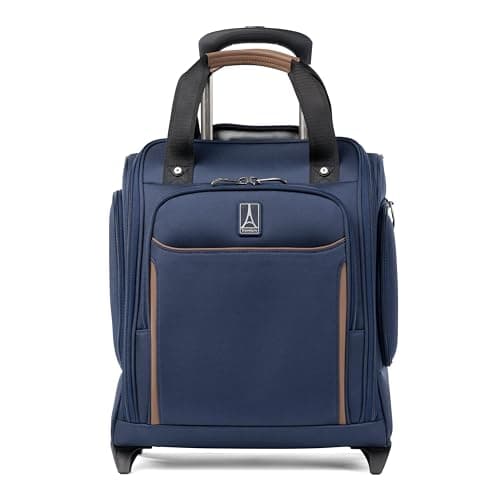
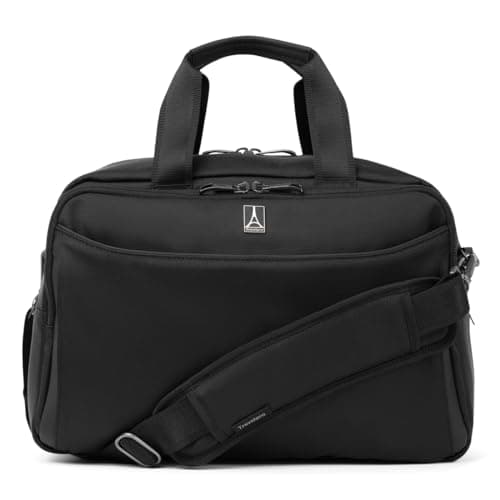
A soft tote is light, sits flat over an extended handle, and goes under the seat. It is carried on a shoulder every time it comes off the rollaboard, which is fine if it holds documents and a device and bad if it holds a laptop, a meal and two liters of water. A wheeled under-seat case never touches your shoulder, which is the whole argument, and costs you about 4 lb of dead weight and a slightly worse stack. Crew who fly short-haul turns with a heavy kit tend to end up on the wheeled case; crew flying long-haul with a hotel bag tend to end up on the tote. Both are on this page for that reason.
One thing to check before you commit to either: your airline's uniform and bag rules. Some carriers specify the color, some prohibit visible branding on the crew side of the cabin, and some issue the bag. This page ranks what you can buy, not what your employer allows.
What we did not rank, and why
The two lines built explicitly for crew — FlightCrew 5 and Travelpro Pilot — are sold through Travelpro's separate aviation channel with the professional collections behind a login, and they are not on Amazon. We will not rank a bag we cannot send you to a live listing for, and we will not quote specifications for a product behind a login we have not read. If you are crew, that channel is where the dedicated lines and the FlightCrew wheel-kit parts live, and it is worth an account.
We also left out the Travelpro Platinum Elite two-wheel despite it being an obvious candidate: the Amazon listing for it returned an empty availability string when we checked stock in this run, and this site does not feature a product it cannot confirm is purchasable. It is examined in our Platinum Elite review if you want the range.
And the obvious omission: hardside cases. Almost no working crew use one, and the reason is the stack. A domed polycarbonate lid will not carry a tote, a fixed shell cannot overstuff into a crew closet, and a scuffed hard shell looks worse than scuffed fabric in a cabin where passengers can see it. If you are crew who checks a bag on a long-haul pattern, our checked luggage page is the right page for that half of the kit.