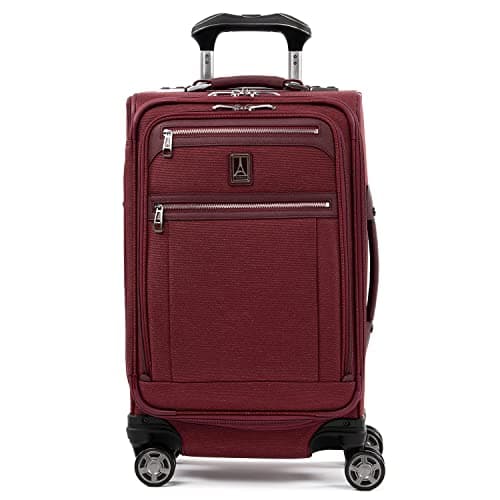
The Travelpro Platinum Elite is the bag that keeps appearing in the hands of people who fly for a living, and that is the most useful single fact about it. Travelpro was founded by a pilot and its bags are built around a specific assumption — that the owner will use the bag several times a week for years, and would rather repair it than replace it. Everything expensive about it follows from that.
Our verdict: worth the premium if you fly at least monthly; overkill if you do not. The build quality is genuinely a tier above mid-range luggage, but the gap only expresses itself over hundreds of trips. Below that frequency the Maxlite 5 — same brand, same warranty, roughly a third of the price — is the more rational buy, and we say so plainly.
To be clear about method: we have not tested this unit. This review compiles Travelpro's published specifications, compares them against the alternatives on the same criteria we use everywhere on this site, and reflects what owners consistently report. Our methodology page explains exactly what that does and does not mean.
What the premium actually buys
Three things, and they are all unglamorous. Ballistic nylon is the fabric difference — a dense, high-tenacity weave originally specified for abrasion resistance, and noticeably more resistant to the scuffing that makes a polyester bag look tired after a year of conveyor belts. Self-aligning wheels are the handling difference: they return to straight rather than wandering, which sounds trivial until you are moving quickly through a terminal with a heavy bag. The contour grip handle is the daily difference — a shaped grip with minimal wobble, where cheaper telescoping handles rattle.
Behind all three sits the limited lifetime warranty, which for Travelpro includes coverage for damage caused by airlines on many claims — an unusual provision, since most warranties explicitly exclude airline damage. That is the clause worth reading before you buy, because it is the one that differentiates this from a generic lifetime promise.
Where it falls short
It is not light. At the softside end of the market, weight is the Maxlite 5's advantage, not this bag's, and if you regularly fly carriers with a 7 kg cabin allowance the Platinum Elite's extra construction works against you — see our international carry-on size guide for why that matters more than most buyers expect.
It is also, plainly, expensive. At several times the price of a competent budget bag, it demands a usage pattern to justify it. And as a softside case it offers less crush protection than a polycarbonate shell, so if you carry camera equipment or anything fragile, a hardside carry-on is the better tool regardless of budget.
The cost-per-trip case
This is the honest way to evaluate it. Divide price by realistic trips before failure. A budget case at $50 that dies after eight trips costs over $6 a trip. The Platinum Elite, if it lasts the hundreds of trips its warranty implies, lands well under $2 — and the warranty means the wheels and handle, the parts that actually fail, are Travelpro's problem rather than yours.
Flip that around and the limitation is obvious. Two trips a year for five years is ten trips; at that rate you will replace the bag out of boredom before you wear it out, and almost any competent bag serves. This is why our budget carry-on picks exist and why we do not pretend everyone should buy premium.
The details that decide whether you still like it in year three
Luggage reviews tend to focus on the spec sheet, but what actually determines whether a bag stays in service is a short list of small things. The handle wobbleis first: a telescoping handle with loose tolerances rattles on every hard floor and gets worse as the tube wears. The Platinum Elite's handle is noticeably more solid than mid-range bags, and that is a direct consequence of the price.
The wheel bearings are second. Sealed bearings keep grit out and stay quiet; cheaper bushings get progressively louder over a year until the bag announces you down a quiet corridor. Third is the external pocket geometry — whether you can actually get a laptop out one-handed at a gate, or whether you have to lay the bag flat and wrestle it. Fourth is the zipper pull hardware, which on cheap bags is where the plating wears off first and where a split eventually starts.
None of these appear in a comparison table, and all four are the difference between a bag you replace at year three and one you keep for a decade. They are also the specific things the warranty covers, which is why a long warranty is really a statement about the parts a maker expects to survive.
Using the warranty in practice
Two practical notes, because a warranty you cannot use is decoration. First, register the bag and keep the proof of purchase — most claims stall on documentation rather than eligibility. Second, understand the split between warranty damage and transit damage. A wheel that fails from normal use is a warranty matter; a wheel a baggage handler sheared off is a claim against the airline, usually within a short window after arrival, as covered in our wheel replacement guide. Travelpro is unusual in covering some airline-inflicted damage, but the airline claim is still normally the faster route when the damage happened in transit.
Alternatives worth considering
- Travelpro Maxlite 5 — same brand and warranty, much lighter, roughly a third of the price. The default recommendation for most people.
- Samsonite Winfield 3 DLX — polycarbonate shell if you need crush protection rather than abrasion resistance.
- LEVEL8 Grace — if a front laptop compartment matters more than fabric grade.
- Samsonite Freeform — the light hardside alternative if the weight of a molded shell is what has put you off one before.