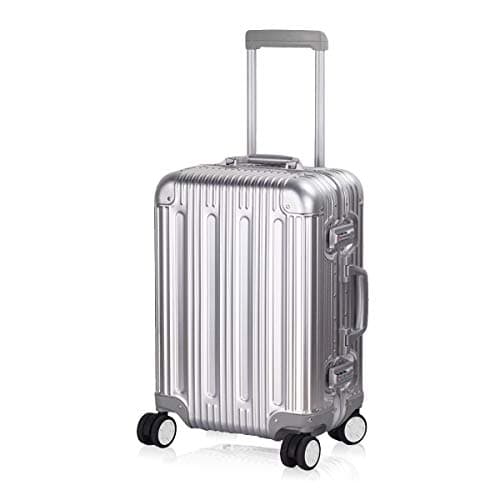
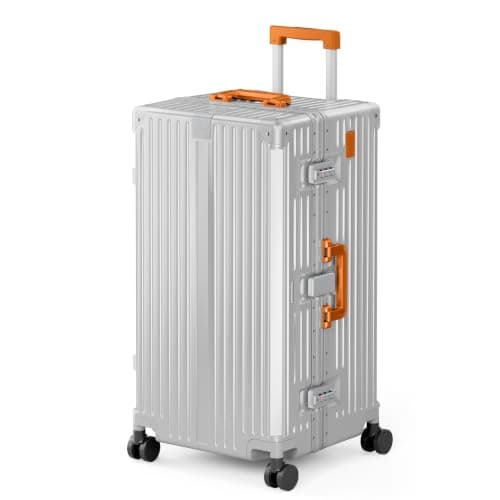
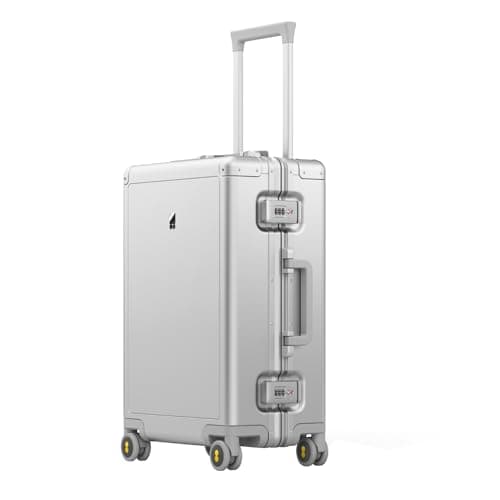
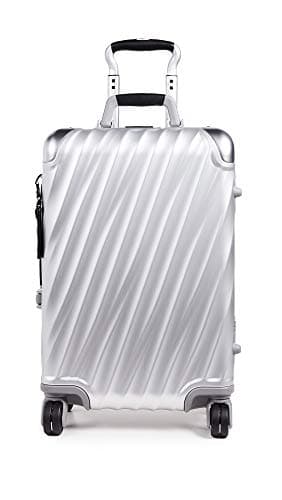
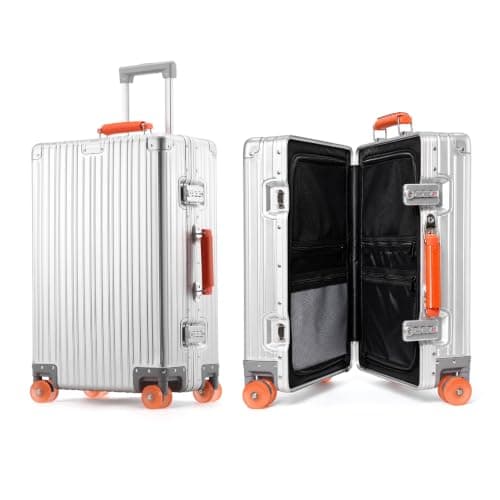
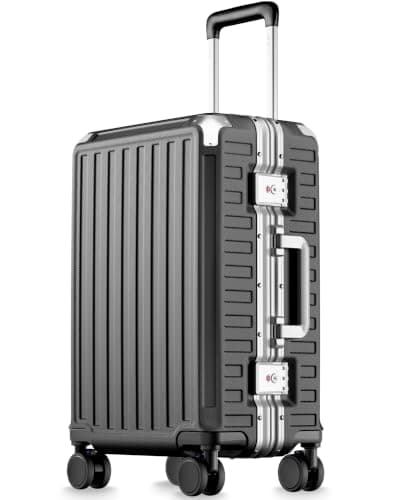
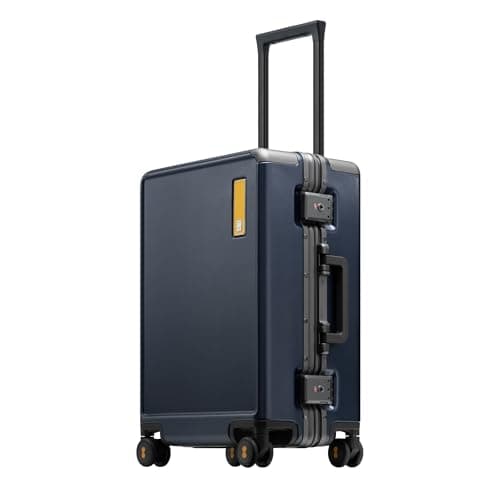
The best zipperless luggage for most people is the LEVEL8 Zipperless Carry-On with Aluminum Frame, because it gives you the thing the format is actually for — a rigid metal perimeter closed by latches, with a TSA lock in the frame — without charging you for an all-metal shell you may not want. The budget pick is the LUGGEX Zipperless Carry-On with Aluminum Frame, the cheapest frame-latch case in our registry and the same structural argument with rougher hardware.
Start with what “zipperless” means, because the word is doing more work than it looks. A conventional suitcase closes with a zipper chain: two rows of teeth, a slider, and a seam that runs the whole way around the case. A zipperless case closes on a rigid frame — usually aluminum — held shut by two or three latches. Nothing about that requires the shell to be metal. Several of the best cases in this format are polycarbonate panels inside an aluminum perimeter, and they behave differently from an all-metal case in ways that matter.
That distinction is why this page exists next to our metal page. Best aluminum luggage ranks the material: it would include a zippered aluminum case and exclude a polycarbonate one. This page ranks the closure: it includes frame-latch cases whatever their panels are made of, and it would exclude an aluminum case that closed on a zipper. If you want the format explained rather than ranked, our zipperless luggage guide walks through how a frame-latch closure works before you spend anything.
What we ranked on
Four things, in this order, and none of them is the finish.
One — latch count and latch coverage. A zipper seam is continuously held along its whole length. A frame seam is held only where the latches are, and the sections between them rely on the stiffness of the frame itself. Two well-placed latches on a cabin-size case is normal and adequate; on a 28-inch case the span between latch points is much longer, which is why frame construction matters more as the case gets bigger.
Two — how many latch points actually lock. This is the specification buyers miss. A frame case opens along its entire perimeter, so a single central TSA lock can leave one end of that perimeter held by nothing but its catch. Cases with dual TSA locks — one at each latch — are genuinely more secure than cases with one, and the difference is largest on a bag you check.
Three — how far the metal goes. An aluminum frame stiffens the mouth of the case and carries the latches; aluminum panels make the whole box rigid. Panels give you a case that will not flex at all and that records every impact permanently. A frame around a polycarbonate shell gives you the closure and a shell that flexes under load and springs back. Neither is more durable in the abstract — they fail differently, which our polycarbonate vs ABS vs aluminum guide sets out in full.
Four — cabin footprint, scored harshly. A soft-sided or zippered hardside case has give: a gate agent's sizer will take a bag that is a little over because the case compresses. A frame case has no give at all. Every published inch is an inch you must actually have. That is why the cases ranked highest here are built on 20-inch bodies rather than 22-inch ones — a 20-inch body plus wheels and handle lands at or under the US 22 × 14 × 9 in convention instead of over it. Measure any of these the way a gate agent does, over the wheels and over the handle: the method is in how to measure luggage.
What the format costs you
Three things, all real. Weight:a frame plus latches is heavier than a zipper, and aluminum panels are heavier again. On a carrier capping cabin baggage at 7 kg including the bag, a metal case spends a serious share of the allowance on itself — the caps are in international carry-on size. No expansion: an expandable zipper adds a couple of inches of depth for the return leg, and a frame case cannot do that at all. And no give at the gate, as above. If any of those three decides your purchase, buy a zippered case and do it without regret — best expandable carry-on and best lightweight luggage are the honest alternatives.
Every product here is one the site has already researched on its own roundup — the scores are the scores it earned there, and the verdicts are rewritten for this ranking. Every dimension, material and closure detail quoted is the maker's own published figure, and where a listing publishes no overall dimension we say so rather than estimate one. We have not lab-tested these cases. See how we test.
The short answer
Quick picks
| # | Product | Best for | Score | Price |
|---|
| 01 | LEVEL8 Zipperless Carry-On with Aluminum FrameThe best-judged case in the format and the one most people should buy. An aluminum perimeter frame with a latch closure and a TSA lock built into the frame, wrapped around a lighter composite shell rather than metal panels - so you get the closure, the rigid mouth and the lock without the weight penalty or the permanent denting of an all-metal case. Quiet double spinner wheels, which is LEVEL8's consistent strength. | Best zipperless luggage overall | | $191.99·Amazon |
| 02 | TRAVELKING All-Aluminum Carry-On with TSA LocksThe pick if you want genuine aluminum panels rather than a metal rim, and the best-secured case on this page regardless of price: it carries DUAL TSA locks, one at each latch, rather than a single central lock. On a case whose seam opens along its whole perimeter, that is the difference between a closure that is properly locked and one that is mostly locked. Real aluminum, real latches, a fraction of the luxury-brand money. | Best all-metal case, and the best locks here | | $229.99·Amazon |
| 03 | ALPHA CAMP 28-Inch Aluminum-Frame Zipperless Trunk CaseThe checked-size answer, and the place where this whole format makes the most sense. A 28-inch aluminum-frame trunk case on latches rather than a zipper, opening evenly down the middle instead of into a lid and a base. The bag that leaves your sight for hours in a baggage system is the bag whose closure you should care about most, and a 28-inch zipper is a long, lightly supervised seam. | Best zipperless checked case | | $199.99·Amazon |
| 04 | LEVEL8 Gibraltar Aluminum Zipperless Carry-On, 20-InchThe best-made case here and the one that copies the format's premium reference most closely: an aluminum-magnesium shell, a zipperless latch closure and a TSA lock in the frame, on eight spinner wheels rather than four. On a case that is heavy before you pack it, more casters means less load on each one, which is the detail that separates this from the cheaper metal cases above. | Best-built zipperless case | | $367.99·Amazon |
| 05 | TUMI 19 Degree Aluminum International Carry-OnThe premium end of the format, and the one case on this page whose maker publishes a full overall dimension that fits the US cabin template: TUMI publishes the 19 Degree Aluminum International Carry-On at 20.5 x 13.5 x 9 in, with reinforced corners and a TSA-approved lock. On a format with no give at a sizer, a published and compliant number is worth more than it sounds. | The luxury tier, and the only one that publishes a compliant size | | $1,295.00·Amazon |
| 06 | LUGMST 20-Inch All-Aluminum Zipperless Carry-OnThe cheapest route in our registry to genuine aluminum panels and a latch closure rather than a zipper, on a 20-inch body - which is the size class with real margin at a cabin sizer rather than a case that sits exactly at the limit. You are buying the construction and nothing else, and at this price that is a rational thing to buy. | Cheapest true all-aluminum latch case | | $139.90·Amazon |
| 07 | LUGGEX Zipperless Carry-On with Aluminum Frame, 20-InchThe budget pick, and the cheapest frame-latch case in our registry. Aluminum perimeter, latch closure, polycarbonate shell, standard 20-inch carry-on body - the same structural argument as our number one for meaningfully less, with a stiffer latch action and weaker wheels. A lot of case for the money. | Budget pick - cheapest zipperless case here | | $99.27·Amazon |
#ad · Live prices from the Amazon Product API, as of November 21, 2026. Where we have no verified live price, we show none — a gap beats a number that has rotted.
In detail
The picks, in full
Best zipperless luggage overall
LEVEL8 Zipperless Carry-On with Aluminum Frame
Aluminum frameZipperless latch closureTSA lockDouble spinners
The best-judged case in the format and the one most people should buy. An aluminum perimeter frame with a latch closure and a TSA lock built into the frame, wrapped around a lighter composite shell rather than metal panels - so you get the closure, the rigid mouth and the lock without the weight penalty or the permanent denting of an all-metal case. Quiet double spinner wheels, which is LEVEL8's consistent strength.
- Build
- 8
- Security
- 9
- Weight
- 8
- Wheels
- 9
- Value
- 8
Pros
- +Latch closure removes the pen-bypass vulnerability every zipper has
- +Much lighter than an all-aluminum case of the same size
- +Quiet double spinner wheels — LEVEL8's consistent strength
- +Costs well under the all-metal cases without giving up the closure
Cons
- −The shell is composite, not metal — it will not look like a Rimowa in ten years
- −LEVEL8's service history is far shorter than the legacy brands
Don't buy this if…
…you want the brushed-metal object - this reads as a polycarbonate case with an aluminum rim, because that is exactly what it is, and the three all-metal cases below are the ones to buy if the look is the point.
This is the pick for the reader who worked out that the latch mattered to them more than the metal did, and that is most readers. The closure is the part of the format that does the work: it cannot be split with a ballpoint pen and re-closed without a trace the way a zipper chain can, and it cannot fail at a slider, which is the single most common way a suitcase dies. The frame carries the latches and stiffens the mouth of the case so the two halves meet squarely even when the bag is packed hard.
What the composite shell buys you is recovery. A polycarbonate panel flexes under impact and springs back; an aluminum panel deforms and keeps the new shape. If you want a case that still looks new in year three, this is the construction that delivers it, and it is lighter for the same external size — which matters most on the weight-capped international cabin allowances covered in international carry-on size.
One honest limitation shared with every case on this page: there is no expansion. A frame does not stretch. If you habitually come home with more than you left with, read best expandable carry-on before you commit to this format at all.
Best all-metal case, and the best locks here
TRAVELKING All-Aluminum Carry-On with TSA Locks
Aluminum panelsLatch closureDual TSA locksSpinner wheels
The pick if you want genuine aluminum panels rather than a metal rim, and the best-secured case on this page regardless of price: it carries DUAL TSA locks, one at each latch, rather than a single central lock. On a case whose seam opens along its whole perimeter, that is the difference between a closure that is properly locked and one that is mostly locked. Real aluminum, real latches, a fraction of the luxury-brand money.
- Build
- 8
- Security
- 9
- Weight
- 5
- Wheels
- 7
- Value
- 8
Pros
- +Actual aluminum construction, not a metallic finish on plastic
- +Twin latch closure with TSA-recognized locks — no zipper to bypass
- +Develops the scuffed patina aluminum owners actually want
- +A fraction of the price of the luxury aluminum brands
Cons
- −Heavy — the weight penalty is real on any carrier that weighs cabin bags
- −Dents permanently where a polycarbonate shell would spring back
- −Small brand with limited spare-parts availability
Don't buy this if…
…you need the hardware to feel expensive - this is a specification purchase rather than a finish purchase, and the difference shows in the latch action and the handle rather than in the metal itself.
Two locks instead of one is not a marketing count, and it is the reason this case outranks more expensive metal cases on our second criterion. A frame-and-latch case is held shut at its latch points. Lock one of them and the other is still only latched. Dual TSA locks secure both ends of the perimeter, which matters most on a bag that spends time out of your sight in a baggage system.
The panels are aluminum rather than a metallic finish on plastic, and that is worth being clear about because the cheap end of this category is full of the latter. What you get is a box that does not flex at all, so the contents are not squeezed when the case is loaded under other bags, and a surface that collects dents permanently. Owners who like these cases call that patina. It is a fair description, and it starts on the first flight.
It is heavy, like every all-metal case. If you fly carriers that weigh cabin baggage, do the arithmetic before you buy any case on this page — and if the number does not work, the aluminum-frame cases above and below give you the same closure for less mass. The metal field ranked on its own merits is in best aluminum luggage.
Best zipperless checked case
ALPHA CAMP 28-Inch Aluminum-Frame Zipperless Trunk Case
28-inch checkedAluminum frameLatch closureSpinner wheels
The checked-size answer, and the place where this whole format makes the most sense. A 28-inch aluminum-frame trunk case on latches rather than a zipper, opening evenly down the middle instead of into a lid and a base. The bag that leaves your sight for hours in a baggage system is the bag whose closure you should care about most, and a 28-inch zipper is a long, lightly supervised seam.
- Build
- 7
- Security
- 9
- Weight
- 4
- Wheels
- 7
- Value
- 8
Pros
- +Latch closure on the bag that actually leaves your sight — the strongest use case for zipperless
- +Trunk-style opening splits the case evenly rather than into a lid and a base
- +Aluminum frame stiffens the seam, which is where large cases fail
Cons
- −Heavy before you pack it — a real problem against the 50 lb checked limit
- −28 inches invites overpacking and overweight fees
- −Little brand history behind the warranty
Don't buy this if…
…you fly with weight limits in mind - a 28-inch frame case is heavy before you pack it, and on a 50 lb or 23 kg checked allowance the case itself takes a meaningful share of the number.
Scale changes the engineering here. On a cabin case, two latches and a stiff frame span a short perimeter. On a 28-inch case the distance between latch points is much greater, which is why the aluminum frame stops being a styling decision and becomes the structural one: it keeps the seam aligned across a span where a zippered shell relies on the zipper tape to hold the two halves in register.
The trunk-style opening is the other reason to prefer this over a large zippered case. It splits the volume into two equal halves rather than a deep base and a shallow lid, which is a genuinely better way to pack a case this size — and it means you are not excavating a four-foot-deep well to find one thing.
Do the allowance arithmetic first. At 28 inches you are close to the 62-linear-inch oversize threshold every major US carrier publishes, and a frame case is heavy empty, so the practical payload is lower than the volume suggests. The limits are in checked bag size and weight limits, and the large-case field in best 28-inch luggage.
Best-built zipperless case
LEVEL8 Gibraltar Aluminum Zipperless Carry-On, 20-Inch
Aluminum-magnesium shellZipperless latch closureTSA lock8 spinner wheels
The best-made case here and the one that copies the format's premium reference most closely: an aluminum-magnesium shell, a zipperless latch closure and a TSA lock in the frame, on eight spinner wheels rather than four. On a case that is heavy before you pack it, more casters means less load on each one, which is the detail that separates this from the cheaper metal cases above.
- Guarantee
- 7
- Materials
- 9
- Hardware
- 9
- Capacity
- 7
- Value
- 9
Pros
- +Real metal shell, not a polycarbonate case with aluminum trim
- +Zipperless latch closure has no zipper teeth to burst or be pen-picked
- +Costs a fraction of the aluminum cases it is styled after
- +The finish patinas into something that looks better used than new
Cons
- −Heavy - metal costs you packing weight before you put anything in it
- −Dents permanently, from the first flight, and cannot be popped back out
Don't buy this if…
…you need the case to be light or to stay unmarked - an aluminum shell is the heaviest way to buy a carry-on and it will dent on its first trip, which is equally true of the metal cases costing several times more.
Aluminum-magnesium is the right alloy choice for luggage and worth understanding: magnesium stiffens the panel without adding mass, which is how a metal case stays anywhere near a usable weight. The result is a shell with no flex at all and a surface that records every impact permanently — the trade metal buyers are knowingly making.
Eight wheels is the specification we would actually pay the premium for. Wheels are the most common hardware failure on any suitcase, and a metal case arrives at the airport heavier than a polycarbonate one of the same size. Spreading that mass across eight contact points rather than four reduces the load each caster carries over a jet bridge and a parking garage. If you are cross-shopping this against the brand it most clearly answers, our RIMOWA alternatives page puts it against RIMOWA's own published Original Cabin figures.
$367.99·View on Amazon$459.9920% off
Price as of November 21, 2026. Prices change — Amazon's at checkout is the one that counts.
#ad · we may earn a commission from this link to LEVEL8 Gibraltar Aluminum Zipperless Carry-On, 20-Inch
The luxury tier, and the only one that publishes a compliant size
TUMI 19 Degree Aluminum International Carry-On
Aluminum shell20.5 x 13.5 x 9 inTSA-approved lockReinforced corners
The premium end of the format, and the one case on this page whose maker publishes a full overall dimension that fits the US cabin template: TUMI publishes the 19 Degree Aluminum International Carry-On at 20.5 x 13.5 x 9 in, with reinforced corners and a TSA-approved lock. On a format with no give at a sizer, a published and compliant number is worth more than it sounds.
- Materials
- 9
- Hardware
- 8
- Organization
- 6
- Airline fit
- 8
- Value
- 6
Pros
- +Aluminum is the stiffest shell format sold, and a latch closure cannot be burst open like a zipper
- +At 20.5 in high it is sized for international allowances, unlike the domestic-sized TUMIs above
- +Reinforced plastic corners protect the format's most vulnerable point
- +Lined interior with adjustable clothing straps and an ID tag included
- +Ages into a patina that many owners consider the point of the bag
Cons
- −Aluminum dents permanently on the first rough handling and does not spring back
- −Heavy - TUMI's bullet gives 135 oz (3.83 kg) while the technical details list 11 lb; we cannot reconcile the two
- −A latched aluminum case has no expansion, so the return leg has to fit in what you left
- −Scratches are permanent and visible, which not every owner enjoys
- −By a distance the worst value on this page in pure carrying terms
Don't buy this if…
…price is the reason you are shopping zipperless - the four cases above deliver the same closure for a fraction, and the format's benefits do not scale with the money.
The published-size point is the strongest thing about this pick. Most of the metal end of this category does not publish an overall dimension at all, which is the standing problem with cases that cannot be squashed into a sizer: the makers least likely to tell you the real number are the ones whose cases depend on it. TUMI publishes 20.5 × 13.5 × 9 in — inside the 22 × 14 × 9 in US convention on all three axes.
Reinforced corners are the specification that matters most on a rigid case, because corners are where a dropped bag lands and where a panel deforms first. Read the warranty before you commit, though, and read it against the price: TUMI publishes a Five-Year Limited Warranty on its wheeled luggage, not a lifetime one. We set the premium warranty landscape out in luggage warranties explained, and the brand range in best TUMI luggage.
Cheapest true all-aluminum latch case
LUGMST 20-Inch All-Aluminum Zipperless Carry-On
Aluminum panels20-inch bodyZipperless latchesSpinner wheels
The cheapest route in our registry to genuine aluminum panels and a latch closure rather than a zipper, on a 20-inch body - which is the size class with real margin at a cabin sizer rather than a case that sits exactly at the limit. You are buying the construction and nothing else, and at this price that is a rational thing to buy.
- Build
- 7
- Security
- 9
- Weight
- 5
- Wheels
- 6
- Value
- 9
Pros
- +Lowest entry price for genuine metal panels and a latch closure
- +Standard 20-inch carry-on body rather than an oversized one
- +Zipperless closure removes the single biggest luggage security weakness
Cons
- −No service network or spare parts to speak of
- −Heavy, like every aluminum case
- −Latch and corner tolerances are looser than the premium metal brands
Don't buy this if…
…you expect a service relationship - there is no published warranty term and no spare-parts route here, so treat it as a specification purchase to be replaced rather than repaired.
A 20-inch metal body is the right size for this format and the reason we rank it above a cheaper 22-inch case would be ranked. Aluminum cannot be compressed into a sizer, so every published inch of width and height is an inch you have to actually have. A 20-inch body plus wheels and handle lands at or under the US convention; a 22-inch metal body does not, and the bags that get turned away at a gate are the ones with no give.
Be clear about what the price does not include. Latch and corner tolerances are looser than the premium metal cases above, and there is no repair network behind it. For a case whose main failure mode is cosmetic denting that matters less than it would on a zippered bag with a slider to fail — but if a decade of service is the point, the honest answer is to buy a brand with a documented repair route, which is the argument in Briggs & Riley alternatives.
Budget pick - cheapest zipperless case here
LUGGEX Zipperless Carry-On with Aluminum Frame, 20-Inch
Aluminum framePolycarbonate shellLatch closure20-inch body
The budget pick, and the cheapest frame-latch case in our registry. Aluminum perimeter, latch closure, polycarbonate shell, standard 20-inch carry-on body - the same structural argument as our number one for meaningfully less, with a stiffer latch action and weaker wheels. A lot of case for the money.
- Build
- 7
- Security
- 9
- Weight
- 8
- Wheels
- 6
- Value
- 9
Pros
- +Zipperless latch closure at the lowest price we would still recommend
- +Polycarbonate shell rather than a cheaper ABS blend
- +Light for a frame case — the aluminum is only the perimeter
- +Standard 20-inch carry-on dimensions
Cons
- −Latch action is stiffer and less refined than the pricier frame cases
- −Wheels are the weak point, as usual in this price band
- −Brand has essentially no service infrastructure
Don't buy this if…
…you open and close the case constantly - a stiff latch is a daily annoyance a zipper never is, and this is where the price shows.
The reason this is a genuine recommendation rather than a cheap filler pick is the shell spec: polycarbonate rather than a cheaper ABS blend, inside a metal perimeter that carries the latches. That is the same construction as our number one, and it is light for a frame case because the aluminum is only the rim.
Where the money shows is the hardware. The latch action is stiffer and less refined than the pricier frame cases, the wheels are the weak point as usual in this band, and the brand has essentially no service infrastructure. If the budget is the binding constraint and the closure is not actually the point, a well-made zippered case at the same money is a better bag — see best luggage under $100 and best budget carry-on.
$99.27·View on Amazon$139.9929% off
Price as of November 21, 2026. Prices change — Amazon's at checkout is the one that counts.
#ad · we may earn a commission from this link to LUGGEX Zipperless Carry-On with Aluminum Frame, 20-Inch
The closure, case by case
Every row is that maker's own published specification. Where a listing publishes no overall dimension, the row says so rather than estimating one. Live prices and a per-row buy button are in the quick picks above.
| Case | Metal coverage | Closure | Locks | Published size |
|---|
| LEVEL8 aluminum-frame carry-on | Frame only; polycarbonate panels | Zipperless latches | TSA lock | Not published for this listing |
| TRAVELKING all-aluminum carry-on | Aluminum panels | Twin latches | Dual TSA locks | Not published for this listing |
| ALPHA CAMP 28-inch trunk case | Aluminum frame | Latches, trunk opening | Not published for this listing | 28-inch checked; overall not published |
| LEVEL8 Gibraltar carry-on | Aluminum-magnesium panels | Zipperless latches | TSA lock | 20-inch body; overall not published |
| TUMI 19 Degree Aluminum International | Aluminum | Latches | TSA-approved lock | 20.5 x 13.5 x 9 in |
| LUGMST 20-inch all-aluminum | Aluminum panels | Zipperless latches | Not published for this listing | 20-inch body; overall not published |
| LUGGEX zipperless carry-on | Frame only; polycarbonate shell | Latch closure | Not published for this listing | 20-inch body; overall not published |
One row in seven publishes a full overall dimension. That is the honest state of this category, and it is the single best reason to buy a 20-inch body rather than a 22-inch one in this format: a rigid case cannot be persuaded into a sizer, so the margin has to be designed in rather than argued at the gate.
What a latch closure actually removes
Two failure modes, both of them real and both of them things a zipper cannot be fixed out of. The first is covert entry. A closed zipper chain can be split with the point of a ballpoint pen, the contents removed, and the chain re-closed by running the sliders back over it — leaving a bag that looks untouched. There is no equivalent attack on a latched frame: it opens, or it does not. The second is mechanical failure. Sliders wear, teeth distort when a bag is overpacked, and a zipper that has blown open in a baggage system cannot be closed again at the carousel. Latches either hold or break, and when they break they break visibly.
Keep the security benefit in proportion, though. A latch closure defeats the opportunist with a pen; it does not defeat a determined attacker with time, and no suitcase does. If theft is your actual concern, the closure is one layer and your packing choices are another — how to prevent luggage theft and best luggage locks cover the rest, and TSA-approved luggage locks explains which locks a screener can open without cutting.
Frame or panels: decide this before you shop
Buy an aluminum frame with a polycarbonate shell if what you want is the closure. You get the rigid mouth, the latches and the lock, on a shell that flexes under impact and recovers, at a lower weight and a lower price. This is the right answer for most buyers and it is why our top pick and our budget pick are both built this way.
Buy aluminum panels if you want the object: a box that will not flex at all, that will still be structurally sound in fifteen years, and that will look used after the first trip. It is heavier, it holds less for the same external size because the frame and the rigid corners consume interior space, and it costs more. None of that is a defect — it is what the material charges.
Buy neither if you fly weight-capped cabin allowances, need expansion, or routinely rely on a soft case squeezing into a sizer. We would rather tell you that here than sell you a format that fights your flying. Start instead with best polycarbonate luggage or best hardside carry-on.
Zipperless luggage sets, and why we do not rank one
“Zipperless luggage sets” is one of the suggestions Google offers against this query, so it is worth answering directly: our registry does not hold a frame-latch set we would rank, and we are not going to invent one. The format is concentrated in cabin cases and single large trunk cases, which is where the engineering argument is strongest. If you want matched pieces, the honest route is a well-made zippered set — best hardside luggage sets and best luggage sets rank those — and to buy one frame case for the trips where the closure matters.
Living with latches
Two practical notes from the format rather than from any one case. Latches need both hands and a flat surface in a way a zipper does not, so packing on a hotel bed is slower and packing on a cramped floor is genuinely awkward. And a frame case has one failure mode a zippered case does not: if a latch breaks, the case is open and there is no workaround. A cross strap is the sensible insurance on a checked frame case — see best luggage straps.
How we picked
We did not lab-test these bags
Everyone in this category says they tested twenty suitcases. We have not lab-tested any of these, and we say so. What we did instead: compiled each bag's published specifications, checked its dimensions against the airline sizers, ran the cost-per-trip and weight-to-capacity math, read the aggregated owner reviews, and scored every pick against a published rubric. The scores are judgments from documented research — not measurements we took, because we do not have a lab and we will not pretend we do. Where a number came from someone else's work, we name them in Sources.
Questions
Frequently asked
What is the best zipperless luggage?+
The LEVEL8 Zipperless Carry-On with Aluminum Frame, because it delivers what the format is actually for - a rigid aluminum perimeter closed by latches, with a TSA lock in the frame - without charging for metal panels most buyers do not need. For genuine aluminum panels and the best security on this page, the TRAVELKING all-aluminum carry-on, which carries dual TSA locks rather than one. For the cheapest way in, the LUGGEX.
Is zipperless luggage more secure?+
Against one specific and common attack, yes. A closed zipper chain can be split with a ballpoint pen and re-closed with no visible trace; a latched frame cannot be opened that way at all. It is not proof against a determined thief with time, and no suitcase is. The detail that matters most is how many latch points lock: a frame case opens along its whole perimeter, so dual TSA locks are meaningfully better than a single central one.
Does zipperless luggage have to be aluminum?+
No, and this is the most common misunderstanding about the format. What makes a case zipperless is a rigid frame and latches; the panels inside that frame can be polycarbonate. Our top pick and our budget pick are both aluminum-frame cases with polycarbonate shells, which is lighter than all-metal, recovers from impacts instead of denting permanently, and costs less.
What are the downsides of zipperless luggage?+
Three. It is heavier than a zippered case of the same size, which matters on carriers that cap cabin baggage by weight. It cannot expand, because a frame does not stretch. And it has no give at a gate sizer - every published inch is an inch you must actually have, which is why we rank 20-inch bodies above 22-inch ones in this format. Latches are also slower to use than a zipper and need two hands.
Can a zipperless suitcase be a carry-on?+
Yes, and most of this page is carry-on size. Prefer a 20-inch body: a rigid case cannot be compressed into a sizer, so a 20-inch body plus wheels and handle lands at or under the 22 x 14 x 9 in US convention, where a 22-inch metal body does not. Measure over the wheels and over the handle the way a gate agent does, and check the carrier - several European and low-cost airlines gauge depth more tightly than US carriers.
Is a cheap zipperless suitcase worth it?+
For the closure, yes; for a service relationship, no. The latch closure and the rigid frame are most of what makes the format worth owning, and the cheapest cases here deliver both. What they do not deliver is a published warranty term or a spare-parts route, so treat one as a purchase to be replaced rather than repaired. If long-term repairability is the point, buy a brand that publishes a repair route instead.
Receipts
Sources
We do not run a testing lab, and we do not pretend to. Specifications come from the manufacturer's own listing or manual, and size and weight limits from the airline's official baggage-policy page. Where we could not verify something, we say so on the page rather than quietly leaving it out. Read our full method.