Skip to content
Suite & Sand

Head-to-head · Compare

Away vs TUMI: which carry-on is worth it?

TUMI costs three to four times what Away does. On the two makers' own published figures the TUMI flagship carry-on holds six liters less, weighs 1.7 lb more, and carries a warranty term of the same length. Here is what the money actually buys - and what it does not.

By Stephen V.Updated How we test
#ad

We earn a commission when you buy through our Amazon links, at no extra cost to you. It never changes a verdict, and we say so when the cheaper bag is the better buy. How this works.

This is the comparison where the published figures do something unusual: they go the opposite way to the price. Away publishes 41 liters at 7.5 lb empty for The Carry-On. TUMI publishes 35 liters at 9.2 lb empty for the Alpha Large Dual Access Expandable 4-Wheeled Carry-On, its flagship cabin bag. That is six liters less space for 1.7 lb more weight, from the bag that costs three to four times as much. And TUMI's published warranty on wheeled luggage is a Five-Year Limited Warranty, which is the same five-year shape as Away's LifetimeCare complimentary window — so the money does not buy a longer term either.

None of which makes TUMI a bad bag, and this page is not going to pretend it does. It makes TUMI a different kind of bag, and the entire decision turns on whether the thing it is better at is a thing you need. So before the picks, the one sentence version: buy the Away if you want the most packing volume per pound and per dollar; buy the TUMI if you need a bag that opens from the front at a boarding gate and survives two decades of being thrown into vehicles. Everything below is the long version, with every figure attributed.

First, the category mismatch nobody mentions

Away and TUMI are not making the same product, and most "Away vs TUMI" comparisons quietly compare across the line. Away's flagship is a hardside: The Carry-On is 100% polycarbonate, a rigid clamshell that opens flat like a book. TUMI's flagship is a softside: the Alpha line is FXT ballistic nylon over an internal frame, a fabric upright that opens through a lid and a front panel.

That is a material decision before it is a brand decision, and it is the bigger of the two. Our hardside vs softside guide sets out the trade in full, but the short version for this page is: a shell protects contents and wipes clean; a fabric bag absorbs an overstuffed load, takes external pockets, and does not crack. If you already know which of those you want, you may have already chosen your brand and can stop reading.

TUMI does make a hardside — the 19 Degree line, recycled polycarbonate, and it is the bag an Away cross-shopper most wants to see compared. We have deliberately kept it out of the buy rows below, and the reason is stock rather than quality: when we checked every 19 Degree carry-on listing in this pass, two returned an empty availability string, three returned "Only 1 left in stock" and one returned "Temporarily out of stock." This site does not feature a product it cannot confirm is comfortably purchasable. What we can report from the listings we read is the figure that matters most, because it is unusual: the 19 Degree Large Expandable Carry-On publishes 21.8 x 15.8 x 9.0 in — a width 1.8 in over the US 14 in cabin convention, against Away's 14.4 in, which is 0.4 in over. On published geometry the Away is much the closer fit, and a hard shell cannot give that width back at a rigid sizer.

The spec table, published figures only

Published figureAway The Carry-OnTUMI Alpha Large Dual Access
Exterior21.7 x 14.4 x 9 in21.8 x 14.0 x 9.0 in
Expanded depthNot expandable11 in
Empty weight7.5 lb9.2 lb
Capacity41 L35 L
Shell / fabric100% polycarbonateFXT ballistic nylon
Front accessNoYes — dual access front panel
WarrantyLifetimeCare (see below)Five-Year Limited Warranty

Away's figures are its own published specification, recorded in full on our Away The Carry-On review. TUMI's are its published product figures for the Alpha Large Dual Access Expandable 4-Wheeled Carry-On, previously sold as the International Dual Access 4 Wheeled Carry-On; retailer listings for the same SKU range from 9.2 to 9.39 lb and 21.75 to 21.8 in tall, and one authorized retailer publishes 17.8 L against TUMI's 35 L, which is irreconcilable and which we have not tried to average. Both figures in the table are the maker's. We have not weighed or packed either bag — see how we test.

Which Alpha Large Dual Access are you looking at?

Before the analysis, a disambiguation that caught us out and will catch you out, because this bag exists in two widths and the listings do not make that obvious.

TUMI's own product page publishes 21.8 x 14.0 x 9.0 in at 9.2 lb for the Alpha Large Dual Access Expandable 4-Wheeled Carry-On, and that is the version in the table above and the one ranked below. But several retailers list a 16-inch-wide version at about 9.7 lb, and our TUMI range page records a listing describing the bag at 22 x 16 x 9 in — two inches over on width rather than inside the allowance. Both pages are reporting real published figures; they are reporting different variants. Amazon's own technical details compound it: one line on the listing gives 4.4 kg (about 9.7 lb) and another on the same page gives 11.88 lb, which looks like packaging weight rather than the bare bag.

The practical consequence is simple and it is the only thing you need to take from this section. Do not buy an Alpha carry-on on its model name. Open the listing, find the width figure, and if it says 16 in, that is a bag two inches over the US cabin convention in ballistic nylon — which at least gives at a sizer, unlike a shell. If it says 14 in, you have the version compared here.

Capacity: the number that decides it

Six liters is not a rounding error. On a cabin bag, 41 L against 35 L is about 17% more packing volume, which in practice is two to three more outfits or one pair of shoes and a jacket. Our how many outfits fit in a carry-on guide works that arithmetic from case dimensions rather than from a maker's claim, which is the better route when two makers measure differently.

And the exteriors are nearly identical — 21.7 x 14.4 x 9 against 21.8 x 14.0 x 9.0 in. Same box, six fewer liters inside it. Where did the volume go? Into structure and features, and this is the honest answer to why TUMI costs what it does rather than an argument against it. A ballistic nylon upright needs an internal frame the polycarbonate clamshell does not, because the fabric contributes no rigidity of its own. The dual-access design puts a second opening and a padded laptop compartment in the front face, and a padded compartment is volume you cannot pack loosely. There are external pockets, which live inside the same exterior envelope. Every one of those is a real feature. Every one of them costs liters.

TUMI's answer to the volume gap is the published 11 in expanded depth, which is a genuine 2 in of zip expansion. It is also, at 11 in, roughly 2 in outside every cabin depth template in use — the US convention is 9 in and the European gauge most commonly 20 cm. So the expansion is real, it is useful, and it is a hold-bag feature on a cabin bag: fine on the way home when you are checking it anyway, not something you can rely on at a gate. The same caveat applies to every expandable carry-on we rank, which is why our expandable carry-on page states the expanded figure on every pick.

Weight: 1.7 lb, and where it actually hurts

On a US domestic route with no cabin weight limit, 9.2 lb versus 7.5 lb is a thing you feel lifting the bag into a bin and nothing more. On the weight-capped international routes common across Asia-Pacific, the Middle East and much of Europe, it is a budget line.

Against a 7 kg (15.4 lb) cabin cap, an empty Away has consumed 49% of your entitlement and an empty TUMI 60%. That leaves 7.9 lb of packing allowance against 6.2 lb — the TUMI takes 1.7 lb, or about 22%, of what you had left. On a 10 kg cap it is a smaller share and still real. This is the single most practical reason to buy the Away, and it is also why our international carry-on page ranks on empty weight before it ranks on anything else, and why neither of these bags tops it.

Both are heavy bags in absolute terms. The lightweight class starts a long way under 7.5 lb, and if weight is your deciding criterion then the honest answer is that this comparison is the wrong one to be running.

Warranty: the finding that surprised us

The received wisdom is that TUMI money buys a warranty you never think about again. The published terms do not say that.

TUMI publishes a Five-Year Limited Warranty on all wheeled luggage and body-worn bags (and a Two-Year Limited Warranty on select accessories, small leather goods, electronics, eyewear and belts). Within the first year, TUMI covers repair costs for defects in manufacturing, workmanship and wear, pays shipping both ways to its repair facility, and — this part is genuinely good and unusual — covers damage from airline or other transit mishandling. After year one, coverage continues for functional and structural failure, with shipping covered only if the item is in warranty and accompanied by proof of purchase. Aesthetic damage is excluded at all times, including in the first year. Coverage starts at purchase or delivery and requires an authorized TUMI store, dealer or TUMI.com. Registering the TUMI Tracer ID is recommended for authenticity verification, not required for the warranty.

Away publishes LifetimeCare for suitcases bought on or after April 14, 2026: five years of complimentary repairs, up to one replacement inside that window, a service fee from year six onward, in-store repairs and round-trip shipping covered — with bags and accessories on a separate limited one-year warranty, and a paid LifetimeCare Pro upgrade extending the complimentary window to ten years and up to two replacements. The full terms are on our Away review.

Read those side by side and the comparison is closer than the price gap implies. Both are five-year complimentary windows. TUMI will still repair a bag beyond the five years, as a paid service; so will Away, for a service fee from year six. TUMI's first-year airline-damage cover is the better clause, by a distance — airline damage is the most likely thing to happen to a checked bag and almost no warranty covers it. Away's replacement provision is the better clause in years two to five. What neither offers is the unconditional lifetime repair that Briggs & Riley does, and if warranty is your deciding factor then that is the brand to look at rather than either of these. Our luggage warranties explained guide ranks the classes.

Build: what the TUMI money genuinely buys

Having spent four sections on the ways Away wins on paper, here is the part the spec sheet does not capture, stated as the judgment it is rather than as a measurement.

FXT ballistic nylon does not crack. A polycarbonate shell is tough and flexes under impact, but its failure mode is a crack or a split seam and that failure is terminal — you cannot patch a shell. Ballistic nylon's failure mode is abrasion and a worn corner, which is cosmetic for years before it is structural. For a bag that is going in and out of car boots, hotel luggage rooms and overhead bins several hundred times, that difference compounds. It is also why softside luggage survives in the premium market at all when hardshells look better in photographs.

Front access is a real workflow feature. A dual-access panel means the laptop comes out at security and the bag goes into a bin without the case being opened flat on a floor. On a hardside clamshell that operation requires a horizontal surface you do not have at a gate. If you fly for work weekly, this is worth more than six liters — which is precisely the case our business travel carry-on page makes, and why TUMI ranks on it.

And TUMI repairs bags. Its published policy is that products outside warranty may still qualify for repair beyond the first five years of ownership, and if an item cannot be fixed it may be replaced — with a similar style if the original is discontinued, the customer paying any price difference, and any balance returned as a gift card if the new style costs less. That is a specific, documented process rather than a slogan, and the existence of it is a large part of what a twenty-year bag actually is.

Backpacks: the other half of the query

"Away vs TUMI backpack" is one of the most common forms this comparison takes, and the two brands are even further apart there than on luggage. Both sell on Amazon and both listings were live when we checked in this pass: Away's Everywhere Zip Backpack is positioned as an airline-approved personal item that holds up to a 16 in laptop, and TUMI's Alpha Bravo Navigation Backpack is an everyday travel pack fitting up to a 15 in laptop, at roughly three times the Away's price. We have not given either a buy row on this page, because a carry-on comparison that also ranks backpacks ranks neither properly. Both brands are ranked against the rest of the field, with published figures, on our best luxury travel backpack page and best carry-on backpacks.

Buying either one: stock is the real difference

One practical finding from this run that affects which bag you can actually get. Away's Amazon listings were uniformly "In Stock" across every size and finish we read. TUMI's were not. Across the TUMI carry-on listings we checked, several returned "Only 1 left in stock," two returned an empty availability string, one returned "Temporarily out of stock," and the ASIN this site previously used for the Alpha Large Dual Access came back "Currently unavailable" — we replaced it with the Black colorway, which is live, in the same pass.

That is what buying a $900 bag through a marketplace looks like: colorways appear and vanish as individual third-party and first-party listings churn, and the ASIN you bookmarked last month may be dead. It is not a reason to avoid TUMI; it is a reason to buy the colorway that is in stock rather than the one you wanted, or to buy direct. Away, selling a far narrower range at a tenth of the SKU count, simply does not have this problem. Away's Amazon listing titles do round the size figure — The Carry-On is titled a 22-inch case against a published 21.7 in — so buy against the published exterior rather than the inch number in the product name, on either brand.

The verdict

Away The Carry-On for most people cross-shopping these two. It publishes more volume, less weight and a closer fit to the cabin template, in a 100% polycarbonate shell, with a five-year complimentary repair window that matches TUMI's published term — at a fraction of the price. The things you give up are front access, fabric durability and expansion.

TUMI Alpha Large Dual Access if you fly for work most weeks, want a bag that will not crack, and value getting a laptop out at a gate over six liters of packing space. The first-year airline-damage clause is the best warranty sentence either brand publishes, and the out-of-warranty repair path is real. Accept the 9.2 lb.

Neither if your deciding factor is empty weight on a 7 kg route, or an unconditional lifetime guarantee. Both bags lose those arguments to cheaper competitors, and we say so on best lightweight carry-ons and best Briggs & Riley respectively.

Every figure above is a published one, cited in Sources. Where published sources conflict — TUMI's weight across retailers, and one retailer's 17.8 L against TUMI's 35 L — we have said so rather than picking a number. We have not weighed, packed or tested either bag.
The short answer

Quick picks

#ProductBest forScorePrice
01
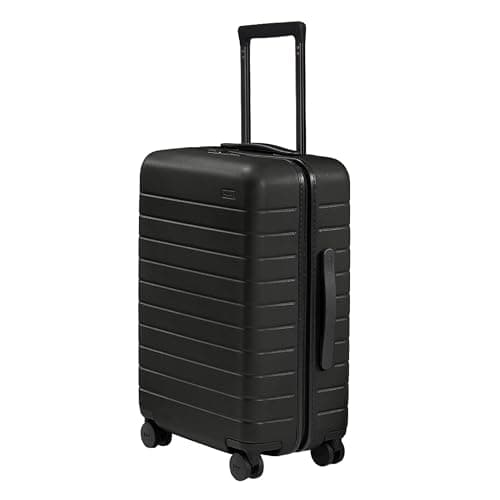
Away Away The Carry-On
Away The Carry-On

The winner on published numbers, and not narrowly. Away publishes 21.7 x 14.4 x 9 in, 7.5 lb empty and 41 L in a 100% polycarbonate shell, with LifetimeCare covering five years of complimentary repairs and up to one replacement in that window. It is six liters larger and 1.7 lb lighter than the TUMI flagship inside a near-identical exterior, at a fraction of the price.

Best for most buyers
8.2
$275.00Amazon
02
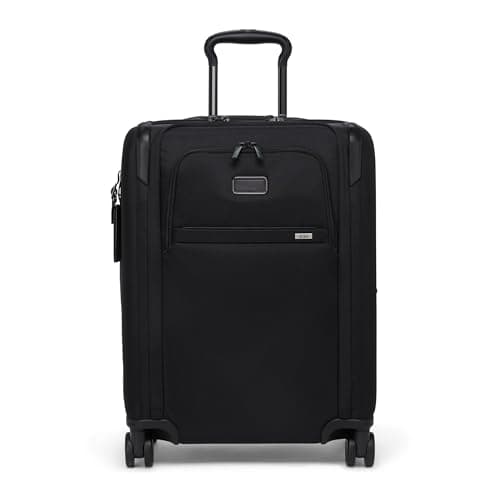
TUMI TUMI Alpha Large Dual Access Expandable 4-Wheeled Carry-On
TUMI Alpha Large Dual Access Expandable 4-Wheeled Carry-On

The TUMI to buy if you want TUMI, and the bag that justifies itself on workflow rather than on specs. TUMI publishes 21.8 x 14.0 x 9.0 in, 9.2 lb empty, 35 L and an 11 in expanded depth, in FXT ballistic nylon with a dual-access front panel, under a Five-Year Limited Warranty whose first year covers airline transit damage and round-trip repair shipping.

Best for weekly business travel
6.6
$995.00Amazon
03
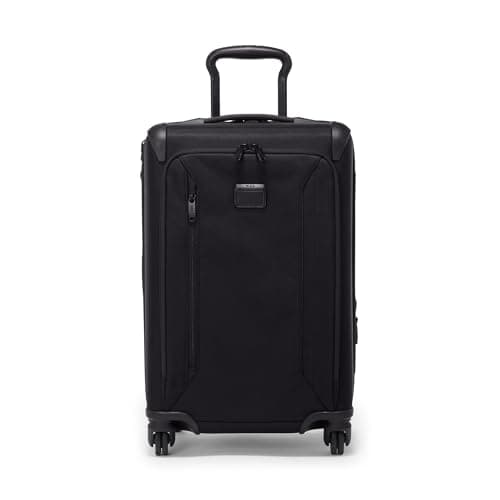
TUMI TUMI Aerotour 4 Wheel Expandable Carry-On, 21.75"
TUMI Aerotour 4 Wheel Expandable Carry-On, 21.75"

The cheapest honest way into TUMI, and the better-value TUMI of the two here. Published figures for the Aerotour International are about 21.8 x 14 x 9 in, 8.6 lb and 35 L in nylon - the same published capacity as the Alpha Large Dual Access for roughly 0.6 lb less weight and substantially less money, under the same Five-Year Limited Warranty.

Best value TUMI
7.2
$595.00Amazon
04
Away Away Bigger Carry-On
Away Bigger Carry-On

The size answer, and the one to buy if the Away wins on volume and you want more of it. Away publishes 22.7 x 15.4 x 9.6 in, 7.9 lb and 49 L - eight liters more than The Carry-On for four tenths of a pound, which is the best volume-per-pound trade either brand offers. It is also over the US cabin template on all three axes, which is the price of those liters.

Best for maximum volume
7.6
$295.00Amazon

#ad · Live prices from the Amazon Product API, as of November 12, 2026. Where we have no verified live price, we show none — a gap beats a number that has rotted.

In detail

The picks, in full

01
Away Away The Carry-On

Best for most buyers

Away The Carry-On

21.7 x 14.4 x 9 in7.5 lb empty41 L published100% polycarbonate
8.2/10

The winner on published numbers, and not narrowly. Away publishes 21.7 x 14.4 x 9 in, 7.5 lb empty and 41 L in a 100% polycarbonate shell, with LifetimeCare covering five years of complimentary repairs and up to one replacement in that window. It is six liters larger and 1.7 lb lighter than the TUMI flagship inside a near-identical exterior, at a fraction of the price.

Capacity
9
Weight
7
Published fit
8
Warranty
8
Value
9

Pros

  • Publishes 41 L against TUMI's 35 L inside a near-identical exterior - about 17% more packing volume
  • Published 7.5 lb empty is 1.7 lb lighter, which is 22% of what is left of a 7 kg cabin allowance
  • Published 14.4 in width is 0.4 in over the US convention against the TUMI 19 Degree Large's 15.8 in
  • LifetimeCare's five-year complimentary window matches TUMI's published five-year limited term
  • Every Away listing we read in this pass returned In Stock, across sizes and finishes

Cons

  • No expansion at all - the TUMI publishes 2 in of zip expansion to an 11 in depth
  • No front access, so the laptop comes out only by opening the case flat
  • Published 14.4 in width is still over the US 14 in convention, and a shell cannot give it back
  • 7.5 lb empty is close to half of a 7 kg international cabin cap - this is not a light bag
  • A polycarbonate shell's failure mode is a crack, which is terminal where abraded nylon is not

Don't buy this if…

…you fly for work most weeks. Front access at a gate and a fabric shell that cannot crack are the two things the TUMI does better, and both matter more on a weekly schedule than six liters does.

Scored identically to the 7.4 our standalone Away review gives it? No — and the gap is deliberate. That review scores The Carry-On against the whole market, where 7.5 lb and a $200-plus price are weak. This page scores it against TUMI, where its weight and its price are both strengths. The axes are different because the question is.

$275.00View on Amazon

Price as of November 12, 2026. Prices change — Amazon's at checkout is the one that counts.

#ad · we may earn a commission from this link to Away The Carry-On

02
TUMI TUMI Alpha Large Dual Access Expandable 4-Wheeled Carry-On

Best for weekly business travel

TUMI Alpha Large Dual Access Expandable 4-Wheeled Carry-On

21.8 x 14.0 x 9.0 in9.2 lb empty35 L publishedFXT ballistic nylon
6.6/10

The TUMI to buy if you want TUMI, and the bag that justifies itself on workflow rather than on specs. TUMI publishes 21.8 x 14.0 x 9.0 in, 9.2 lb empty, 35 L and an 11 in expanded depth, in FXT ballistic nylon with a dual-access front panel, under a Five-Year Limited Warranty whose first year covers airline transit damage and round-trip repair shipping.

Capacity
6
Weight
5
Published fit
9
Warranty
8
Value
5

Pros

  • Dual-access front panel gets a laptop out at a gate without opening the case flat
  • FXT ballistic nylon abrades rather than cracks, and abrasion is cosmetic for years
  • First-year warranty covers damage caused by an airline or other carrier - almost no rival clause does
  • Published 14.0 in width is the only figure here that is inside the US 14 in convention
  • Published 2 in of zip expansion to an 11 in depth, useful on the way home
  • Documented out-of-warranty repair path beyond the five-year term, with a replacement provision

Cons

  • Published 35 L is six liters less than the Away inside a near-identical exterior
  • Published 9.2 lb empty is 60% of a 7 kg cabin cap before you pack anything
  • At 11 in expanded it is roughly 2 in outside every cabin depth template - a hold feature on a cabin bag
  • The Five-Year Limited Warranty is a term, not a lifetime, and aesthetic damage is excluded throughout
  • TUMI's Amazon listings churn hard - the colorway this site used previously is now Currently unavailable
  • Retailer figures for this SKU disagree (9.2 to 9.39 lb, and one publishes 17.8 L against TUMI's 35 L)
  • The line is sold in two widths - a 14 in version (this one) and a 16 in version at ~9.7 lb - and the listings do not flag which is which

Don't buy this if…

…you fly weight-capped international routes. At a published 9.2 lb this bag spends 60% of a 7 kg allowance on itself, and no feature on it buys that back.

A 6.6 on a bag this good needs explaining. Build quality is not one of the five axes on this page, because it is not a published figure and we have not tested either bag — what is scored here is capacity, weight, published fit, warranty terms and price-for-what-you-get. On those five, measured against an Away at a quarter of the money, this is the honest result. On a page ranking premium softside uprights against each other it would score far higher, which is roughly where our TUMI range page puts it.

$995.00View on Amazon

Price as of November 12, 2026. Prices change — Amazon's at checkout is the one that counts.

#ad · we may earn a commission from this link to TUMI Alpha Large Dual Access Expandable 4-Wheeled Carry-On

03
TUMI TUMI Aerotour 4 Wheel Expandable Carry-On, 21.75"

Best value TUMI

TUMI Aerotour 4 Wheel Expandable Carry-On, 21.75"

~21.8 x 14 x 9 in~8.6 lb published35 L publishedNylon, zip expansion
7.2/10

The cheapest honest way into TUMI, and the better-value TUMI of the two here. Published figures for the Aerotour International are about 21.8 x 14 x 9 in, 8.6 lb and 35 L in nylon - the same published capacity as the Alpha Large Dual Access for roughly 0.6 lb less weight and substantially less money, under the same Five-Year Limited Warranty.

Capacity
6
Weight
6
Published fit
9
Warranty
8
Value
7

Pros

  • Published 35 L matches the Alpha Large Dual Access for meaningfully less money
  • Published ~8.6 lb is lighter than the Alpha flagship's 9.2 lb
  • Same Five-Year Limited Warranty on wheeled luggage as every other TUMI here
  • Published ~14 in width is inside the US 14 in cabin convention
  • Was comfortably In Stock when we checked, which several TUMI carry-ons were not

Cons

  • Published weight is not settled - retailers give ~8.6 lb while the Amazon listing shows 11 lb, which looks like packaging data
  • No dual-access front panel, so the main reason to buy an Alpha is absent
  • Still 6 L short of the Away's published 41 L, at several times the price
  • A Continental variant exists at 42 L, 8.9 lb and ~21.8 x 16 x 9 in - 2 in over on width - and the listings mix the two up
  • Nylon rather than ballistic nylon on the sources that name a material, so this is not Alpha fabric

Don't buy this if…

…front access is why you were looking at TUMI. This is the value model and the dual-access panel is exactly what it does without - if you want that feature, the Alpha Large Dual Access is the bag.

$595.00View on Amazon

Price as of November 12, 2026. Prices change — Amazon's at checkout is the one that counts.

#ad · we may earn a commission from this link to TUMI Aerotour 4 Wheel Expandable Carry-On, 21.75"

04
Away Away Bigger Carry-On

Best for maximum volume

Away Bigger Carry-On

22.7 x 15.4 x 9.6 in7.9 lb empty49 L published100% polycarbonate
7.6/10

The size answer, and the one to buy if the Away wins on volume and you want more of it. Away publishes 22.7 x 15.4 x 9.6 in, 7.9 lb and 49 L - eight liters more than The Carry-On for four tenths of a pound, which is the best volume-per-pound trade either brand offers. It is also over the US cabin template on all three axes, which is the price of those liters.

Capacity
10
Weight
7
Published fit
5
Warranty
8
Value
8

Pros

  • Published 49 L is 14 L more than either TUMI here, for 1.3 lb less than the Alpha flagship
  • Eight extra liters over The Carry-On for four tenths of a pound - the best trade on this page
  • Same 100% polycarbonate shell and the same LifetimeCare terms as The Carry-On
  • Was In Stock across several listings when we checked, like every other Away bag

Cons

  • Published 22.7 x 15.4 x 9.6 in is over the US 22 x 14 x 9 in template on all three axes
  • A hard shell cannot be compressed at a sizer, so that overage is not something you can pack around
  • Amazon's titles for this bag are not a size guide - the same model appears as both a 23-inch and a 26-inch listing
  • 7.9 lb empty is over half of a 7 kg international cabin allowance
  • No expansion and no front access, same as the standard Carry-On

Don't buy this if…

…you fly European low-cost carriers or any airline with a rigid gate sizer. At a published 15.4 in wide this is the riskiest bag on the page at a gauge, and the risk is a checked-bag fee at the gate.

$295.00View on Amazon

Price as of November 12, 2026. Prices change — Amazon's at checkout is the one that counts.

#ad · we may earn a commission from this link to Away Bigger Carry-On

How we picked

We did not lab-test these bags

Everyone in this category says they tested twenty suitcases. We have not lab-tested any of these, and we say so. What we did instead: compiled each bag's published specifications, checked its dimensions against the airline sizers, ran the cost-per-trip and weight-to-capacity math, read the aggregated owner reviews, and scored every pick against a published rubric. The scores are judgments from documented research — not measurements we took, because we do not have a lab and we will not pretend we do. Where a number came from someone else's work, we name them in Sources.

Questions

Frequently asked

Is TUMI worth the money compared to Away?
On published specifications, no - TUMI's flagship Alpha Large Dual Access carry-on publishes 35 L at 9.2 lb against Away's 41 L at 7.5 lb, inside a near-identical exterior, and TUMI's wheeled-luggage warranty is a Five-Year Limited Warranty rather than a lifetime one. What the money buys is FXT ballistic nylon that abrades rather than cracks, a dual-access front panel that gets a laptop out at a gate, a first-year warranty clause covering airline-caused damage, and a documented repair path beyond the warranty term. If you fly for work most weeks those are worth more than six liters. If you fly a few times a year they are not.
Which is lighter, Away or TUMI?
Away. Away publishes 7.5 lb empty for The Carry-On and 7.9 lb for the Bigger Carry-On; TUMI publishes 9.2 lb for the Alpha Large Dual Access Expandable 4-Wheeled Carry-On, and retailer listings for the Aerotour give about 8.6 lb. Against a 7 kg (15.4 lb) cabin cap the Away leaves 7.9 lb for your clothes and the TUMI flagship leaves 6.2 lb, so the TUMI costs you roughly 22% of your remaining allowance.
Does Away or TUMI have the better warranty?
They are closer than the price gap suggests, and each wins a different clause. TUMI publishes a Five-Year Limited Warranty on wheeled luggage whose first year covers manufacturing, workmanship and wear defects plus damage from airline or carrier mishandling, with round-trip repair shipping paid; aesthetic damage is excluded throughout. Away publishes LifetimeCare for suitcases bought on or after April 14, 2026: five years of complimentary repairs, up to one replacement inside that window, and a service fee from year six. TUMI's airline-damage clause is the better one. Away's replacement provision is better in years two to five. Neither is the unconditional lifetime repair Briggs & Riley publishes.
Does TUMI make a hardside carry-on like Away's?
Yes - the 19 Degree line, in recycled polycarbonate. We did not give it a buy row here because we could not confirm a comfortably purchasable listing in this pass: two 19 Degree carry-on listings returned an empty availability string, three returned "Only 1 left in stock" and one returned "Temporarily out of stock". The figure worth knowing is that the 19 Degree Large Expandable Carry-On publishes 21.8 x 15.8 x 9.0 in - a width 1.8 in over the US 14 in convention, against Away's 14.4 in. On published geometry the Away is much the closer fit, and neither shell can give that width back at a rigid sizer.
Away vs TUMI backpack - which should I buy?
They are not competing at the same price. Away's Everywhere Zip Backpack is sold as an airline-approved personal item holding up to a 16-inch laptop; TUMI's Alpha Bravo Navigation Backpack is an everyday travel pack fitting up to a 15-inch laptop at roughly three times the price. Both were live on Amazon when we checked. We rank both brands against the rest of the field, with published figures, on our best luxury travel backpack and best carry-on backpack pages rather than here, because a carry-on comparison that also ranks packs ranks neither properly.
Can I buy Away and TUMI on Amazon?
Both, but the experience differs. Every Away listing we read in this pass returned In Stock across sizes and finishes. TUMI's listings churn hard: several carry-ons returned "Only 1 left in stock", two returned an empty availability string, one was temporarily out of stock, and the ASIN this site used previously for the Alpha Large Dual Access now returns "Currently unavailable". Buy the TUMI colorway that is actually in stock rather than the one you wanted, and on either brand buy against the published exterior dimensions rather than the inch figure in the listing title - both brands round it.

Keep reading

Receipts

Sources

We do not run a testing lab, and we do not pretend to. Specifications come from the manufacturer's own listing or manual, and size and weight limits from the airline's official baggage-policy page. Where we could not verify something, we say so on the page rather than quietly leaving it out. Read our full method.