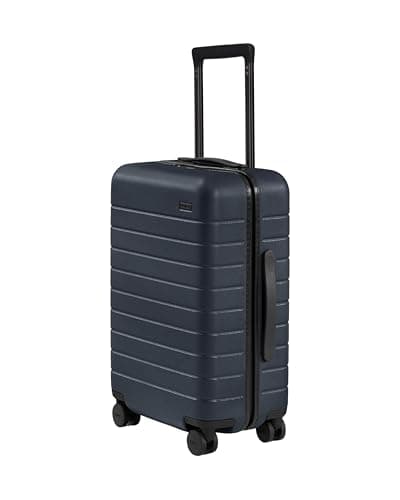
Away sells the carry-on that most people picture when they picture a nice suitcase: a smooth polycarbonate shell, a TSA-approved combination lock, four spinner wheels and a price that asks you to accept the design is worth roughly double what a mainstream hardside costs. Two things changed in 2026 that most reviews of this bag have not caught up with. Away replaced its warranty with a program it calls LifetimeCare, and Away began listing The Carry-On on Amazon after years of selling direct only.
Our verdict: a genuinely well-built bag, and a value calculation that only works if you want this bag specifically. The published numbers are good without being exceptional, the warranty is more honest than most and less open-ended than the word "lifetime" implies, and the shell is matched by cases costing substantially less. None of that makes it a bad purchase. It makes it a design purchase with a solid product underneath — which is a legitimate thing to buy, as long as you know that is what you are buying.
Method note: we have not tested this unit. This review works from Away's own published specifications and warranty terms, checks those dimensions against the airline standards we document elsewhere on this site, and sets the bag against the alternatives on our standard criteria. See how we test for exactly what that means, and what it does not mean.
The published numbers
| Spec | Away The Carry-On |
|---|
| Published exterior | 21.7 x 14.4 x 9 in |
| Published interior | 20.1 x 13.9 x 7.5 in |
| Published empty weight | 7.5 lb |
| Published capacity | 41 L |
| Shell | 100% polycarbonate |
| Wheels | Four 360-degree spinner wheels |
| Handle | Quick-release trolley, two height settings, plus an underside grab handle |
| Lock | TSA-approved combination lock |
| Battery / USB charger | Not included |
| Warranty | LifetimeCare, for suitcases bought on or after April 14, 2026 |
| Returns | 100 days, unused items |
| Sold on Amazon? | Yes — and direct |
Every figure above is Away's own published specification at the time of writing. Away revises specifications, colors and terms without notice, so confirm them on the listing before you buy.
The four tenths of an inch nobody quotes
The US carry-on convention is 22 x 14 x 9 inches including wheels and handles, which is the number our carry-on size guide works from. Away publishes The Carry-On at 21.7 x 14.4 x 9 in. Read that carefully: it is shorter than the standard by three tenths of an inch, exactly at the limit on depth, and wider than the standard by four tenths. Away's own wording is that the bag "meets carry-on requirements for most major airlines" — most, not all, and the qualifier is doing real work.
On US domestic flying this is very close to irrelevant. Gate sizers exist, but a bag that reads as normal luggage almost never meets one, and 0.4 in of width is not what gets a case pulled. On a European low-cost carrier with a drop-in template, or on any airline that gauges rather than eyeballs, the extra width is the dimension most likely to catch — cabin templates are usually tight on depth and width rather than height. Our carry-on size by airline table has the published allowance for each major carrier, and the international carry-on size guide covers the 55 x 40 x 20 cm template that this bag is not built for.
The interior is where the shell shape pays you back. Away publishes 20.1 x 13.9 x 7.5 in inside, which is an unusually square packing box for a case this size — the walls are thin relative to the exterior and there is very little wasted volume around the wheel wells. That is the honest engineering argument for the price, and it is a better one than the marketing usually makes.
What 7.5 pounds actually costs you
This is the number we would push back hardest on. At 7.5 lb empty, The Carry-On is not a light bag by 2026 standards — it is roughly half a pound heavier than the closest premium competitor and meaningfully heavier than the featherweight softside cases we rank in our lightweight carry-on picks.
Domestically that costs you nothing but effort: US carriers rarely weigh cabin bags, so the penalty is the overhead lift rather than an allowance. Internationally it is arithmetic. On a 7 kg (15.4 lb) cabin cap — the norm across much of Asia-Pacific and the Middle East — an empty Carry-On has already consumed close to half your entitlement. That leaves under 8 lb for clothes, shoes, electronics and a toiletry bag, which is not a week's packing. If most of your flying is on weight-capped carriers, this is the wrong shape of purchase at any price, and we would say the same about every premium polycarbonate case in this class.
What LifetimeCare actually promises
Away's current program applies to suitcases purchased on or after April 14, 2026, and replaced the older limited lifetime warranty. Away describes it as repairs for the life of the suitcase, with the detail that matters sitting in the middle of that sentence:
- For the first five years, repairs for functional damage caused by manufacturing defects or unexpected rough travel are complimentary.
- Up to one replacement inside that five-year window if a covered bag cannot be repaired.
- After five years, repairs remain available but carry what Away calls a reasonable service fee.
- In-store repairs and round-trip shipping are covered by Away, and you can claim without registration if you have valid proof of purchase.
- Bags and accessories are not suitcases. Away covers those under a limited one-year warranty instead — worth knowing before you buy a matching weekender.
Away also sells an upgrade it calls LifetimeCare Pro, which extends the complimentary window to ten years and up to two replacements. That is a paid add-on rather than the standard cover, and it is a fair signal of how the base program is meant to be read.
Our honest assessment: this is clearerthan most luggage warranties rather than more generous than them. Almost nobody in this category tells you what happens in year six; Away does, and what it tells you is that year six costs you something. A rival promise described as "lifetime" with no stated fee schedule is either better or vaguer, and the marketing copy will not tell you which. Our luggage warranties guide walks through the wording to look for, and for context, the only mainstream brand we cover whose guarantee explicitly covers airline-inflicted damage is Briggs & Riley.
Buying it on Amazon, or buying it direct
For years the summary of this bag included "you can only buy it from Away." That is no longer true, and it changes the practical calculus in three ways: you can price-compare The Carry-On against every Samsonite and LEVEL8 in the same tab, you return it through Amazon's returns process rather than the brand's, and it ships on Amazon timelines. We will be plain about our own incentive here — the buy button on this page is a tagged Amazon link and we earn a commission if you use it. The direct-from-Away route earns us nothing, and there are real reasons to take it.
Two cautions if you buy on Amazon, and they apply to any premium brand sold there. First, check the ships-from and sold-by fields before ordering rather than buying from an unfamiliar third-party seller. Second — and this one is specific to Away — the Amazon listing titles are not a reliable size guide. The Carry-On is titled as a 22-inch case against Away's published 21.7 in height, and the Bigger Carry-On appears under more than one inch figure across its own listing titles. Buy against the published exterior dimensions in the table above, not against the number in the product name.
The argument for direct is range. Away's own store carries the full color and size lineup; Amazon carries a subset. The 100-day return window on unused items is Away's own policy, so if a specific finish matters to you, direct is still where it lives.
What you actually get inside
Away publishes a double-buckle compression pad, three mesh pockets plus one hanging pocket, and a water-resistant polyester laundry bag with a drawstring closure. That is a better interior than the mainstream hardside default, which is usually a divider and a pair of straps, and the included laundry bag is the kind of small thing you keep using for years.
The compression pad is the feature doing the most work. A hardside case has a fixed volume, so the only way to fit more into it is to compress what is already there — and a buckled pad does that far more evenly than the X-straps most cases ship with. Our carry-on packing guide covers how to get the most out of one.
Two absences are worth naming. There is no battery or USB charger included — Away does not ship one with this suitcase, so if you specifically want a case that charges your phone, see our guide to luggage with USB charging and the airline rules that come with it. And there is no front-access laptop compartment, which is the standard hardside compromise: getting a laptop out at security means opening the whole case flat.
The Carry-On, the Bigger Carry-On, or the Flex?
Away sells three versions of this bag and the differences are real. The Carry-On is the one reviewed here: 21.7 x 14.4 x 9 in, 7.5 lb, 41 L. The Bigger Carry-On is 22.7 x 15.4 x 9.6 in, 7.9 lb and 49 L — eight more liters for four tenths of a pound, which is a good trade on paper and a bad one at a strict gate, because it is over the 22 x 14 x 9 convention on all three dimensions. Away describes it as meeting carry-on requirements for most major US airlines, and that US qualifier is the point: it is a domestic-sized bag.
The Carry-On Flexshares the standard exterior at 21.7 x 14.4 x 9 in and 41 L, adds an expansion zip worth about 2.25 in and 47 L, and weighs 7.9 lb. Away's own caveat is the honest one — depending on the aircraft, you may have to check it when fully expanded. It also costs meaningfully more than the standard case and, at the time of writing, we could not find it stocked on Amazon; it is a direct purchase. If an expansion zip is what you are after, our best expandable carry-on picks cover the field at a range of prices.
Our recommendation across the three: take the standard Carry-On unless you fly US domestic almost exclusively and routinely come home fuller than you left, in which case the Bigger Carry-On is the better bag and you accept that it will not pass a strict international gauge.
Where it sits against the alternatives
Against Monos, the two are close enough on paper that the spec sheet will not decide it — Monos publishes at exactly 22 x 14 x 9 in and half a pound lighter, Away carries about a liter more and is the one you can buy on Amazon. Our Away vs Monos comparison puts every published figure side by side. Against Samsonite, the question is simply whether the design is worth the difference, because the shell material and the wheel count are not meaningfully different; Away vs Samsonite works that through. Against Béis, it is a luggage brand against a lifestyle brand, and the sizing surprise is on the other side — see Away vs Béis.
The broader field is the real test. A LEVEL8 Grace gives you a comparable polycarbonate shell and a similar look for a fraction of the money, and a Samsonite Winfield 3 gives you a 10-year warranty and one of the largest repair networks in luggage. Both are in our best hardside carry-on ranking with live prices. If your decision is being made on cost per trip rather than on how the bag looks in a hotel corridor, one of those is the rational answer and we would rather say so.
Who should buy it
Buy The Carry-On if you want this bag — the finish, the interior, the brand — and the price is money you are comfortable spending on design. It is well built, the interior is better than the mainstream default, the warranty terms are unusually specific, and the Amazon listing removes the old friction of buying and returning direct. Those are real reasons, and wanting a nice object is not a defect in your reasoning.
Buy something else if you fly weight-capped international routes, where 7.5 lb empty is half your allowance; if you regularly meet a European low-cost gauge, where 14.4 in of width is working against you; or if value is the deciding factor, in which case the full carry-on ranking has several cases that do the same job for considerably less.