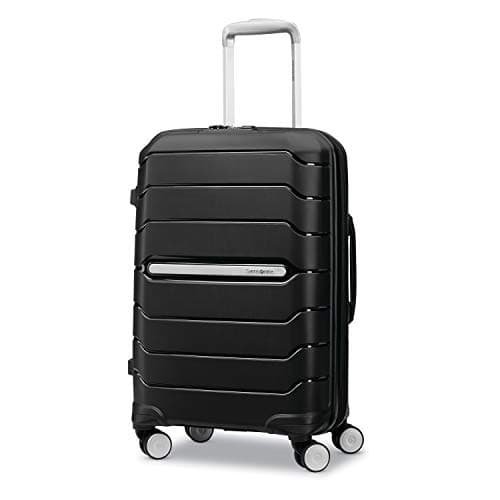
The Samsonite Freeform exists to solve one specific complaint: hardside luggage protects your things but weighs too much. Samsonite's answer was to build the shell from polypropylene rather than the polycarbonate it uses elsewhere — a lighter plastic that still molds into a rigid case. The result is one of the lightest genuine hardside carry-ons from a major brand.
Our verdict: an excellent buy if weight is your priority and you pack sensibly. The material trade is real and worth understanding, because polypropylene is more flexible than polycarbonate. That flexibility is why the bag is light; it is also why an overstuffed Freeform bows in a way a Winfield does not.
Method note: we have not tested this unit. This review compiles Samsonite's published specifications, sets them against the alternatives on our standard criteria, and reflects what owners consistently report. See how we test for what that means.
The polypropylene question
This is the whole review, so it is worth being precise. Polypropylene is lighter than polycarbonate for a given volume of shell, and it is genuinely tough — it resists cracking well and is highly resistant to fatigue from repeated flexing. What it is not is stiff. Polycarbonate resists deformation more firmly and springs back sharply; polypropylene gives more readily under load.
In practice: pack the Freeform normally and you get hardside protection at a weight closer to a softside bag, which is a genuinely excellent trade. Pack it to bursting and the shell bows outward, which can make it awkward in a tight sizer and puts more strain on the zipper. Our materials guide covers how the shell plastics compare in full.
The material trade-off in full - density, impact resistance, cold behavior and price - is on our polypropylene vs polycarbonate luggage guide, where the Freeform is the polypropylene pick against the Winfield 3 DLX.
What it gets right
- Weight. The core selling point, and it delivers — this is the pick we recommend to anyone who finds hardside cases hard to lift into a bin.
- The 10-year limited warranty. Standard across Samsonite's range and backed by one of the largest repair networks in luggage.
- Cleaning and weather. A molded shell wipes clean and shrugs off rain in a way fabric does not.
- Price. It typically sits below the polycarbonate Winfield 3 DLX while offering the same warranty.
What it gets wrong
- Shell rigidity when overpacked — the direct cost of the weight saving.
- Basic interior. Organization is a divider and straps; nothing like the LEVEL8's laptop compartment.
- No front access. Getting the laptop out at security means opening the whole case, which is the standard hardside compromise.
How it fits into the wider Samsonite range
Samsonite runs several overlapping lines with confusingly similar positioning, and the Freeform is best understood by what it is not. The Winfield 3 DLX is the polycarbonate default: stiffer, more protective, heavier, and the safer choice if you carry anything fragile. The Omni PCis the value polycarbonate line, with a micro-diamond texture that hides scuffs the Winfield's gloss finish puts on display, usually at a lower price than either.
The Freeform is the only one of the three that leads on weight, and that is the entire reason to choose it. If weight is not your constraint, one of the other two is probably the better bag for the money — which is not a criticism of the Freeform so much as a description of what it was built to do. Our best Samsonite luggage page sets all three side by side, including the sets and the checked cases, and our Winfield 3 DLX review takes the polycarbonate default apart on its own published figures.
How the weight saving pays off in practice
The arithmetic is where this bag justifies itself. On a carrier with a 7 kg cabin allowance — the norm across much of Asia-Pacific and the Middle East — every 500 g of suitcase is 500 g of clothing you leave at home. Shaving roughly a kilogram off a typical polycarbonate carry-on is somewhere between two and three additional outfits, which on a week-long trip is the difference between packing comfortably and doing laundry in a sink. Our international carry-on size guide works through the full calculation.
The saving matters domestically too, just differently. US carriers rarely weigh cabin bags, so the benefit is not an allowance — it is the overhead lift. Getting a packed case above shoulder height is the single most physically demanding thing you ask of a carry-on, and a kilogram off the empty weight is felt on every one of those lifts across the life of the bag.
What owners consistently flag
Two themes recur, and both are consequences of the same material choice rather than defects. The first is shell flex under a full load — pack it to capacity and the panels bow visibly, which is unnerving if you have come from a rigid polycarbonate case, though it is the polypropylene behaving as designed rather than failing. The second is that the bowing makes a tight sizer harder: a bag that measures compliant when packed normally can catch on a strict gate sizer when stuffed. Neither is a reason to avoid the bag; both are reasons to pack it sensibly.
The counterpoint owners raise just as often is that the shell takes knocks without cracking. Polypropylene is highly resistant to fatigue from repeated flexing, which is precisely the load a checked or gate-checked bag receives. It gives, and then it goes back.
Who should buy it
Buy the Freeform if you want a molded shell but have struggled with the weight of one — travelers who fly weight-capped international routes, anyone who lifts their own bag overhead, and anyone who has previously bought a heavy hardside and regretted it. It is the bag we point to on our women's carry-on list for exactly that reason.
Buy something else if you routinely overstuff — a softside Maxlite 5 flexes by design and is happier being crammed — or if you carry genuinely fragile equipment, where the stiffer polycarbonate of the Winfield 3 DLX is the safer shell.