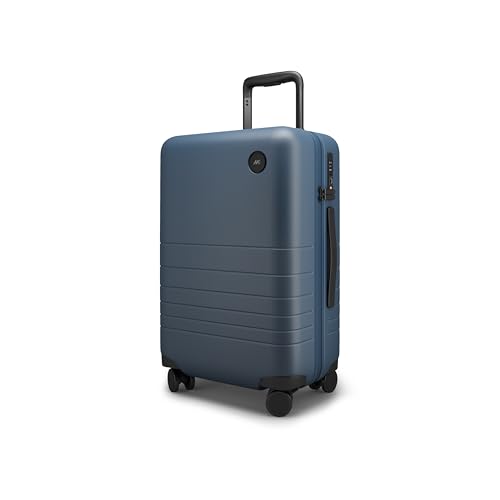
Nearly every premium carry-on this site has measured against the US cabin template comes in over it somewhere. The Samsonite Winfield 3 DLX publishes 22.25 in tall. The Samsonite Omni PC publishes 15 in wide. Away publishes 14.4 in wide. The TUMI 19 Degree Large publishes 15.8 in wide. Monos publishes 22 x 14 x 9 in — exactly the template, on all three axes, with nothing to argue about at a gate. That is the finding this review exists for, and on the dimension that is hardest to cheat it makes the Monos the best-fitting premium carry-on we have published figures for.
Now the part that stops this being a straightforward recommendation. In the course of checking those figures we found that Monos's own website publishes two different empty weights and two different warranty terms for this suitcase, and that Amazon sells it under a third inch label. None of that makes it a bad bag. All of it makes it a bag you should buy against a specification you have confirmed yourself on the day, which is advice we would rather give plainly than hide.
The published specification
| Published exterior | 22 x 14 x 9 in |
| Published interior | 20 x 13.5 x 9 in |
| Published capacity | 39.9 L |
| Published empty weight | 6.60 lb / 2.99 kg (product page) — 7.01 lb (Monos FAQ) |
| Shell | Polycarbonate, described as aerospace grade |
| Lock | TSA-approved, per the Amazon listing |
| Warranty | Limited lifetime (product page) — 2 years (Monos FAQ) |
| Name on the box | "21" Carry-On Suitcase" on monos.com; "20 Inch" on Amazon |
Every row is a published figure, cited in Sources. Three rows carry two numbers, and that is not sloppiness on our part — it is the subject of two sections below. Monos's product pages truncated before their specification tables on every automated read in this pass, so the figures here are Monos's published numbers as carried by its own specifications section and FAQ and by a named third-party reviewer. We have not weighed or packed this case. See how we test.
The fit: exactly the template, and why that is rarer than it sounds
The US domestic carry-on convention is 22 x 14 x 9 in including wheels and handles. A published 22 x 14 x 9 in exterior means the bag was designed to the number rather than to a marketing size, and on a rigid shell that distinction is the whole ballgame: a hard case cannot be compressed into a sizer. An inch of overhang on a fabric bag is a shove; on polycarbonate it is a gate-check fee.
How much does that matter in practice? On US mainline routes, rarely — cabin bags are not routinely gauged. It matters on the carriers that do gauge, and it matters to anyone who has ever been caught: our what happens if your carry-on is too big guide works through why the gate is the expensive place to be stopped.
Two honest qualifications on the fit, though, because "fits the template" is not the same as "fits everywhere." Nine inches deep is about 23 cm, against the 20 cm depth gauge several European carriers use — so this bag is compliant in the US sense and about 3 cm too deep for a strict European cabin gauge, exactly like every other 9-inch case we rank. Our international carry-on size guide has the gauges by carrier. And a published figure is a design target, not a guarantee about the unit in your hallway; if you fly a gauging carrier, measure the bag you receive.
One bag, three inch labels
This is the second thing worth knowing before you shop, and it is a pattern this site now documents across several brands.
Monos titles the product "21" Carry-On Suitcase" on its own store. Amazon titles the same suitcase "Monos Carry-On Luggage 20 Inch". The published exterior height is 22 in. Three numbers, one bag, and only the last one is what an airline measures — because the 22 in figure includes the wheels and the handle housing while the 20 and 21 in labels describe the case body.
We have seen precisely this on the Travelpro Maxlite Air V2, which is sold under an 18.75 in case body, a 20-inch retail label and a 22 in published overall, and on Away's The Carry-On, whose Amazon title rounds a published 21.7 in up to 22. The rule that follows is the same every time: buy against the published exterior dimensions, never against the inch figure in the product name. Our how to measure luggage guide shows how to take the overall figure yourself.
Two published weights, 0.41 lb apart
Monos's product page gives 6.60 lb / 2.99 kg. Monos's own FAQ gives 7.01 lb. The Amazon listing title gives 6.6 lb, agreeing with the product page. We are not averaging those, and we are not guessing which is the bare case.
Does 0.41 lb matter? On a US route, no. On a weight-capped international route it is real arithmetic. Against a 7 kg (15.4 lb) cabin cap, 6.60 lb is 43% of your entitlement and 7.01 lb is 46% — so the difference between Monos's two figures is about 3% of everything you are allowed to carry. That is the kind of margin people lose a bag over at a check-in desk, and a brand selling at this price should publish one number. Either way this is not a light bag: our lightweight carry-on class starts well under 6 lb, and our international carry-on page ranks on empty weight before anything else.
For context on the same page of the market: Away publishes 7.5 lb for The Carry-On and Samsonite publishes 6.97 lb for the Winfield 3 DLX. On either Monos figure this is the lighter bag of the three, which is a genuine point in its favor and is why our Away vs Monos comparison gives it the weight column.
The warranty: lifetime, or two years?
This is the finding that would change our recommendation if it resolved the wrong way, and it is unresolved.
Monos's product page states that every Carry-On comes with a limited lifetime warranty, and the page carries the words "Lifetime Warranty included with every purchase." Monos's FAQ states that all bags are backed by a 2-year warranty. Those are not two readings of one policy; they are different policies, on the same website, for the same product. One of them is out of date and we cannot tell which from the published pages.
We also could not confirm the widely-repeated 100-day trial for this model in this pass. We found it stated on a third-party listing for the Aluminum Carry-On Plus, which is a different and much dearer product. If the trial is the reason you are buying, confirm it applies to the bag you are ordering before you order it.
What that means for a buyer is simple and worth saying bluntly: if warranty length is a deciding factor, do not decide on Monos until you have the term in writing from Monos. The brands whose terms we could read without ambiguity publish 10 years (Samsonite), five years (TUMI), a limited lifetime warranty naming wheels and zippers (Travelpro) and unconditional lifetime repair (Briggs & Riley). Our luggage warranties explained guide ranks those classes, and a bag whose own maker publishes two answers does not place in them.
Which Monos are you actually looking at?
The range is wide and the names are close enough to confuse, so here it is in plain order of what changes. The Carry-On is the bag reviewed here. The Carry-On Pro adds a front laptop compartment. The Carry-On Plus is the taller case, and the Carry-On Pro Plus — sold on Amazon as a 23-inch case with a front pocket — is the taller case with the pocket. The Expandable Carry-On and Expandable Carry-On Pro add a zip expansion, the Hybrid adds a front access panel, and the Aluminum Carry-On sits at the top of the range in a different material entirely. Prices climb in roughly that order; the live numbers are on the buttons, never in this copy.
Two cautions on that range. Anything labeled Plus or 23-inch is taller than the 22 in template, so the single best reason to buy Monos — the exact fit — does not apply to it. And an expandable carry-on expands into depth, the axis that is already at the limit, which makes the expander a hold-bag feature on a cabin bag; we say the same on our expandable carry-on page. If the exact-template fit is why you are here, buy the plain Carry-On.
Buying it, and stock
Monos sells direct and through its own Amazon storefront, and the practical difference in this pass was stock by colorway. The Ocean Blue listing came back "In Stock." The Midnight Black listing — the one this site's four Monos comparison pages have used — came back "Only 5 left in stock", and two further colorways returned 8 and 12 units. Monos's own store carries far more colors than Amazon does.
So: buy the color that is actually in stock rather than the color you wanted, or buy direct if the color is the point. Monos's own site reports a 4.9-out-of-5 rating across more than three thousand reviews for this case — that is a vendor-reported figure on the vendor's own page, which is worth exactly what you think it is worth, and we cite it as what it is rather than as evidence.
Who should buy it
Buy it if you want a premium polycarbonate carry-on and you fly carriers that gauge cabin bags. Nothing else at this level publishes an exterior that is inside the US template on all three axes, and on a rigid shell that is the one spec you cannot work around. It is also the lighter bag than either Away or the Winfield 3 DLX on either of Monos's own weight figures.
Do not buy it if warranty certainty matters to you, until Monos resolves the lifetime-versus-two-years contradiction in writing. At this price that is a reasonable thing to insist on, and several competitors publish one unambiguous term.
Do not buy it either if you fly European low-cost carriers on a 20 cm depth gauge — 9 in is about 23 cm and no amount of template compliance in the US sense fixes that — or if empty weight is your deciding criterion, where the sub-6 lb class wins outright. And if the design is what you are paying for rather than the fit, Away vs Monos and Monos vs Samsonite both work through whether the premium is worth it against the alternatives.
Every figure in this review is published by Monos, published on the Amazon listing, or attributed to a named third party, all cited in Sources. Where Monos publishes two numbers we have printed both. We have not weighed, packed or stress-tested this case.