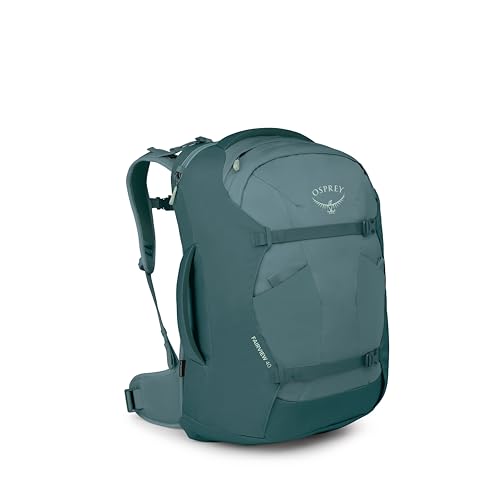
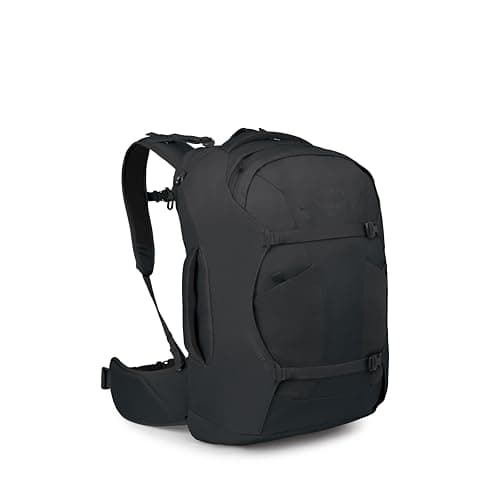
Here is the whole comparison in one sentence: the Farpoint and the Fairview are the same 40-liter pack with two different harnesses, and the harness you want is decided by your torso length, not by your gender. Osprey publishes 40 L for both. The published dimensions match within about a centimeter. The laptop sleeve, the lockable zips, the stowable harness and the All Mighty Guarantee are the same. On Amazon in this pass the two were priced within pennies of each other. There is no spec-sheet winner here, and any page that declares one is comparing something other than the specifications.
What there is, instead, is a fit problem with a documentation problem on top of it. The Fairview is built for shorter torsos and narrower shoulders; the Farpoint for longer torsos. That is the one axis that matters. And the published torso ranges for the Fairview do not agree with each other across the retailers that list it — we found 13–19 in, 14–19 in and 15–18.5 in — which is an awkward state of affairs when torso length is the only thing separating the two bags. This page sets out every figure we could verify, says which sources disagree, and tells you how to measure the one number that decides it.
A sourcing note, up front. osprey.com returned HTTP 403 to every automated request in this pass — product pages, the regional pages and its own owner's manual PDF. Every figure below is therefore either Osprey's published number as carried by a named retailer, Osprey's own owner's manual for the Farpoint/Fairview series, Osprey's own regional product copy, or a figure already verified on our Farpoint 40 review from Osprey's product page in an earlier pass. We have not weighed, packed or worn either pack. See how we test.
The spec table, published figures only
| Published figure | Farpoint 40 | Fairview 40 |
|---|
| Capacity | 40 L / 2,440 cu in | 40 L / 2,441 cu in |
| Dimensions | 21.7 x 13.8 x 9.1 in | 21.7 x 13.8 x 9.1 in, or ~22 x 14 x 9 in |
| Empty weight | 3 lb 6.4 oz / 3.27 lb / 3.17 lb | 3 lb 6.4 oz / ~3.2 lb / 3.411 lb |
| Torso fit | 16–21 in | 13–19 in / 14–19 in / 15–18.5 in |
| Hip fit | Not found published | 27–39 in |
| Laptop sleeve | 16-inch direct-zip | 16-inch direct-zip |
| Harness | Suspended zip-away, straighter cut | Suspended zip-away, S-curved, contoured hipbelt |
| Frame | LightWire | Load-lifting LightWire |
| Warranty | All Mighty Guarantee | All Mighty Guarantee |
Three rows carry multiple figures, and that is the honest state of the published record rather than hedging on our part. Both packs are published at several empty weights depending on which listing you read — which means the weight difference between the Farpoint and the Fairview is smaller than the disagreement within each one's own published figures. Treat them as the same weight and stop thinking about it.
The only difference that matters: the harness
A travel pack carries its load through a hipbelt onto your pelvis, and it can only do that if the belt lands on your hips rather than your ribs or your thighs. That is a function of the distance from the C7 vertebra at the base of your neck to the top of your iliac crest — your torso length — and it has almost nothing to do with your height and nothing at all to do with your gender. Two people the same height can differ by three inches of torso.
Osprey builds the Fairview for the shorter end of that range with an S-curved shoulder harness — shaped to clear a chest rather than run straight across one — and a contoured hipbelt cut for a narrower frame and a higher, more angled iliac crest. Osprey's own copy calls it a "women's-specific fit" with a "load-lifting LightWire frame" and a "padded, lightweight and breathable spacermesh hipbelt with a crossbody system." The Farpoint uses the straighter cut over the same frame.
One independent observation worth more than the marketing copy: a reviewer who used both found that the Fairview's shoulder straps stayed in place without the sternum strap fastened, where the Farpoint's did not. That is what the S-curve is actually for, and it is the kind of thing a spec table cannot tell you.
So which do you buy? Measure, do not guess
Measure your torso. Tilt your head forward and find the bony bump at the base of your neck — that is C7. Put your hands on your hips with your thumbs pointing back and feel for the shelf of bone at the top of your pelvis; the imaginary line between your thumbs is the bottom of the measurement. Have someone run a soft tape down the curve of your spine between those two points. That number, in inches, is the only input this decision needs.
Then: a torso under about 19 in points to the Fairview; over about 19 in points to the Farpoint, and the overlap in the middle is real rather than a fudge — the published ranges genuinely overlap by two to three inches, so people in the 16–19 in band can wear either and should choose on shoulder and hip shape instead.
Two cautions on those numbers. The Fairview's published torso range is not consistent across retailers. One major outdoor retailer publishes 14–19 in; two others publish 15–18.5 in; one buyer's guide publishes 13–19 in, which is the outlier and which we would not rely on. If you are near either end of that band, the half inch of disagreement is exactly the margin that decides whether the belt lands correctly — so try the pack on, or buy from somewhere with a returns policy you are happy to use. And the Fairview is sold in two harness sizes where sources describe the Farpoint as a single size with an adjustable torso; Osprey's own owner's manual for the series lists the women's sizes as WXS/M and WS/M. Check which size a listing is actually selling you before you order, because the listings do not always say.
What is identical, and therefore not worth agonizing over
Capacity. 40 L on both, published at 2,440 and 2,441 cubic inches — a one-cubic-inch difference that is a rounding artifact, not a design choice.
Airline fit, including the same problem. Both are published at 21.7 x 13.8 x 9.1 in, and some Fairview listings round that to 22 x 14 x 9 in. Either way the depth figure is the one to watch: 9.1 in is over the 9 in US convention, and about 23 cm against the 20 cm gauge several European carriers use. A pack is soft, so it compresses in a sizer where a shell cannot — which is the single best practical argument for a travel pack over a case on gauging carriers, and it is the argument our carry-on backpack page is built on. Our can a backpack be a carry-on guide covers how the rules treat packs.
The laptop sleeve. A 16-inch direct-zip compartment on both, which means the laptop comes out at security without opening the main compartment — the same workflow feature we credit TUMI for in Away vs TUMI, at a fraction of the money.
The guarantee. Osprey's All Mighty Guarantee on both. It is one of the stronger documents in the category and it does not vary between the two packs, which is why we have not scored it as a discriminator below. Our warranties guide ranks it against the luggage brands.
Price. On Amazon in this pass the two sat within pennies of each other. It is worth saying plainly because the assumption that the women's version is a cheaper or lesser product is common and wrong: it is the same pack, built to the same standard, at the same price, with a harness shaped differently.
What about the 55, and the Fairview Trek?
"Farpoint 40 vs 55" is asked almost as often as Farpoint vs Fairview, so briefly, and only where we can be accurate. The 55 models in both lines are a different proposition rather than a bigger version of the same one: they pair a main pack with a zip-off daypack, and the combined volume puts the main bag outside cabin dimensions. If the reason you are looking at a 40 is that it is a carry-on, the 55 is not the same purchase — it is a checked bag with a daypack attached. We have not verified the current 55's published dimensions and weights in this pass and are not going to quote figures we have not read, so treat that as the shape of the decision rather than a specification.
Osprey also sells a Fairview Trek line, which is a hiking-oriented pack rather than a travel pack. If a listing says Trek, it is not the bag on this page.
The verdict
Farpoint 40 if your torso measures roughly 19 in or more. It is also the one to default to if you cannot measure and you are buying for someone tall, and it is the model with more independent coverage behind it, including our own full review.
Fairview 40 if your torso measures under roughly 19 in, or if a straight shoulder strap has ever sat wrong across your chest. Nothing is given up by choosing it — same volume, same features, same guarantee, same price — and the S-curved harness is a real engineering answer to a real fit problem rather than a color change.
Neither if you want to roll rather than carry. A 40 L pack at the weight limit is on your back for the whole walk, and plenty of people who buy one end up wanting wheels; our rolling backpack page covers the hybrid, and our flagship carry-on roundup covers the cases.