Skip to content
Suite & Sand

Guides · Guides

What happens if your carry-on is too big?

Three outcomes, and which one you get depends almost entirely on where you are standing when someone notices.

By Stephen V.Updated How we test
#ad

We earn a commission when you buy through our Amazon links, at no extra cost to you. It never changes a verdict, and we say so when the cheaper bag is the better buy. How this works.

Three things can happen, and they are not equally likely. Most often: nothing. On a great many flights nobody measures anything, the bag goes in the bin, and the limit functions as a guideline. Next most likely: a free gate-check — your bag is tagged at the gate, travels in the hold, and you collect it at the carousel or planeside. Worst case: a paid gate-check, charged at the gate, and the gate rate is routinely higher than what the same bag would have cost as a checked bag booked online. The one thing that is always true: the decision is made by a person at a gate, and the only evidence that counts is the metal sizer next to them.

That asymmetry is the whole practical lesson of this page. Being caught at the check-in counter is cheap and being caught at the gate is expensive. At the counter you can repack, move things into a coat, or pay the ordinary checked-bag rate. At the gate you have a queue behind you, no table to repack on, and a fee schedule designed to discourage exactly what you are doing. If you have any doubt about your bag, resolve it before security — not at the end of the jet bridge.

Why we do not print the fees

Deliberately, and for the same reason as our checked bag fees guide: gate and oversize charges changed more than once inside twelve months on at least one major carrier, they vary by route and fare class, and airline sites block automated checking — so any figure we printed would be unverifiable and would rot. We would rather send you to the airline's own live page than publish a number that is wrong by the time you read it. Check your carrier's baggage page before you fly; it is the only source that is current by definition.

Outcome one: nothing happens, and why

Enforcement is not random, it is situational, and knowing the pattern is genuinely useful. A bag is far more likely to be measured when the flight is full and the overheads are going to run out, when the carrier makes a material share of its revenue from baggage fees, when you are boarding in a later group, and when the gate has a sizer physically placed in the boarding lane rather than off to one side. It is far less likely on a half-empty flight, in an early boarding group, on a legacy carrier on a business route, or where there is no sizer in sight. None of this is a rule you can rely on — it is why the same bag flies unchallenged for years and then gets stopped.

Outcome two: the free gate-check

The common middle case, and it is not a disaster — but it has costs that are not money. Your bag is tagged and goes into the hold, which means anything you cannot check travels without you. That matters: lithium batteries and power banks are generally not permitted in checked baggage, and medication, documents, keys and valuables should never be in a bag you may be separated from. The practical habit is to keep a small pouch inside your carry-on holding exactly those items, so a gate-check becomes a thirty-second transfer rather than an emergency unpack in the boarding lane. What can and cannot travel in the hold is in checked luggage rules and what not to pack in a carry-on.

The second cost is the bag itself. A case designed for an overhead bin is now in a hold being handled by machinery, and a soft case especially will come back dirtier than it went in. If your bag is gate-checked, this is the moment the warranty wording from luggage warranties explained becomes relevant — most warranties exclude airline damage entirely, and the ones that cover it (Travelpro's Trusted Companion Promise) usually require registration within 120 days of purchase, long before the damage happens.

Outcome three: the paid gate-check

This is the one worth engineering around. The fee is assessed at the gate, it is typically higher than the online checked-bag rate for the same bag, and on the ultra-low-cost carriers it can be a significant fraction of what you paid for the ticket — which is the business model, not an accident. There is no negotiation available and no appeal at the gate; the sizer is the arbiter. If the agent has already decided, paying and boarding is almost always the right move, and the thing to fix is the bag, before the next trip.

Why bags that fit for years suddenly do not

Four reasons, and three of them are about you rather than the airline. The expansion zip. Two inches of expansion on a 9-inch-deep carry-on is a 22 percent increase in depth. Use it on a cabin trip and a compliant bag becomes non-compliant while looking identical to you. Soft-panel bulge. A fabric case packed hard exceeds its published depth with the zip untouched, because the panels move. The published figure was never the real figure. Most cases publish the body height, not the overall height with wheels and retracted handle — Samsonite publishes 22.25 x 14.5 x 9.5 inches overall for a case it sells as a 20-inch carry-on, and that is a brand being unusually transparent. And the frame is not the published limit. Sizers are built to the airline's dimensions with no manufacturing generosity, so a bag that is exactly at the limit is a bag that fits only if nothing bulges. Measure the way a gate agent does — over the wheels, over the handle, at the widest point — using the method in how to measure luggage.

The weight version of the same problem

Outside the United States the frame is often not what stops you — the scale is. A large number of European, Asian and Middle Eastern carriers cap cabin baggage by weight, commonly at 7 or 8 kg including the case, and they weigh it at the gate. A bag that passes every sizer in America can be comfortably over a 7 kg cap, because the case itself may be 4 to 5 kg of it. There is no repacking your way out of a weight cap; the only remedies are a lighter case or fewer things. The carriers that enforce it are listed in international carry-on size, and the lightest compliant cases are in best lightweight carry-on.

How to stop it happening

In order of effectiveness. Buy a case with margin rather than a case at the limit — a 20 or 21-inch body instead of a 22, which is the single change that removes the problem permanently. Never use the expansion zip on a cabin trip. Weigh the bag at home if any part of your itinerary is on a weight-capped carrier, because the gate is a bad place to discover a number. Pack flat-sided so a soft case does not bulge past its own depth. Board earlier if your fare allows it — the sizer appears when the bins start filling. And keep a personal-item bag that is unambiguously compliant as plan B: if your roller gets gate-checked, the pouch of things you cannot check comes out and goes into it. Rules per carrier are in carry-on size by airline and personal item size by airline.

Three things that make this a non-problem

Each of these addresses one of the three failure modes above — a case with margin, a plan-B bag that is never gate-checked, and a scale for the carriers where the problem is weight rather than size.
The short answer

Quick picks

#ProductBest forScorePrice
01
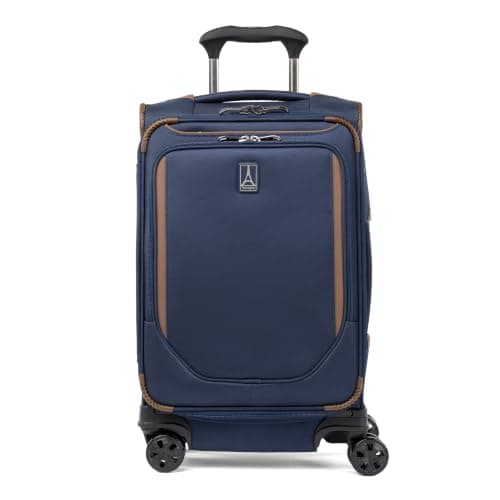
Travelpro Travelpro Crew Classic Softside Carry-On, 21-Inch
Travelpro Crew Classic Softside Carry-On, 21-Inch

The simplest permanent fix: a 21-inch body rather than a 22-inch one, which gives you margin on a rigid sizer where a 22-inch case gives you none. Structured softside compartments mean it holds its shape and packs flat-sided rather than bulging, and Travelpro's limited lifetime warranty names the wheels and zippers.

A case with margin instead of a case at the limit
8.2
$254.99Amazon
02
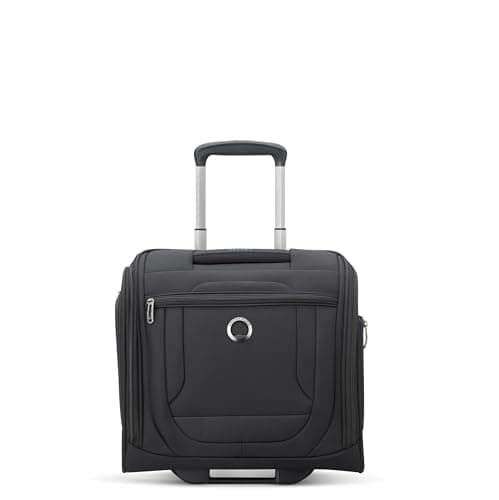
DELSEY PARIS DELSEY PARIS Helium DLX 16-Inch Under-Seater
DELSEY PARIS Helium DLX 16-Inch Under-Seater

A 16-inch under-seater at 5 lb with a laptop sleeve - small enough to be unambiguously a personal item on any carrier, which means it never meets a sizer argument. If your roller does get gate-checked, this is where the medication, documents, power bank and laptop go in the thirty seconds before the bag is tagged.

Plan B: the bag that is never gate-checked
7.4
$135.99Amazon
03
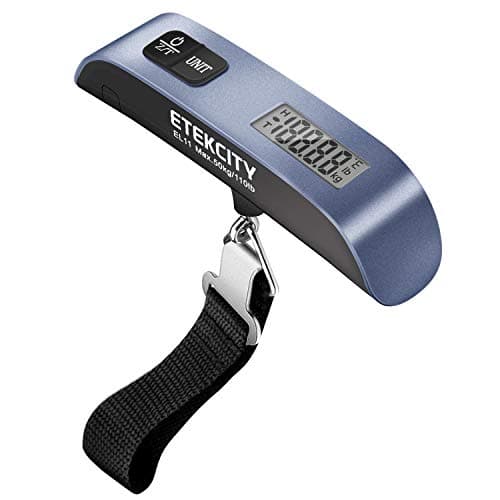
Etekcity Etekcity Digital Luggage Scale, 110 lb
Etekcity Digital Luggage Scale, 110 lb

The remedy for the weight version of this problem, which is the one you cannot repack your way out of. A 110 lb / 50 kg capacity hanging scale with a locking display so you can read the figure after the bag has stopped swinging, and a backlit LCD for the hallway you will actually use it in.

For the carriers where the scale is the problem
8.6
$11.16Amazon

#ad · Live prices from the Amazon Product API, as of October 17, 2026. Where we have no verified live price, we show none — a gap beats a number that has rotted.

In detail

The picks, in full

01
Travelpro Travelpro Crew Classic Softside Carry-On, 21-Inch

A case with margin instead of a case at the limit

Travelpro Crew Classic Softside Carry-On, 21-Inch

SoftsideStructured compartmentsSpinner wheelsLimited lifetime warranty
8.2/10

The simplest permanent fix: a 21-inch body rather than a 22-inch one, which gives you margin on a rigid sizer where a 22-inch case gives you none. Structured softside compartments mean it holds its shape and packs flat-sided rather than bulging, and Travelpro's limited lifetime warranty names the wheels and zippers.

Durability
9
Weight
7
Capacity
8
Warranty
10
Value
7

Pros

  • The most thought-through interior layout in the range
  • Holds its shape when empty, which makes packing faster
  • Same limited lifetime warranty as the rest of the brand
  • Cheaper than Platinum Elite while keeping most of the structure

Cons

  • Heavier than Maxlite for the same external size
  • Structure costs usable volume — a Maxlite of the same size swallows more

Don't buy this if…

…you already pack in cubes - you are paying for organization you have solved, and the structure costs you some usable volume.

$254.99View on Amazon

Price as of October 17, 2026. Prices change — Amazon's at checkout is the one that counts.

#ad · we may earn a commission from this link to Travelpro Crew Classic Softside Carry-On, 21-Inch

02
DELSEY PARIS DELSEY PARIS Helium DLX 16-Inch Under-Seater

Plan B: the bag that is never gate-checked

DELSEY PARIS Helium DLX 16-Inch Under-Seater

16 in under-seater5 lbLaptop sleeve5-year limited warranty
7.4/10

A 16-inch under-seater at 5 lb with a laptop sleeve - small enough to be unambiguously a personal item on any carrier, which means it never meets a sizer argument. If your roller does get gate-checked, this is where the medication, documents, power bank and laptop go in the thirty seconds before the bag is tagged.

Build
8
Weight
9
Capacity
6
Wheels
7
Value
7

Pros

  • Five pounds empty, so it costs almost nothing against a weight-capped cabin allowance
  • Designated laptop sleeve plus tie-down straps and a mesh zip pocket inside
  • Luggage sleeve sits it on the handle of a rolling case, so you tow one unit
  • Front and side exterior pockets reach documents without opening the bag

Cons

  • Two inline wheels, not spinners — it pulls behind you rather than rolling upright
  • A 16-inch under-seater is a day bag, not a weekend's clothes
  • Five-year warranty, where the Helium DLX rollaboards publish ten

Don't buy this if…

…you want this to replace a carry-on - 16 inches is a personal item, not a cabin bag, and you will not fit a week of clothes in it.

$135.99View on Amazon

$159.9915% off

Price as of October 17, 2026. Prices change — Amazon's at checkout is the one that counts.

#ad · we may earn a commission from this link to DELSEY PARIS Helium DLX 16-Inch Under-Seater

03
Etekcity Etekcity Digital Luggage Scale, 110 lb

For the carriers where the scale is the problem

Etekcity Digital Luggage Scale, 110 lb

110 lb / 50 kg capacityLocking displayBacklit LCDBattery powered
8.6/10

The remedy for the weight version of this problem, which is the one you cannot repack your way out of. A 110 lb / 50 kg capacity hanging scale with a locking display so you can read the figure after the bag has stopped swinging, and a backlit LCD for the hallway you will actually use it in.

Accuracy
8
Capacity
9
Readability
9
Build
7
Value
10

Pros

  • Capacity covers any checked bag limit
  • Reading holds after you set the bag down
  • Backlit display readable in a dim hallway
  • Cheapest of the well-reviewed scales

Cons

  • Strap buckle is fiddly on thick suitcase handles
  • Coin-style batteries eventually need replacing

Don't buy this if…

…all your flying is US domestic - cabin bags are measured rather than weighed there, and a sizer is the only thing you need to worry about.

$11.16View on Amazon

Price as of October 17, 2026. Prices change — Amazon's at checkout is the one that counts.

#ad · we may earn a commission from this link to Etekcity Digital Luggage Scale, 110 lb

How we picked

We did not lab-test these bags

Everyone in this category says they tested twenty suitcases. We have not lab-tested any of these, and we say so. What we did instead: compiled each bag's published specifications, checked its dimensions against the airline sizers, ran the cost-per-trip and weight-to-capacity math, read the aggregated owner reviews, and scored every pick against a published rubric. The scores are judgments from documented research — not measurements we took, because we do not have a lab and we will not pretend we do. Where a number came from someone else's work, we name them in Sources.

Questions

Frequently asked

What happens if your carry-on is too big?
One of three things. Most often nothing — on many flights nobody measures. Next most likely, a free gate-check: the bag is tagged, travels in the hold, and you collect it at the carousel or planeside. Worst case, a paid gate-check charged at the gate, usually at a higher rate than the same bag would have cost checked online. The sizer frame at the gate is the only evidence that counts.
Is it cheaper to be caught at check-in or at the gate?
Check-in, substantially. At the counter you can repack, redistribute into a coat, or pay the ordinary checked-bag rate. At the gate there is no table to repack on, a queue behind you, and a fee schedule specifically designed to discourage oversize cabin bags. If you have any doubt, resolve it before security.
Does a gate-checked bag cost money?
Sometimes. Gate-checking is frequently free when the overheads are simply full and the airline is clearing bags to board on time. It is charged when the bag is being gate-checked because it is oversize. Fees vary by carrier, route and fare, change frequently, and are only reliable on the airline's own live baggage page — which is why we link those rather than printing numbers.
What should you take out of a bag before it is gate-checked?
Lithium batteries and power banks, which are generally not permitted in checked baggage; medication; travel documents; keys; and anything valuable or fragile. The practical habit is to keep those items in a small pouch inside your carry-on so a gate-check becomes a thirty-second transfer rather than an emergency unpack in the boarding lane.
Why did my carry-on suddenly stop fitting?
Usually the expansion zip — two inches of expansion on a 9-inch-deep case is a 22 percent increase in depth. Otherwise: a soft case packed hard bulges past its published depth even unexpanded, the published figure was the body height rather than the overall height with wheels and handle, and gate sizers are built to the exact limit with no manufacturing generosity.
Do airlines weigh carry-on bags?
In the United States, essentially never — cabin bags are assessed by size. Outside it, frequently: a large number of European, Asian and Middle Eastern carriers cap cabin baggage at 7 or 8 kg including the case and weigh it at the gate. A case that is 4 to 5 kg empty has already spent most of that allowance, and there is no repacking your way out of a weight cap.

Keep reading

Receipts

Sources

We do not run a testing lab, and we do not pretend to. Specifications come from the manufacturer's own listing or manual, and size and weight limits from the airline's official baggage-policy page. Where we could not verify something, we say so on the page rather than quietly leaving it out. Read our full method.