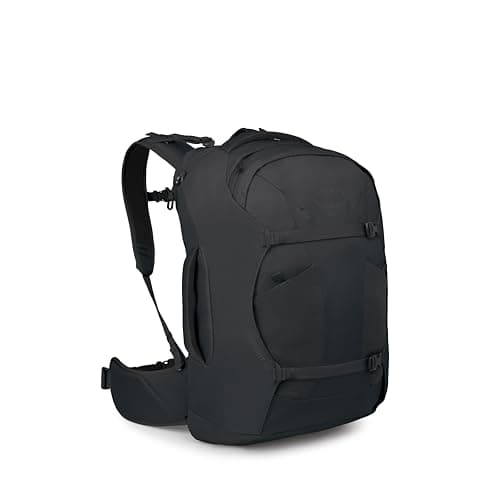
The Osprey Farpoint 40 is the bag this site names more often than any other travel pack. It is the #1 pick on our best carry-on backpack roundup, it appears on the college luggage and personal item pages, and it is the pack almost every one-bag forum answer eventually converges on. That makes it the bag most in need of an actual examination rather than another recommendation.
Our verdict: still the default one-bag pack, and the only one in its class that carries a heavy load properly — with one published dimension that matters more than its reputation suggests. Forty liters in a suitcase-style clamshell, a suspended harness with a real hipbelt that zips away behind a back panel, a 16-inch laptop sleeve and a guarantee Osprey publishes as covering any product from any era. It scores 8.4 here. The caveat is depth: the published 9.1 inches is over the US 9-inch carry-on convention, and at roughly 23 cm it is well over the 20 cm depth several European carriers gauge.
That score is lower than the 8.8 the same pack carries on our carry-on backpack roundup, and the difference is deliberate rather than a contradiction. That page scores comfort, capacity, organization, build and value — it is a pack-against-pack ranking. This review adds a fifth axis the roundup does not use, airline fit, because a single-product review has to answer "will it get on the plane" and a comparative ranking does not. The Farpoint loses points on that axis and gains none elsewhere, so the two numbers measure different questions. The site does the same thing on best 2-wheel luggage, where the Travelpro Bold scores 8.8 on one page and 7.7 on another.
Every figure below is a published one, taken from Osprey's authorized retail listings and cited in Sources. We have not weighed, loaded or carried this pack, and where published figures disagree with each other — which on this pack they do, on both weight and fabric — this review states the range rather than picking the flattering number. See how we test.
The published numbers
| Spec | Published figure | What it means |
|---|
| Capacity | 40 L (2,440 cu in) | About a week of clothing for one person with cubes |
| Dimensions | 21.7 x 13.8 x 9.1 in | Roughly 55 x 35 x 23 cm |
| Empty weight | 3 lb 6.4 oz on the REI listing; 3.27 lb and 3.17 lb elsewhere | Published figures disagree by about a quarter of a pound |
| Main fabric | 100% recycled 210D nylon with PFAS-free DWR (REI) | Other published descriptions cite a heavier recycled polyester |
| Laptop | Direct-zip sleeve, up to 16 in | Reachable without opening the main compartment |
| Harness | Zip-away harness and hipbelt behind a back panel | Stows so the pack checks or stows without strap damage |
| Fit | One size, adjustable torso length | The Fairview 40 is the women's-fit sibling |
The depth figure, and why it is the headline
This site applies one standard to every bag it covers: state the published overall dimension against the template the airline actually gauges. For the Farpoint 40 that produces an uncomfortable answer, and it is the main reason this review exists.
The US domestic cabin convention is 22 x 14 x 9 inches including wheels and handles. The Farpoint publishes 21.7 x 13.8 x 9.1 in: under on height by three-tenths of an inch, under on width by two-tenths, and over on depth by a tenth. In practice a soft pack compresses and a tenth of an inch is not what gets a bag stopped — but it is why Osprey's own positioning is "meets domestic carry-on size requirements" rather than a guarantee, and why the pack's fit depends on how much you have put in it.
The international picture is less forgiving. Several European carriers gauge a cabin bag at roughly 55 x 40 x 20 cm, and the lower-cost ones enforce the depth dimension with a rigid sizer at the gate. The Farpoint's published dimensions convert to about 55 x 35 x 23 cm: comfortably inside the width, exactly at the 55 cm height, and about three centimeters over on depth. A packed 40 L pack does not compress to 20 cm. That is the single most useful sentence in this review, and it is why our international carry-on backpack page ranks the Farpoint fourth rather than first and puts a 55 x 40 x 20 cm pack at the top instead. The templates themselves are set out in international carry-on size.
The harness is the reason to buy it
Everything else on this page is a caveat; this is the argument. Most 40-liter travel packs are duffels with shoulder straps bolted on. The Farpoint has a suspended harness with a padded hipbelt, which moves the load off your shoulders and onto your hips — the strongest part of your body and the part that does not ache after twenty minutes. Loaded to the brim with a week of clothing and a 16-inch laptop, a 40 L pack is somewhere between 20 and 30 lb depending on what you packed, and that is exactly the weight at which the difference between a real harness and a pair of straps stops being subtle.
The harness and hipbelt both zip away behind a back panel. That is a genuinely thought-out detail rather than a feature-list entry: straps and belts are what get caught in a baggage system and torn off, so a pack that can hide them is a pack you can gate-check without fear. It also makes the Farpoint behave like a duffel when you want it to — one grab handle on the top and one on the side, and nothing dangling.
The clamshell is the other structural choice worth naming. It opens flat, like a suitcase, rather than top-loading like a hiking pack. That means packing cubes sit in it as neat rectangles and you can get at the bottom of the bag without unloading the top, which is the single biggest practical difference between a travel pack and a trekking pack.
Where the published figures disagree
Two of them do, and it is worth recording honestly rather than quoting the convenient number.
- Empty weight. The REI listing publishes 3 lb 6.4 oz (about 3.4 lb). Other published listings for the same pack give 3.27 lb and 3.17 lb (about 1.44 kg), and a UK retailer gives 1.48 kg. The spread is roughly a quarter of a pound — immaterial against a 50 lb checked allowance, and not immaterial against a 7 kg international cabin cap, where it is the difference between about 5.6 and 5.5 kg of usable allowance. Our how much luggage weighs guide explains why makers publish conflicting weights: shipping weight, colorway, and the wrong size in a range are the three usual culprits.
- Main fabric. REI publishes 100% recycled 210D nylon with a PFAS-free DWR. Other published descriptions of the current pack cite a heavier recycled polyester in the 450D range for the body panels. Both can be true of one pack — travel packs commonly use a lighter fabric on the lid and a heavier one on the base — but no single published source we could reach sets out the full fabric map, so we state both figures rather than assert one.
The reason this matters beyond pedantry: a 210D nylon pack and a 450D polyester pack are different products in how they scuff, how they take a wet baggage cart and how long they last. If longevity is your deciding factor, the guarantee below is a better thing to lean on than the denier number.
The All Mighty Guarantee, scored honestly
Osprey publishes the All Mighty Guarantee as covering any Osprey product from any era, repaired or replaced for any reason. If that holds for this pack it is the strongest warranty in the travel-bag category and a large part of why the Farpoint is recommended as a buy-once pack.
We are scoring it as published but unconfirmed, exactly as this site did on the 2-wheel luggage page, and the reason is procedural: osprey.com returned HTTP 403 to every automated fetch we attempted in this run, so we could not read the current guarantee terms in Osprey's own words or confirm whether the Farpoint line carries the full guarantee rather than a limited version. We have not downgraded it — the durability and warranty axis still scores 9 — but we are telling you the basis. If the guarantee is decisive for you, read it on Osprey's own site before you buy. What luggage warranties generally do and do not cover is in our warranty guide.
Which version: Farpoint or Fairview?
Osprey builds the same pack in two harness fits. The Farpoint 40 is the men's fit; the Fairview 40 is the women's-fit sibling, with a harness and hipbelt shaped for a different torso and shoulder geometry, and it is stocked on Amazon in several colorways. The capacity, the clamshell, the laptop sleeve and the guarantee are the same. If the pack is for someone with a shorter torso or narrower shoulders, buy the Fairview; the difference is in how the load sits, which is the only thing this pack is really selling. The current Farpoint is a single size with an adjustable torso length, which widens the range it fits but does not replace the harness shaping.
Who should not buy it
Three groups, plainly. Anyone flying strict European low-cost carriers regularly — the 23 cm published depth is the wrong axis to be over on, and a bag sized to the template is a better purchase than a bag you hope gets waved through. Anyone with a back, shoulder or knee problem — the whole premise is that you carry the load, and a wheeled carry-on spares you that entirely. And anyone who mostly needs a personal item — 40 liters is a full carry-on allowance, and spending it on a bag you meant to put under the seat is a category error our personal item page exists to prevent.