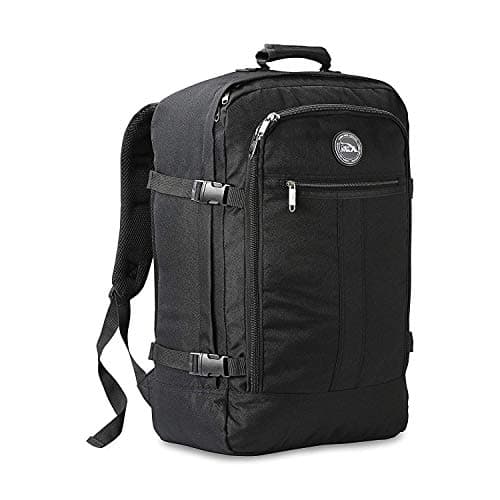
Almost every "best carry-on backpack" list, including our own general one, is written against the American standard: 22 x 14 x 9 inches, no weight limit worth mentioning, and a 40-liter pack as the default answer. Fly outside the US and two of those three assumptions break. European low-cost carriers cap depth at 20 cm against the US standard's 23, and much of Asia-Pacific and the Middle East weighs the cabin bag at 7 kg — about 15.4 lb, bag included. This page ranks packs against those constraints instead.
Three templates cover nearly everything you will meet, and they are the ones our international carry-on size guide documents in full:
- The 55 x 40 x 20 cm cabin bag. The European low-cost standard, usually only available on a priority or paid fare, commonly with a 10 kg limit. The strictest of the three on depth.
- The free under-seat bag. On basic low-cost fares this is the only bag you get without paying, and packs are sold to two common shapes — roughly 40 x 30 x 20 cm and around 40 x 20 x 25 cm. Carriers publish their own figures and change them, so check the airline before you buy and cross-check our personal item size by airline table.
- The 7 kg weight cap. Common across Asia-Pacific and Middle East carriers and actively enforced with scales, unlike US domestic flying where cabin bags are effectively never weighed.
That third one is why a backpack is often the smarter international bag in the first place. A hardside spinner that weighs 3.5 kg empty has taken half a 7 kg allowance before you pack a shirt. A 0.7 kg pack has taken a tenth of it. The trade is that you carry the load on your shoulders instead of rolling it, and that a soft bag gives your contents no structural protection — which is a real cost, not a footnote.
The five picks below are ranked on five criteria, in this order. Template fit— the published dimensions measured against the templates above, which is the whole reason this page exists and separate from "airline approved" on a listing. Empty weight — scored harshly, because on a weight-capped carrier it converts directly into clothes you can or cannot bring. Usable capacity — what the pack actually holds inside the template it fits, not its headline liter figure. Carry comfort — harness, back panel and whether it can carry a full load without hurting. And value.
Method note: we have not lab-tested these packs. Every dimension, weight and capacity quoted is the manufacturer's own published figure from its current retail listing, and the scores are judgments from that documented research plus aggregated owner reviews. Where a maker does not publish an empty weight, we say so rather than estimate one. See how we test. Airline limits are the carriers' own published figures and change without notice — confirm on the airline's baggage page within a week of flying.
Why the US answer is the wrong answer abroad
The default recommendation in this category — a 40-liter clamshell travel pack — was shaped by a market where the binding constraint is a 22 x 14 x 9 in overhead bin and nobody weighs anything. Under those rules a bigger, heavier, better-carrying pack is simply a better pack, and the advice is sound.
Outside the US, two different constraints bind. The first is depth. European low-cost carriers converge on a 20 cm cabin-bag depth against the US standard's 23, and depth is exactly where a soft pack grows when you fill it. Three centimeters sounds trivial and is the single most common reason a bag that has flown twenty US flights gets stopped at a Dublin or Milan gate. The second is weight, and it is the more expensive one.
The 7 kg arithmetic, done properly
Seven kilograms is 15.4 pounds including the bag. That is the strictest common international rule and it is normal across much of Asia-Pacific and the Middle East, where scales at the gate are routine rather than theoretical. Run the subtraction on the packs on this page:
- Cabin Max Metz at 0.7 kg leaves you 6.3 kg of belongings.
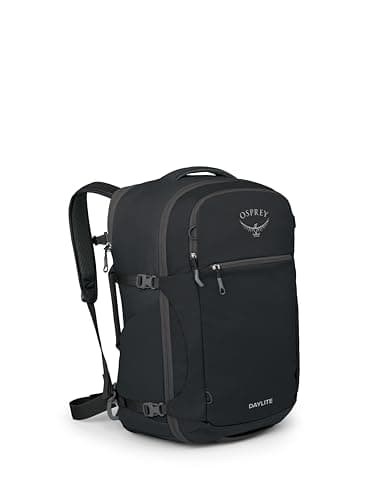
- Osprey Daylite 44 at 1.06 kg leaves you 5.94 kg.
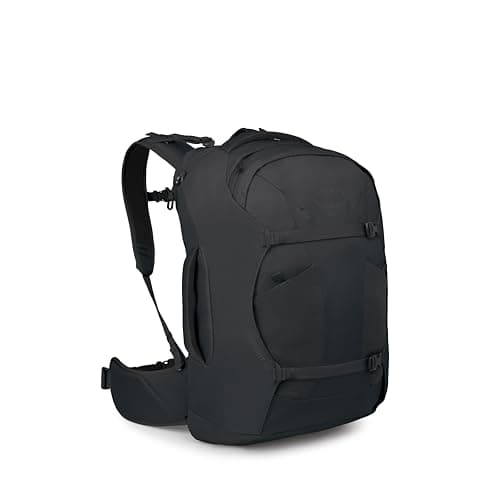
- Osprey Farpoint 40 at about 1.44 kg leaves you 5.56 kg.
- A typical 3.5 kg hardside carry-on leaves you 3.5 kg.
The gap between the lightest pack and a mid-weight wheeled case is 2.8 kg — roughly the weight of a pair of shoes, a jacket and three days of clothing. That is the whole argument for carrying rather than rolling on weight-capped routes, and it is why empty weight is scored harshly on this page and why we score it separately rather than folding it into value.
"Airline approved" on a listing means very little
Nearly every pack in this category is sold as flight approved, TSA approved or airline approved. None of those phrases is regulated and none of them tells you which airline. A bag can be perfectly legal on American and Delta and fail a Ryanair gauge on the same day. The only claim worth reading on a product listing is the published dimensions, and the only check worth doing is measuring your loaded pack against the carrier you are actually flying — the method is in our how to measure luggage guide.
One honest note on our own picks: the two budget packs on this page do not publish an empty weight, and we have not invented one. Where a maker stays silent about a number, so do we.
The free bag versus the paid cabin bag
On a European low-cost basic fare the free allowance is a single under-seat bag; the larger 55 x 40 x 20 cm cabin bag is a paid or priority add-on. That is a recurring cost — charged per direction, on every flight — and it is the reason a pack that keeps you inside the free allowance is often the highest-return luggage purchase you can make. Two return trips is usually the payback.
The catch, and it is a real one, is that free-bag shapes differ between carriers. Buying a wide 40 x 30 x 20 cm pack for an airline whose gauge is narrower wastes part of the allowance, and buying a narrow one for a wide gauge does the same in reverse. Look up the carrier before you buy rather than after — start with our personal item size by airlinetable and confirm on the airline's own baggage page.
What you give up by carrying instead of rolling
This page is enthusiastic about packs and it should still say the obvious. A backpack puts the entire load on your body, which is fine at 6 kg and unpleasant at 12. It offers no structural protection, so anything fragile is protected only by what you wrap it in. It creases clothes more than a flat-floored case. And on a long airport transfer with a connection, a wheeled bag is simply easier.
The honest split: if your international flying is weight-capped or budget-carrier heavy, a pack wins on arithmetic and it is not close. If it is long-haul full-service where the cabin bag is rarely weighed, a wheeled case is the more comfortable choice and our best carry-on for international travel picks are built for exactly that. Plenty of people should own one of each, which is cheaper than it sounds given what the packs on this page cost.
What we would actually buy
For most people flying a mix of international routes: the Osprey Daylite Carry-On Travel Pack 44. It is 1.06 kg for 44 liters with a real laptop compartment, it clears the US standard and most full-service international limits, and it is well enough made to still be in service in five years. Its only failure is the European low-cost gauge.
For anyone whose flying is Ryanair, Wizz, easyJet and their equivalents: the Cabin Max Metz, because it is built to the 55 x 40 x 20 cm template rather than approximately near it, and because 0.7 kg is a genuinely decisive number under a weight cap. Add a set of packing cubes and accept the basic harness.
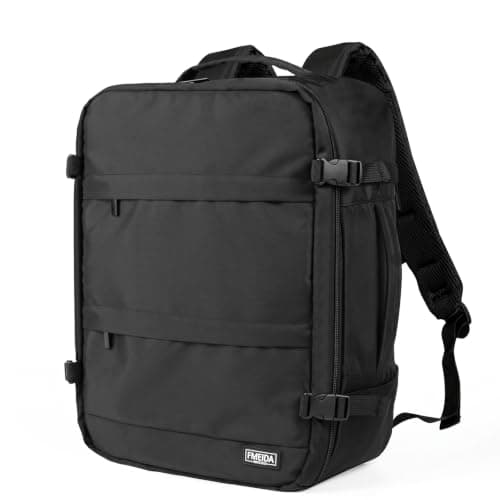
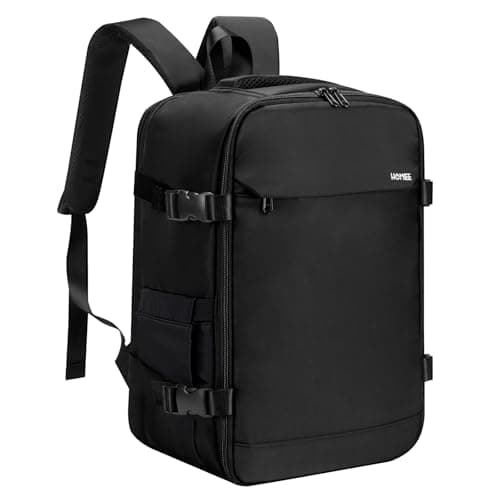
For anyone flying a basic fare with only the free bag: the pack shaped for your carrier's gauge — the Fmeida for a wide one, the HOMIEE for a narrow one — checked against the airline first. And for anyone who will genuinely be carrying a full load through long transfers, the Farpoint, knowing exactly what its depth and its weight cost you.