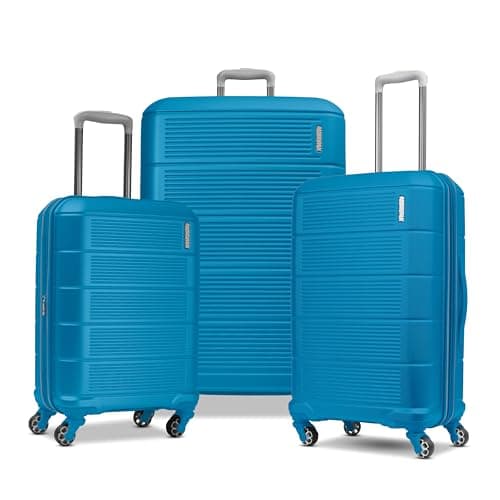
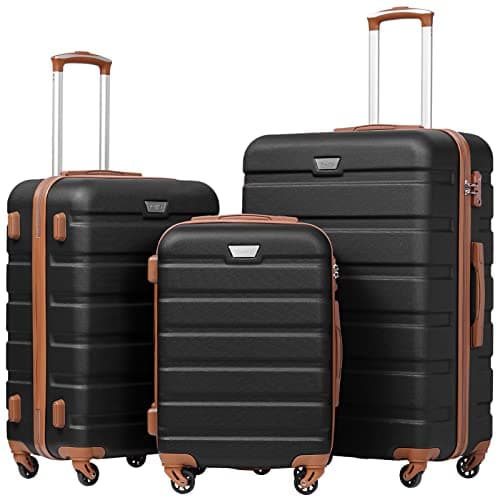
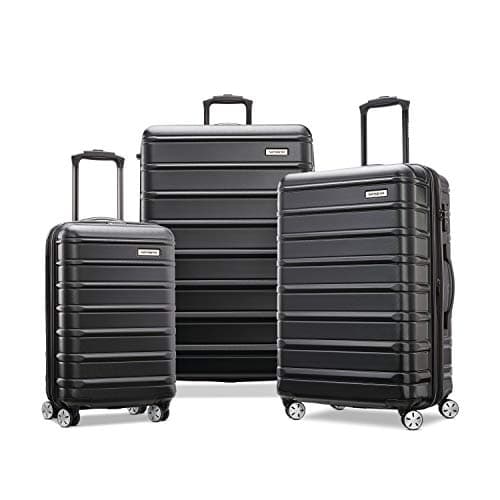
The best luggage for a family of four is the Samsonite Omni 2 hardside three-piece set, and the reason is not that three pieces matches four people - it does not. It is that a family checks fewer bags than it has members and carries one per person, so what you actually need is two large shared cases plus cabin bags, and a 20/24/28-inch set delivers exactly that shape in one purchase with a 10-year limited warranty and a service network behind it. If the budget is the binding constraint, the American Tourister Stratum 2.0 three-piece set is the same shape from Samsonite's own value brand.
This page exists because the standard advice - buy the biggest set you can afford - is wrong for a family, and wrong in a specific, expensive way. A family of four flying economy has four cabin allowances and usually pays for two checked bags, because the fare for the other two costs more than the inconvenience of sharing. That means the thing you are buying is two shared checked cases and four cabin bags, not four of everything. Buy four 28-inch cases and you will pay four checked-bag fees, hit the 50 lb limit before any of them is full, and own four pieces of furniture you cannot store.
So the ranking below is built on three constraints a general luggage-set roundup does not use. Per-person allowance - how the set divides across two adults plus children without buying a fourth case. Identification - four matching cases from the same set are four identical black bags on a carousel, which is the single most common family complaint and the cheapest thing on this page to fix. Fifty weeks of storage - a set that nests is a set that fits in one closet; a set that does not is four separate pieces of furniture. If you want the broader comparison across all buyers rather than families specifically, our best luggage sets roundup ranks the same category on cost-per-piece, and sets for couples covers the two-adult version of this problem.
Every product here is one the site has already researched on its own roundup - the scores are the scores it earned there, and the verdicts are rewritten for the family brief. Specifications are the manufacturer's published figures; we have not lab-tested any of these. See how we test.
How many suitcases does a family of four actually need?
Two checked and four cabin, in the usual case. The arithmetic is simple and it is the reason this page ranks a three-piece set first rather than a four-piece. Most US economy fares charge per checked bag, so a family of four that checks four bags pays four fees in each direction. Checking two and sharing them costs half that, and two large cases hold a family of four's clothing for a week comfortably - the binding constraint is the 50 lb per-bag weight limit, not volume. Every person still gets a cabin bag and a personal item, because those are free.
For a family of five or six, the shape becomes three checked and five or six cabin bags, which is a three-piece set plus one additional medium case rather than a second set. Our checked luggage roundup is where to buy that extra case, and checked bag size and weight limits has the 50 lb and 62-linear-inch arithmetic in full.
Why two 24-inch cases beat two 28-inch cases
A 28-inch case reaches 50 lb before it is physically full of anything denser than clothing. Families pack shoes, toiletries, books and chargers, and those are dense. Two 24 to 26-inch medium cases hold a family's week of clothing, fill up at roughly the weight limit rather than well past it, fit in a rental car boot and a train rack that a pair of 28s will not, and stay under the 62-inch combined-dimension oversize threshold with room to spare. If you are buying a set, this is the argument for using the 24 and the 28 as your two checked bags rather than buying a second 28.
The identification problem, and how to actually solve it
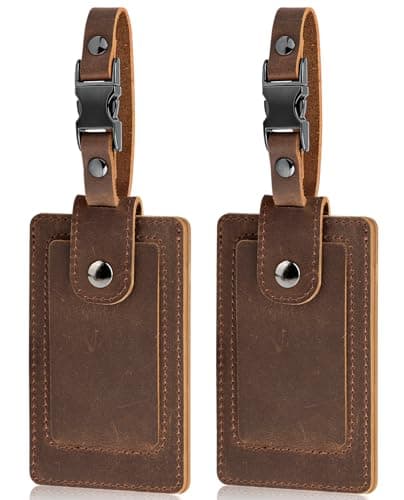
A matching set is the thing families most often regret, for one reason: four identical cases on a carousel. Three fixes, in order of how well they work. A different luggage tag on each case - cheapest, and enough for most families; our luggage tag picks rank them on the loop that holds them on and whether your address is on public display. A different color per person where the set offers it, which is why some families deliberately buy two smaller sets in two colors rather than one large set. And a tracker in each checked bag, which does not help you spot the bag but does tell you whether it is on the carousel at all - see our luggage tracker picks.
Where it lives for the other fifty weeks
Family luggage is in motion for about two weeks a year and is furniture for the other fifty, so nesting is a real buying criterion rather than a nicety. A 20/24/28 set that nests occupies the footprint of the 28 alone. Four separately bought cases occupy four footprints. If storage is genuinely tight, our guide to storing luggage at home covers nesting, what to put inside the cases so the space is not wasted, and why a sealed case in a damp garage is a mould problem waiting to happen.
On the identification problem specifically - four matching cases being four indistinguishable bags - our guide to making your luggage stand out ranks the fixes by how long each one survives a baggage system, and makes the case for differentiating the pieces rather than the set: one tag color per person, so your family's bags are distinguishable from each other as well as from everyone else's.
How we picked
We did not lab-test these bags
Everyone in this category says they tested twenty suitcases. We have not lab-tested any of these, and we say so. What we did instead: compiled each bag's published specifications, checked its dimensions against the airline sizers, ran the cost-per-trip and weight-to-capacity math, read the aggregated owner reviews, and scored every pick against a published rubric. The scores are judgments from documented research — not measurements we took, because we do not have a lab and we will not pretend we do. Where a number came from someone else's work, we name them in Sources.