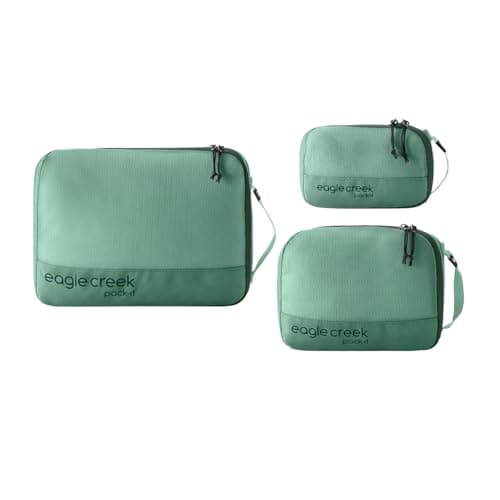
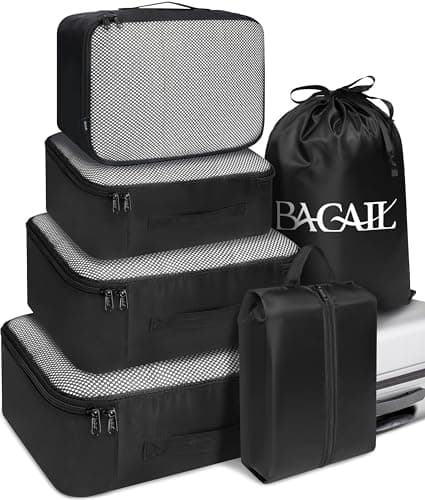
Plain packing cubes do not save space. They add two layers of fabric and a zip around every group of clothes, and they turn a soft, conforming mass into a stack of rectangles that cannot fill the rounded corners of a suitcase. On a tightly packed bag the net effect is usually slightly less usable volume, not more. What they save is time - and if you have ever unpacked a whole case on a hotel bed to find one shirt, that is worth more than the volume.
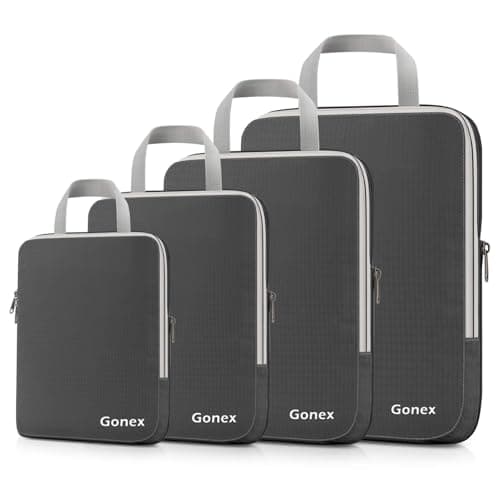
Compression cubes do save space, and the mechanism is different: a second zip closes the cube down over its contents and expels the air trapped between layers of soft fabric. That air is real volume, and for knitwear, t-shirts, underwear and anything fleece or down it is a significant fraction of what the pile occupies. That is why the honest answer to this question is two answers, and why buying the wrong type is the most common mistake in the category.
What compression actually removes
Air between layers of soft fabric - nothing else. This matters, because it tells you exactly which items compression helps and which it cannot touch. It works on knits, t-shirts, underwear, socks, fleece, down jackets and anything else whose packed volume is mostly loft. It does nothing for shoes, books, toiletry bottles, chargers, a hair dryer, or a camera - solid objects have no air to expel, and no cube makes a shoe smaller.
Which leads to the practical rule people get backwards: a suitcase full of soft clothing benefits enormously from compression; a suitcase whose volume is dominated by hard objects benefits almost not at all. If your bag is full because of shoes and gear, cubes are not your answer - how to pack shoes is.
The costs, which nobody lists
Weight. This is the big one and it catches people at the desk. Freeing up 20% of your volume does not free up any of your 50 lb allowance - it just means you can now fit more weight into the bag than you are allowed to carry. A set of cubes also weighs something itself. If you use compression cubes on a checked bag, weigh it; our luggage weight guide has the arithmetic and best luggage scales has the tool.
Wrinkles. Compression works by pressing fabric against fabric under load, which is precisely how creases set. Knits do not care. Cotton shirts, linen and anything tailored do. Structured items should be folded flat in the main compartment or carried in a garment bag, not compressed - see how to pack a suit and best garment bags.
Rigidity. A compressed cube is a firm brick. Bricks stack but do not conform, so the gaps at the perimeter of the case get larger rather than smaller. The way around it is to compress the bulky soft items and leave some clothing loose to fill the gaps - a mixed load beats an all-cube load in a tightly packed bag.
They are useless at the sizer. On a cabin bag the binding constraint is usually the gate frame, not the volume - and no amount of internal organization makes a case narrower. If your carry-on will not fit the sizer, you need a smaller case, not cubes; the measuring method is in how to measure luggage.
Where plain cubes genuinely win
Three situations, and all three are real. A multi-stop trip where you live out of the bag for two weeks and never fully unpack - cubes are the difference between a wardrobe and a pile. A shared bag, where one cube per person turns a joint suitcase into two sealed allocations and ends the argument. And repacking to leave, where dirty clothes in their own cube means the bag closes on the last morning in two minutes instead of twenty. None of that is a space claim, and none of it is worth less for being a time claim.
What to look for, if you are buying
Compression or plain - decide first, from the two answers above, and note that a compression cube works perfectly well uncompressed so it is the more flexible purchase. Size against your case width - cubes that are slightly narrower than the interior of your bag stack without wasting a strip down one side, and this is the detail that separates a good set from a frustrating one. Mesh or solid tops - mesh lets you see the contents and vents damp clothing; solid hides mess and protects a little better. Zip quality - the compression zip is the component under load and the one that fails, so it is the thing to read reviews about. Set composition - a six-piece set with three small cubes and one usable large one is worse than a three-piece set with the sizes you will actually use.
Which to buy, for which problem
Three registry picks, each researched on our packing cubes roundup: the compression set if space is the problem, the organization set if the problem is finding things, and the volume set if the problem is that you have a lot of clothes and a fixed budget.
The honest arithmetic, with numbers
We have not run a controlled test and we are not going to claim one. What is checkable is the mechanism, and the mechanism puts bounds on the answer. Soft, lofted clothing packed loose is mostly air between layers; compressing it removes that air and nothing else. So the saving scales with how much of your bag is soft clothing. A case that is 80% knitwear will gain meaningfully; a case that is half shoes, toiletries and electronics will gain very little, because those items were never holding air in the first place. Any source quoting you a single percentage for "how much space cubes save" is quoting a number that depends entirely on what is in the bag.
The strategy that actually works in a full case
Mix. Compress the bulky soft items - sweaters, fleece, a down layer - into cubes, keep shoes bagged at the perimeter near the wheels, and leave a handful of soft garments loose to fill the irregular gaps that rigid cubes leave at the corners and around the handle tubes. An all-cube load is tidy and wastes the shape of the bag; a mixed load is slightly less tidy and uses it. The full method, including where weight should sit in a checked case, is in how to pack a suitcase, and the cabin-specific version is in how to pack a carry-on.
Cubes versus the alternatives
Vacuum bags compress harder than any cube and are the right tool for bedding or a winter coat; they also need a vacuum at the other end to repack, crease everything severely, and are miserable for a multi-stop trip. An expandable suitcase solves a different problem - it adds cubic inches rather than removing air - and it is the right answer when you are bringing back bulky objects rather than clothes. Our expandable luggage sets page sets out where that expansion is free and where it costs you an oversize fee. A bigger bag is the answer people avoid and should sometimes take - though note that a bigger checked case gives you more volume and less weight to fill it with, because the case itself eats the allowance.
Do cubes help with a carry-on?
With the packing, yes. With the fitting, no. A cabin bag is constrained by the gate sizer - a rigid frame measuring height, width and depth - and no internal arrangement changes the external dimensions of a hardside case. On a softside carry-on it is actually worse: compressed bricks inside a fabric case can make the panels bulge past their published depth, which is one of the ways a compliant bag fails a sizer. Pack a softside cabin bag flat-sided. Our softside carry-on roundup goes into that failure mode, and what size is a carry-on has the dimensions.