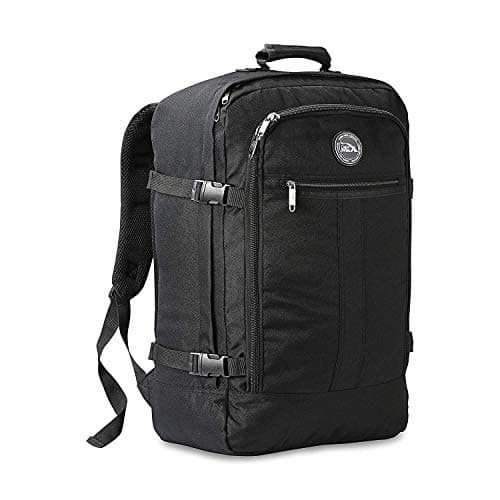
The best travel backpack under $100 is the Cabin Max Metz 44L, and it is for the traveler flying carriers that measure: Cabin Max publishes 55 × 40 × 20 cm — the common international cabin frame, exactly — holding 44 liters at a published 0.7 kg empty, which is the best size-to-weight figure in this band by a wide margin. The budget pick is the Fmeida 24L Personal Item Backpack: the cheapest pack here, and it still publishes its dimensions (40 × 30 × 20 cm) and a 15-inch laptop sleeve, which most packs at twice the money do not. Every pack below carried a live Amazon price under $100 at our last price check (as of November 12, 2026).
Here is what changes under $100. You are not choosing between fabrics or frames or suspension systems — at this price everything is a polyester or nylon shell with a simple padded harness, and the differences between them are small. What is not small is whether the maker tells you how big the pack is.
That matters more on a backpack than on a suitcase, because a backpack is the bag airlines are most likely to measure and least likely to let slide. A soft pack with no published dimensions is a gamble at a gate: it might go in the sizer and it might cost you a fee that exceeds the price of the pack. A pack whose published figures match a published allowance is not a gamble at all. So the ranking below is built on three things:
Published dimensions against a real allowance. The two allowances that matter are the 55 × 40 × 20 cm international cabin frame and the much smaller under-seat personal-item box. Four of the six packs below publish figures you can check against one of them. Published empty weight, because on a 7 kg weight-capped cabin ticket a 0.7 kg pack leaves you 14 lb of contents where a 3 kg pack leaves you 9 lb. And capacity you can use, which on a pack means a clamshell or panel opening rather than a top-loading tube, because nobody wants to excavate a rucksack in a hotel room.
Two of these packs have wheels, which is unusual in this band and worth knowing about: a wheeled backpack lets you roll through a terminal and carry up a flight of stairs, at the cost of two to three pounds of wheels and frame. That is the right trade for some people and the wrong one for anybody counting grams on a weight-capped ticket, and the entries say which is which.
If the laptop bay is your first question rather than the price, best travel backpack with a laptop compartment ranks on published sleeve size. For cabin fit with no price ceiling, best carry-on backpack and best carry-on backpack for international travel; for the under-seat slot, best personal item bag; for wheels, best rolling backpack; and for the premium end of the same category, best luxury travel backpack.
Prices come from the live price layer and carry their own “as of” date on every button; we never print a number in prose, because prose cannot expire. If a pack has crossed the $100 line since our last check, its own button will show the real number before this page admits it. Specifications are the manufacturer's published figures; we have not measured these packs ourselves. See how we test.
The short answer
Quick picks
| # | Product | Best for | Score | Price |
|---|
| 01 | Cabin Max Metz 44L Cabin BackpackThe pack built to a published allowance rather than to a vague size. Cabin Max publishes 55 x 40 x 20 cm - the common international cabin frame, to the centimeter - holding 44 liters at a published 0.7 kg in RPET polyester. No other pack in this band gives you a figure you can hold a published airline template against and 44 liters of capacity at the same time. | Best travel backpack under $100 overall | | $79.90·Amazon |
| 02 | Hynes Eagle 40L Travel BackpackThe pack that opens like a suitcase for about half the money of the one above. Hynes Eagle publishes 40 liters with a clamshell opening, a laptop compartment and internal compression straps - and the clamshell is the feature that decides what a travel pack is actually like to live with, because it means you repack from a flat layout instead of excavating a tube. | Best packing format in the band | | $43.99·Amazon |
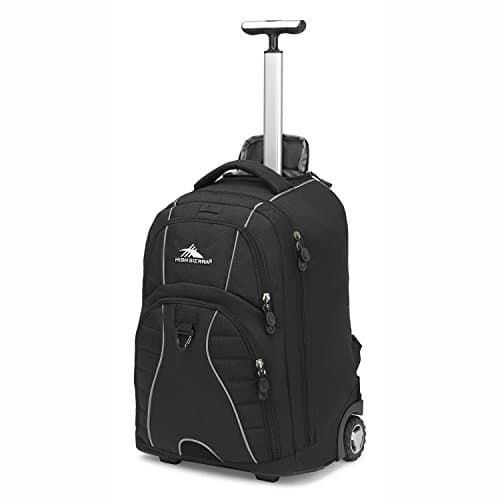
| 03 | High Sierra Freewheel Wheeled Laptop BackpackThe pack for anyone whose route includes both a long terminal and a flight of stairs. A stowable harness means it is a rolling bag when you want one and a backpack when you need one, with a laptop compartment, a telescoping handle and wheels built for the job rather than added as an afterthought. The honest cost is the weight you carry for the privilege. | Best wheeled pack in the band | | $88.99·Amazon |
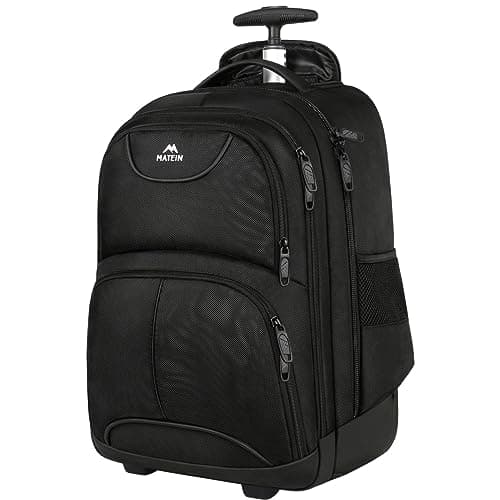
| 04 | MATEIN Rolling Backpack, 17-Inch Water-Resistant Wheeled Laptop BackpackThe value route to a wheeled laptop pack. A 17-inch body in water-resistant fabric with a laptop sleeve, wheels and a telescoping handle at a price that undercuts most non-wheeled travel packs - which makes it the obvious buy for a student, a commuter with a long walk, or anyone whose shoulder has started complaining about a loaded rucksack. | Cheapest wheeled pack with a 17-inch sleeve | | $69.99·Amazon |
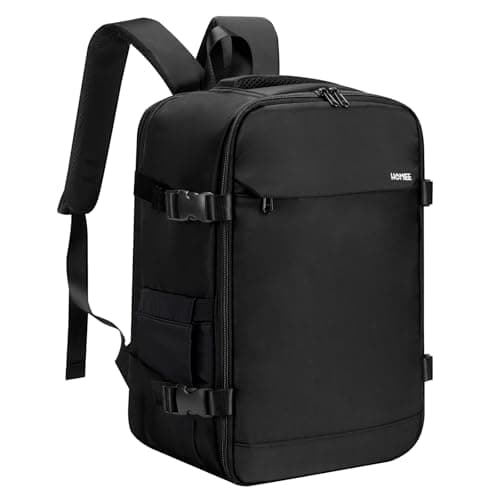
| 05 | HOMIEE 20L Under-Seat Travel BackpackThe pack to buy if your ticket includes a personal item and nothing else. HOMIEE publishes roughly 40 x 20 x 25 cm at 20 liters with a 15.6-inch laptop sleeve in a water-resistant fabric - which is a published figure small enough to clear the under-seat slot on carriers that actually measure it, rather than a cabin bag hoping to pass as a personal item. | Best published fit for the under-seat box | | $36.99·Amazon |
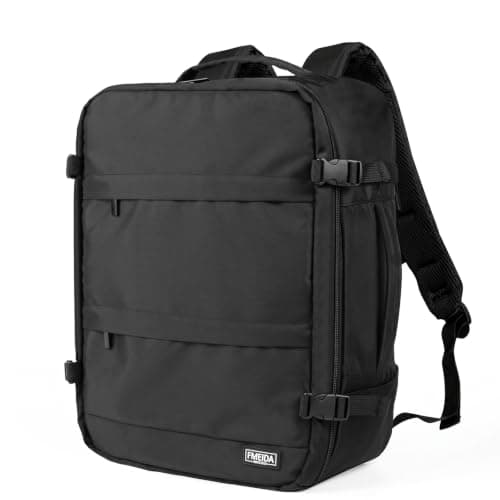
| 06 | Fmeida 24L Personal Item BackpackThe budget pick, and the most surprising entry on this page: it is the cheapest pack here and it still publishes what matters - 40 x 30 x 20 cm, 24 liters, a 15-inch laptop sleeve and an under-seat shape. Plenty of packs at twice this money publish none of that, which is why a cheap pack with a spec sheet outranks an expensive one without. | Budget pick - cheapest pack here, and it still publishes its size | | $34.89·Amazon |
#ad · Live prices from the Amazon Product API, as of November 12, 2026. Where we have no verified live price, we show none — a gap beats a number that has rotted.
In detail
The picks, in full
Best travel backpack under $100 overall
Cabin Max Metz 44L Cabin Backpack
55 x 40 x 20 cm0.7 kg empty44 LRPET polyester
The pack built to a published allowance rather than to a vague size. Cabin Max publishes 55 x 40 x 20 cm - the common international cabin frame, to the centimeter - holding 44 liters at a published 0.7 kg in RPET polyester. No other pack in this band gives you a figure you can hold a published airline template against and 44 liters of capacity at the same time.
- Template fit
- 10
- Empty weight
- 10
- Usable capacity
- 9
- Carry comfort
- 5
- Value
- 9
Pros
- +Published at exactly 55 x 40 x 20 cm - the European low-cost priority template, by design
- +0.7 kg empty leaves 6.3 kg of a 7 kg cabin allowance for actual belongings
- +44 L in a compliant footprint, which is more than most bags that fit this template
- +Compression straps on both sides pull an underfilled load down to shape
- +Costs a fraction of a structured travel pack, so it is easy to own alongside one
Cons
- −Basic harness with no hip belt - 44 L of dense packing sits entirely on your shoulders
- −Soft shell gives contents no structural protection at all
- −44 L will hit a 10 kg carrier limit long before you fill the bag, so the capacity is partly theoretical
- −No meaningful laptop protection - a padded sleeve of your own is not optional
- −Fabric and hardware are priced-to-match, not built to be repaired for a decade
Don't buy this if…
…you want a supportive harness for long carries - 0.7 kg buys you a cabin-shaped bag with simple straps rather than a load-carrying suspension, and a fully packed 44 liters on a thin harness is uncomfortable over a mile.
Building a bag to exactly 55 × 40 × 20 cm is a design decision with consequences, and the main one is that there is no wasted volume: a soft pack filling that box holds appreciably more than a wheeled case of the same external size, because there are no wheel wells, no handle tubes and no shell thickness to pay for. Forty-four liters in a cabin frame is the practical ceiling of the format.
Seven hundred grams is the second number and it is the one that wins the page. On a carrier capping cabin baggage at 7 kg including the bag, this pack spends 10 percent of your allowance on itself where a wheeled carry-on spends nearly half. The arithmetic is in international carry-on size, and the pack in its original context in best carry-on backpack for international travel.
Best packing format in the band
Hynes Eagle 40L Travel Backpack
40 LClamshell openingLaptop compartmentCompression straps
The pack that opens like a suitcase for about half the money of the one above. Hynes Eagle publishes 40 liters with a clamshell opening, a laptop compartment and internal compression straps - and the clamshell is the feature that decides what a travel pack is actually like to live with, because it means you repack from a flat layout instead of excavating a tube.
- Comfort
- 8
- Capacity
- 9
- Organization
- 8
- Build
- 7
- Value
- 9
Pros
- +Full 40L clamshell packing at a budget-friendly price
- +Compression straps cinch a light load down small
- +Dedicated laptop compartment and organized front pocket
Cons
- −Harness and back panel are less supportive than Osprey's
- −Shorter warranty and less proven long-haul durability
Don't buy this if…
…you need published dimensions before you fly - the capacity is published and the external figures are not, so you cannot check this one against a 55 x 40 x 20 cm template the way you can the Cabin Max above.
A clamshell changes the daily experience of a pack more than any fabric or harness detail. A top-loading rucksack means the thing you want is always at the bottom; a panel-loading pack lays open flat on a bed, so you see everything, take one item and zip it shut. Add internal compression straps and the load stops shifting, which also keeps the pack's shape closer to a rectangle — and a rectangular soft bag measures smaller than a bulging one.
Forty liters is the sweet spot of this format: enough for a week with discipline, small enough to be plausible as a cabin bag on most carriers. Treat the absence of published external dimensions as the real caveat. Our cabin-fit ranking is in best carry-on backpack, and the packing method that makes 40 liters work is in best packing cubes.
Best wheeled pack in the band
High Sierra Freewheel Wheeled Laptop Backpack
Laptop compartmentStowable harnessDurable wheelsTelescoping handle
The pack for anyone whose route includes both a long terminal and a flight of stairs. A stowable harness means it is a rolling bag when you want one and a backpack when you need one, with a laptop compartment, a telescoping handle and wheels built for the job rather than added as an afterthought. The honest cost is the weight you carry for the privilege.
- Wheels
- 8
- Harness
- 8
- Capacity
- 7
- Durability
- 8
- Value
- 9
Pros
- +Harness is a real padded backpack harness that stows away when rolling
- +Wheels and housing have a long track record — this design has been in market for years
- +Dedicated padded laptop compartment sized for large machines
- +Well-proven, widely available, and easy to replace like for like
Cons
- −Heavy for a backpack once you factor in the wheel assembly
- −The handle housing is still felt through the back panel under load
- −Commuter proportions rather than travel capacity
Don't buy this if…
…you fly a weight-capped cabin allowance - wheels, a frame and a telescoping handle are two to three pounds of hardware before anything goes in, and on a 7 kg cap that is a serious share of your clothing.
The convertible format solves a real problem that neither a suitcase nor a pack solves on its own: cobbled streets, stairs without a lift and train platforms want a backpack, while a two-mile airport transfer wants wheels. A stowable harness means you are not choosing once at purchase; you are choosing at each leg.
Be realistic about what it costs. Every wheeled bag carries its wheels, axles, frame and handle tubes on every flight, and those also take volume out of the inside of the bag — so a wheeled 40-liter pack holds less than a soft 40-liter pack. It is the right bag for mixed-surface travel and the wrong one for a weight-capped ticket. The wheeled field is in best rolling backpack, and the wheel trade-off in spinner vs 2-wheel luggage.
Cheapest wheeled pack with a 17-inch sleeve
MATEIN Rolling Backpack, 17-Inch Water-Resistant Wheeled Laptop Backpack
17-inchWater-resistant fabricLaptop sleeveWheeled with handle
The value route to a wheeled laptop pack. A 17-inch body in water-resistant fabric with a laptop sleeve, wheels and a telescoping handle at a price that undercuts most non-wheeled travel packs - which makes it the obvious buy for a student, a commuter with a long walk, or anyone whose shoulder has started complaining about a loaded rucksack.
- Wheels
- 6
- Harness
- 6
- Capacity
- 6
- Durability
- 6
- Value
- 9
Pros
- +Compact enough to be manageable on public transport
- +Water-resistant fabric handles rain better than most in this price band
- +Cheap enough that the wheels failing is annoying rather than expensive
Cons
- −Small capacity for travel — this is a commuter bag
- −Budget wheel housing, as above
- −Basic harness that is fine over short distances only
Don't buy this if…
…the bag is your only luggage on a flight - a 17-inch wheeled pack is a commuter and campus bag rather than a week-away travel pack, and it has neither the capacity nor the published dimensions for a cabin allowance.
The case for this bag is physical rather than technical. A loaded laptop bag carried on one shoulder is the most common cause of bag-related back and neck complaints, and the two fixes are a proper two-strap harness or wheels. This has both, for less than a hundred dollars, which is a genuinely useful thing to be able to say.
Set your expectations by the format. Seventeen inches of body is a laptop-and-a-day bag, not a travel pack; the fabric is water-resistant rather than waterproof; and nothing dimensional is published. Buy it for the daily carry and the campus run, and buy one of the 40-liter packs above for the trip. The wheeled field in full is in best rolling backpack.
$69.99·View on Amazon$112.9938% off
Price as of November 12, 2026. Prices change — Amazon's at checkout is the one that counts.
#ad · we may earn a commission from this link to MATEIN Rolling Backpack, 17-Inch Water-Resistant Wheeled Laptop Backpack
Best published fit for the under-seat box
HOMIEE 20L Under-Seat Travel Backpack
~40 x 20 x 25 cm20 L15.6-in laptopWater-resistant
The pack to buy if your ticket includes a personal item and nothing else. HOMIEE publishes roughly 40 x 20 x 25 cm at 20 liters with a 15.6-inch laptop sleeve in a water-resistant fabric - which is a published figure small enough to clear the under-seat slot on carriers that actually measure it, rather than a cabin bag hoping to pass as a personal item.
- Template fit
- 8
- Empty weight
- 8
- Usable capacity
- 5
- Carry comfort
- 6
- Value
- 8
Pros
- +Built to a narrower under-seat shape that some free-bag gauges require
- +Takes a 15.6-inch laptop, which is unusual in a 20 L bag
- +Water-resistant fabric, useful on a bag that spends time on wet ground
- +Slim profile genuinely fits under a seat rather than wedging in
- +Cheap enough to own as a second bag alongside a proper cabin pack
Cons
- −Does not publish an empty weight - we will not quote a figure we cannot verify
- −20 L is the smallest capacity here and it is a hard limit
- −The narrow shape is a liability if your carrier's gauge is the wider 40 x 30 x 20
- −Minimal harness, intended for short carries
- −Budget construction throughout
Don't buy this if…
…you are packing for more than two nights - 20 liters is a day bag with a change of clothes, and the 40 and 44-liter packs above are the ones that replace a suitcase.
The personal-item allowance is the one airlines have tightened hardest, because it is the one most abused. On a basic-economy or low-cost fare the under-seat bag may be your only free baggage, and the box is published at around 18 × 14 × 8 inches on many carriers and smaller on some. A pack publishing 40 × 20 × 25 cm is inside that envelope with room, and it is unusual to find a published figure at this price.
A 15.6-inch sleeve in a 20-liter pack is also a sensible allocation: on a bag this size, the laptop is most of the load and it needs to be against the back panel rather than floating. Carrier-by-carrier figures are in personal item size by airline, and the dedicated ranking in best personal item bag.
Budget pick - cheapest pack here, and it still publishes its size
Fmeida 24L Personal Item Backpack
40 x 30 x 20 cm24 L15-in laptopUnder-seat shape
The budget pick, and the most surprising entry on this page: it is the cheapest pack here and it still publishes what matters - 40 x 30 x 20 cm, 24 liters, a 15-inch laptop sleeve and an under-seat shape. Plenty of packs at twice this money publish none of that, which is why a cheap pack with a spec sheet outranks an expensive one without.
- Template fit
- 10
- Empty weight
- 8
- Usable capacity
- 6
- Carry comfort
- 6
- Value
- 9
Pros
- +Built to the 40 x 30 x 20 cm shape the free under-seat allowances cluster around
- +24 L is at the top of what fits that footprint, so you are not wasting the allowance
- +Padded 15-inch laptop sleeve, which most bags this size and price skip
- +Cheaper than a single gate-check fee on almost any carrier
- +Soft and unstructured, so it compresses into an under-seat space that a rigid bag will not
Cons
- −Does not publish an empty weight - we will not quote a figure we cannot verify
- −24 L is two or three days of clothes at most, and only with disciplined packing
- −Basic straps and back panel - fine for a terminal walk, tiring for a long one
- −No structural protection for anything fragile
- −Budget hardware; zips and buckles are the parts most likely to fail first
Don't buy this if…
…you need the pack to last - at this price the fabric, zips and harness are built to a budget, and a pack used weekly will show it inside a year. Buy it for a few trips a year, not for a commute.
Twenty-four liters in a 40 × 30 × 20 cm envelope is the right shape for the under-seat slot: it is the personal-item box rather than a tall rucksack squeezed into it, so the volume is usable instead of theoretical. That shape is also why it works as a second bag beside a cabin case, sliding under the seat while the case goes overhead.
The honest framing is the same as any budget bag on this site: you are buying a specification rather than a service relationship, and at this price that is a rational trade for a few trips a year. If the pack is going to be used every week, spend the difference on the Cabin Max or the Hynes Eagle above. Its original context, alongside the other published-dimension packs, is in best carry-on backpack for international travel.
What each pack publishes
Every figure below is the maker's own published number. Where a figure is not published for a listing, the row says so rather than carrying an estimate. The live price and a per-row buy button for each pack are in the Quick picks table above, each stamped with its own date.
| Pack | Published dimensions | Published capacity | Published empty weight | Wheels? |
|---|
| Cabin Max Metz 44L | 55 x 40 x 20 cm | 44 L | 0.7 kg | No |
| Hynes Eagle 40L travel backpack | Not published for this listing | 40 L | Not published for this listing | No |
| High Sierra Freewheel | Not published for this listing | Not published for this listing | Not published for this listing | Yes, stowable harness |
| MATEIN rolling backpack 17-inch | 17-inch body; full figures not published | Not published for this listing | Not published for this listing | Yes |
| HOMIEE 20L under-seat backpack | ~40 x 20 x 25 cm | 20 L | Not published for this listing | No |
| Fmeida 24L personal item backpack | 40 x 30 x 20 cm | 24 L | Not published for this listing | No |
Three of six publish dimensions and exactly one publishes an empty weight. That one is the top pick, which is not a coincidence — makers publish the numbers they are proud of, and 0.7 kg for a 44-liter cabin-frame pack is a number to be proud of.
The two allowances a backpack has to clear
The cabin allowance.In the United States the convention is 22 × 14 × 9 inches including handles. Internationally the common frame is 55 × 40 × 20 cm, which is 21.6 × 15.7 × 7.9 inches — note the depth, more than an inch shallower than the US limit, which is where a stuffed backpack fails. Many of those carriers also cap cabin baggage by weight, commonly at 7 kg including the bag.
The personal-item allowance.The under-seat box, commonly published at around 18 × 14 × 8 inches and tighter on low-cost carriers. On a basic fare this may be your only free bag, which is why two packs on this page are built to it. The figures carrier by carrier are in carry-on size by airline and personal item size by airline, and whether a backpack counts as a carry-on at all is in can a backpack be a carry-on.
What you actually give up under $100
Not the fabric, mostly — a 600D polyester at $45 and at $140 are closer than the price gap suggests. What you give up is: the harness, which at this price is padded straps rather than a load-transferring hipbelt and frame, and which is why a fully packed 44 liters is uncomfortable past a mile; the zips, which are the first thing to fail on a cheap pack; the warranty, which is usually unstated; and the published spec sheet, which three of the six packs here do not have. None of those matter much on a pack used a few times a year, and all of them matter on a pack used weekly.
Clamshell or top-loader
Clamshell, almost always, for travel. A panel-loading pack opens flat like a suitcase, so you can see the whole load, remove one item and close it again — and you can pack it in cubes, which keeps the bag rectangular and therefore smaller on a sizer. A top-loading tube is lighter and better for a hiking load, but it buries everything you packed first, and in a hotel room that means unpacking the bag every evening. The Hynes Eagle above is the clearest clamshell in this band.
How we keep this page honest about the $100 line
The number is not written into this page anywhere. Every price you see comes from the live price layer at the moment you load the page, each stamped with its own “as of” date, and the band was verified against that layer at our last check (as of November 12, 2026). Backpack prices in this band move constantly, so if a pack has crossed $100 since then, its own button will show the real number rather than our claim. Where we have no verified live price at all, the button reads “Check price on Amazon” and shows no figure — a gap beats a number that has rotted. The policy is in our editorial policy.
How we picked
We did not lab-test these bags
Everyone in this category says they tested twenty suitcases. We have not lab-tested any of these, and we say so. What we did instead: compiled each bag's published specifications, checked its dimensions against the airline sizers, ran the cost-per-trip and weight-to-capacity math, read the aggregated owner reviews, and scored every pick against a published rubric. The scores are judgments from documented research — not measurements we took, because we do not have a lab and we will not pretend we do. Where a number came from someone else's work, we name them in Sources.
Questions
Frequently asked
What is the best travel backpack under $100?+
The Cabin Max Metz 44L, because Cabin Max publishes 55 x 40 x 20 cm - the common international cabin frame exactly - holding 44 liters at a published 0.7 kg empty, which is the best size-to-weight figure in the band. For the best packing format, the Hynes Eagle 40L clamshell; for the cheapest pack that still publishes its dimensions and laptop sleeve, the Fmeida 24L.
Can a travel backpack under $100 be used as a carry-on?+
Yes, and two packs here publish figures you can check: the Cabin Max Metz at 55 x 40 x 20 cm matches the common international cabin frame, and the Fmeida and HOMIEE packs are small enough for the under-seat personal-item box. The ones that publish nothing dimensional are a gamble at a gate that measures, which is why they rank lower here even where the bag itself is good.
What size travel backpack should I buy?+
Around 40 to 45 liters if the pack is replacing a carry-on suitcase, which is the Cabin Max and Hynes Eagle class and the most common choice. Around 20 to 25 liters if it is your personal item under the seat, or your second bag beside a case. Above 45 liters you are over every cabin allowance and should be checking the bag, at which point a wheeled bag is usually the better tool.
What do you give up on a travel backpack under $100?+
Mostly the harness and the paperwork rather than the fabric. At this price you get padded shoulder straps instead of a load-transferring hipbelt and frame, so a fully packed 40-plus liters is uncomfortable over long distances; the zips are the component most likely to fail; the warranty is usually unstated; and half the packs publish no dimensions. On a pack used a few times a year, none of that is a problem.
Are wheeled backpacks worth it?+
If your route mixes long terminals with stairs, cobbles or train platforms, yes - a stowable harness lets you pick per leg rather than once at purchase. The cost is two to three pounds of wheels, frame and handle tubes that you carry on every trip and that take volume out of the inside of the bag. On a 7 kg weight-capped cabin allowance that is the wrong trade, and a soft pack is the better buy.
Do prices on this page stay under $100?+
Every pack here carried a live Amazon price under $100 at our last price check, and the band is re-verified against the live price layer rather than written into the page. Prices in this band move constantly, so if a pack has crossed the line its own button will show the real current number with its own date stamp. Where we have no verified live price we show none at all.
Receipts
Sources
We do not run a testing lab, and we do not pretend to. Specifications come from the manufacturer's own listing or manual, and size and weight limits from the airline's official baggage-policy page. Where we could not verify something, we say so on the page rather than quietly leaving it out. Read our full method.